
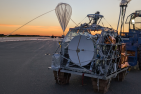
“Getting ready to take to the sky mhf2 Wed, 05/06/2026 - 17:56 The BVEX radio telescope sits beside a high-altitude balloon during launch preparations. “By combining telescopes that are spread around the globe we synthesize a telescope that is basically the size of the world. And traditionally this has been done with ground-based telescopes,” says Dr. Fissel. “We are now trying to demonstrate that flying telescopes can be part of this effort, too.” Building a solution The students will work to build a radio telescope roughly one metre in size and weighting 100 kilograms. Flying around 33 kilometres above sea level, it will be able to observe galaxies simultaneously with telescopes in North America and Europe. This way, the balloon-borne telescope can help solve a limitation of ground-based equipment: in a nutshell, radio telescopes work by collecting data on light that is invisible to regular telescopes. They are good for observing radio waves with wavelengths much longer than visible light, but, on the other hand, aren’t great for observing shorter wavelength radio waves, which lead to better resolution images but can be absorbed by the Earth's atmosphere. Researchers have found that this issue can be solved by placing the telescope up in the stratosphere, above 99.5% of the atmosphere. Putting that plan to practice is the next step. “No one has yet done interferometry between a balloon-borne telescope and ground-based telescopes,” says Dr. Fissel. “That is because, to successfully demonstrate that balloon telescopes can be used as part of these global interferometry arrays, we need to be able to know the position of our telescope to a tenth of a wavelength. For BVEX that means we need to keep track of the telescope to 1 mm precision!” Using data from a wider range of radio waves, the combined ground and balloon-borne radio telescopes system will help generate higher resolution images of the sky, particularly from areas around supermassive black holes. Laura Fissel (Physics, Engineering Physics, and Astronomy), an expert in planet and star formation, is working with students to take part in an exciting project: design and build a radio telescope to be launched to the stratosphere aboard a football field-sized balloon. She leads the Balloon-Borne Very Large Baseline Interferometry Experiment (BVEX), initiated in 2021 and that, to this date, has engaged 17 undergraduate students and four graduate students at Queen’s. The project recently received $291,000 from the Canadian Space Agency (CSA) through the Flights and Fieldwork for the Advancement of Science and Technology program , which enables students to have hands-on experience in space-like missions and support the development of new technology. This award will fund BVEX’s flight in the late summer of 2027, launching from Palmas, Brazil. The challenge As you can imagine, the challenge of creating high-resolution images of the sky is the gargantuan size of the sky itself. The best images we have are composed with a combination of data captured by multiple telescopes pointing at the same region of the sky, then processed with the support of a supercomputer cluster. Wed, 05/06/2026 - 12:00 A group of Queen’s students is designing and building a radio telescope to be launched to the stratosphere aboard a football field-sized balloon. Arts and Science Catarina Chagas, Manager, Strategic Communications and Outreach Student Research Physical Sciences and Engineering Technology and Innovation 0 Queen’s researcher Laura Fissel and members of the BVEX student team with the balloon-borne radio telescope system they are helping design and build. Deck A group of Queen’s students is designing and building a radio telescope to be launched to the stratosphere aboard a football field-sized balloon.
Original story
Continue reading at Queen's Gazette
www.queensu.ca/gazette
Summary generated from the RSS feed of Queen's Gazette. All article rights belong to the original publisher. Click through to read the full piece on www.queensu.ca/gazette.
