
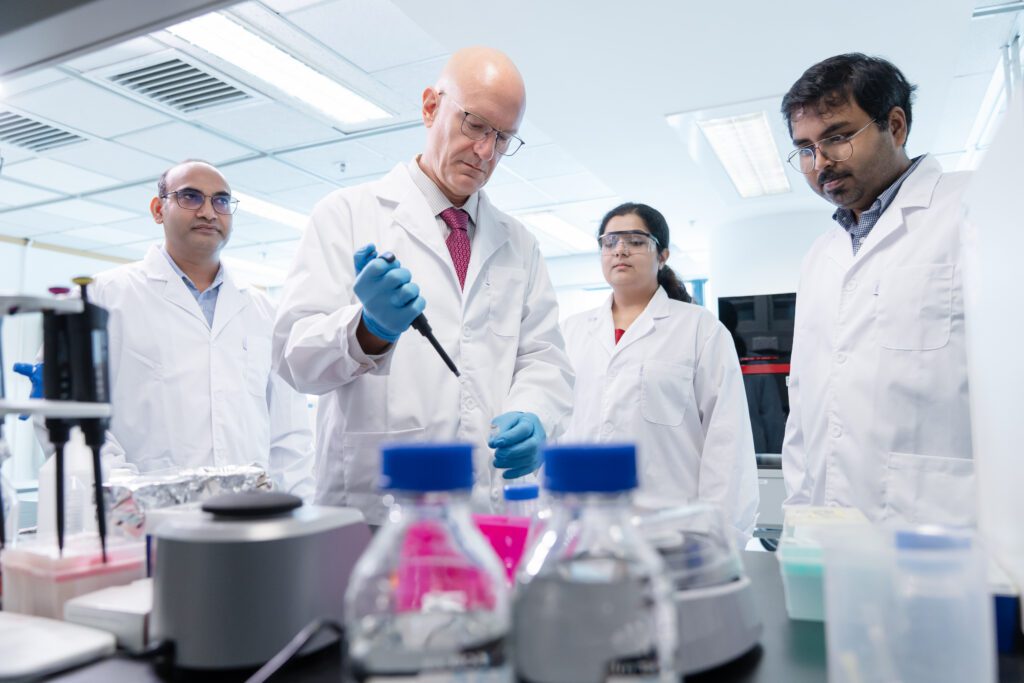
“Most of us have heard the advice: “Don’t blast your music, it’ll ruin your ears.” Well, turns out it’s not just about your hearing. “Although hearing loss is usually seen as an ear issue, it actually affects brain regions involved in memory, emotion, and sound processing,” says Dr. Sojeong Rebecca Pak, who completed her PhD in neuroscience at City University of Hong Kong’s (CityUHK) College of Biomedicine (CBM) and is now a postdoctoral researcher at Harvard Medical School and Massachusetts Eye and Ear Hospital. Dr. Pak is working with the Polley and Takesian laboratories to study how the brain changes over time and to reverse conditions like tinnitus (hearing a sound even when there is no sound around you) and hyperacusis (when your ears are extra sensitive to sound). “It’s exciting to work at the intersection of basic neuroscience and potential treatment strategies, and I feel fortunate to be part of a team that brings together different expertise to tackle these challenging hearing disorders,” she says. Dr. Pak credits her academic journey as a key catalyst to her career. “It gave me both the technical foundation and the personal competencies needed to secure and succeed in my postdoctoral role,” she shares. At CityUHK, you’re encouraged to stay curious. Supervisors guide you along the way, but also give you space to explore your own ideas and learn to think for yourself. Source: City University of Hong Kong Where research has no boundaries The CBM was established to support CityUHK’s mission of becoming a global leader in biomedicine and health. It does this by combining the strengths of biomedical engineering , biomedical sciences and neuroscience . For PhD students, this means stepping into a cross-disciplinary environment from day one. Dr. Pak, for instance, worked with a team from Yonsei University to test a new type of multielectrode array. “Experiences like that make the research environment feel really open and resource‑rich,” she says. Xingting Liu, a PhD student in Biomedical Engineering who’s building a custom-designed microscope, shares a similar experience. “There’s a strong culture of collaboration, not only among students but also between different labs,” she says. “The professors are also very approachable.” Coming from the Department of Biomedical Engineering’s MSc programme, Liu says her supervisor made the transition easier. “Beyond helping me with experimental design, she would guide me through hands-on lab work, encouraging me to think critically at every step,” she shares. “She would refine my presentation skills during group meetings too, pushing me to express my ideas more logically and effectively.” Supportive faculty, with expertise in AI-driven diagnostics, regenerative medicine, neurotechnology, and infectious disease, are everywhere at CBM. “Beyond my supervisor, I benefited from a broader network of great mentors and advisors who offered thoughtful feedback, challenged me academically, and supported my development,” says Dr. Pak. “This collective mentorship created an environment where I felt both supported and pushed to reach higher.” There are many types of research at CBM. Students in biomedical engineering study nanomedicine, biomedical science students focus on cancer, and neuroscience students research dementia — just to name a few. Source: City University of Hong Kong Beyond the lab Something else stood out to Liu and Dr. Pak during their studies: CBM’s state-of-the-art facilities. “I’ve used precision 3D printers with a resolution of two micrometres, as well as mixers, vacuum systems, confocal microscopes, multiphoton microscopes, and structured illumination microscopes,” says Liu. For Dr. Pak, it was the Laboratory Animal Research Unit (LARU) that made an impact. “The staff there take incredible care of the research animals and makes the work possible,” she says. What you learn at CBM doesn’t just stay in the lab though. Being part of Hong Kong’s innovation and technology ecosystem, and CityUHK’s “Health@InnoHK” initiative, which focuses on healthcare technology, PhD candidates have direct pathways to real-world impact. That includes working with clinicians, as well as industry partners like global biotech and medtech firms. Supporting you on your journey is the Knowledge Transfer Office . It connects CityUHK with the wider community through services such as technology licensing, intellectual property administration, and industry collaboration, while fostering innovation and entrepreneurship. For Liu, this ecosystem has been instrumental in shaping her future goals. “After completing my PhD, I hope to pursue a career in research and development, either in the biomedical industry or within academia, focusing on translational medicine,” she says. “The university’s strong emphasis on innovation and its extensive alumni network in Hong Kong and mainland China are also invaluable assets that are preparing me well for my future career.” Follow City University of Hong Kong’s College of Biomedicine on LinkedIn and Instagram .
Original story
Continue reading at Study International
www.studyinternational.com
Summary generated from the RSS feed of Study International. All article rights belong to the original publisher. Click through to read the full piece on www.studyinternational.com.

