
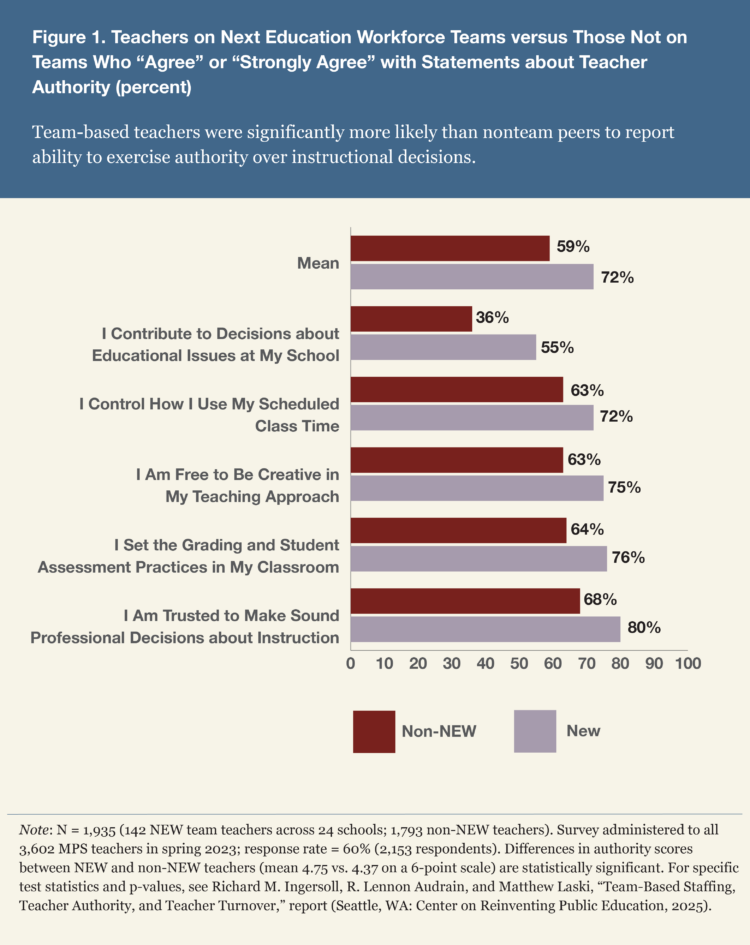
“Across the country, state and district leaders are confronting a familiar, frustrating challenge: Teachers are leaving schools faster than systems can replace them. In response, policy conversations often center on recruitment: expanding preparation pipelines, streamlining licensure, or offering short-term incentives to attract new educators. While these efforts matter, they address only part of the problem. The more difficult—and consequential—issue is retention. Teacher turnover has become a persistent feature of public education, with profound implications for budgets, instructional quality, and educational opportunity. Each year, districts lose not only educators, but also experience, institutional knowledge, and continuity for students. Yet turnover is frequently treated as inevitable: an unfortunate but unavoidable byproduct of a demanding profession. This assumption is increasingly at odds with the evidence. It suggests that teacher turnover is strongly shaped by the structures that determine whether educators are supported or isolated, empowered or constrained, able to collaborate or expected to manage complexity alone. In other words, turnover is not just a labor market problem; it is a school design problem. Turnover is not just a labor market problem; it is a school design problem. For policymakers and members of state boards of education, the implications are significant. If organizational design shapes turnover rates, then policy levers related to staffing flexibility, professional roles, authority, and accountability may be just as important as recruitment strategies. The Cost of Turnover: Dollars and Sense While some teacher turnover is inevitable and even desirable, higher rates of teacher departures carry significant financial and educational consequences for districts and states. Recent national estimates suggest that replacing a single teacher costs districts between $11,000 and $25,000, depending on district size. [1] These costs include separation, recruitment, hiring, onboarding, and initial professional learning. For large districts, the average replacement cost is approximately $24,930 per teacher. Medium-sized districts spend roughly $16,450, while even small districts incur costs exceeding $11,860 per departure. [2] In districts experiencing hundreds of annual departures, turnover can easily consume millions of dollars that might otherwise be invested in instructional improvement or student supports. In districts experiencing hundreds of annual departures, turnover can easily consume millions of dollars. Beyond direct financial costs, turnover disrupts schools in ways that are harder to quantify but equally consequential. High turnover undermines instructional continuity, weakens professional culture, erodes institutional knowledge, and disproportionately affects schools serving students from low-income communities. [3] Turnover Is Structural, Not Episodic Teacher turnover is not a temporary phenomenon. In a typical year, approximately 16 percent of public school teachers leave their school, with about 8 percent transferring to another school and 8 percent exiting the profession entirely. [4] These patterns have remained remarkably stable over time, indicating that turnover is a structural feature of the teaching profession in the United States, not a short-term response to crises or economic cycles. [5] In a typical year, approximately 16 percent of public school teachers leave their school. For context, nursing—a profession widely regarded as similarly demanding—has a comparable national turnover rate of approximately 16–18 percent annually. [6] Attrition rates in high-performing education systems such as Finland and Singapore typically run between 3 and 4 percent annually. [7] At roughly 16 percent overall, and considerably higher in the most disadvantaged schools, teacher turnover significantly exceeds even the most generous cross-sector benchmarks, suggesting a workforce system under structural strain rather than ordinary professional flux. Teachers cite working conditions—workload, isolation, insufficient support, and limited influence over decision making—as primary drivers of departure. [8] This insight has profound implications for policy: Addressing turnover requires redesigning schools as workplaces. A Century-Old Model under Pressure The dominant organizational model for US schooling—the single teacher responsible for a self-contained classroom—was designed in the early 20th century to deliver mass education efficiently. [9] While cost-effective at scale, this “egg-crate” structure isolates teachers and concentrates responsibility in ways poorly aligned with today’s instructional demands. [10] Teachers are expected to differentiate instruction, address academic and well-being needs, collaborate with families, integrate specialized services, and adapt to evolving standards, often with limited planning time and minimal structural support. Unlike most professions involving complex human services, teaching remains largely individualized rather than team based. This mismatch between job design and job demands contributes directly to stress, dissatisfaction, and turnover. [11] Unlike most professions involving complex human services, teaching remains largely individualized rather than team based. Team-Based Staffing as an Alternative Team-based staffing models offer a fundamentally different approach. Rather than assigning one teacher to one classroom, these models distribute instructional responsibility across teams of educators with differentiated roles and shared accountability. The Next Education Workforce (NEW) initiative exemplifies this approach (box 1). Developed through partnerships between Arizona State University and school systems, NEW organizes educators into teams that share responsibility for a roster of students; collaborate daily on planning and instruction; use multiple learning spaces flexibly; differentiate roles based on expertise and experience; group and regroup students according to need; and integrate novice teachers and teacher candidates into supported roles. Participation in NEW is voluntary, and implementation is locally designed rather than centrally prescribed. [12] Box 1. NEW in Action: What the Team Model Looks Like Consider an elementary school team serving approximately 90 grade 3 students. The team consists of a lead teacher, two certified teachers, and a preservice teaching candidate from a university partner program. Every three weeks, the team reviews data and decides how to group students for instruction for the next three weeks. During science, for example, students who need targeted reading support for the nonfiction text gather in a small group with the lead teacher, who uses assessment data to guide the session. Meanwhile, the two certified teachers lead two larger groups working on different scientific writing tasks, one focused on structure and the other on revision strategies. The preservice candidate circulates, providing individual feedback and recording observations to share at the team’s next planning session. No single educator carries sole responsibility for all 90 students at once. Instead, expertise and attention are distributed across the team based on student need. Variations of this configuration occur across grade levels and school types throughout NEW’s partner schools. Secondary teams often organize interdisciplinarily, combining, for example, an English teacher, math teacher, science teacher, and a social studies teacher sharing a cohort of students across extended learning blocks. Teacher Authority Is Central Team teaching alone is insufficient to improve working conditions for teachers. A defining feature of effective team-based staffing is teacher authority—the degree to which educators collectively influence instructional design, schedules, roles, and schoolwide decisions. As decades of research show, teachers who experience greater professional authority report higher job satisfaction, stronger commitment, and lower turnover. [13] Authority aligns responsibility with influence, enabling teachers to exercise professional judgment rather than simply comply with externally imposed decisions. Teachers who experience greater professional authority report higher job satisfaction, stronger commitment, and lower turnover. The NEW model explicitly links teamwork with authority. Teams are expected to adapt instruction to student needs and are granted discretion to do so. This contrasts with reforms that emphasize collaboration without changing underlying decision-making structures. What the Evidence Shows Strong Implementation. In our study of team-based staffing implementation in Mesa Public Schools (MPS)—a large suburban district in the Phoenix metropolitan area serving more than 50,000 students across 82 schools and employing approximately 3,600 teachers—we examined whether the NEW model was being enacted as designed or whether teams existed primarily in name only. We found clear evidence of robust implementation. More than 90 percent of teachers working on NEW teams reported having dedicated shared planning time, and similarly high proportions reported differentiating roles and responsibilities, using data collaboratively to tailor instruction, and grouping and regrouping students based on student needs. Overall, approximately three-quarters of NEW teachers reported that their team practiced at least seven of the eight core elements of the NEW model, indicating high implementation fidelity across schools and grade levels (box 2). [14] Box 2. Eight Elements of the Next Education Workforce Model Shared Responsibility Differentiated Roles and Responsibilities Team-Enabled Deeper Learning Team-Enabled Personalized Learning Dynamic Student Groupings Dynamic Schedules Flexible Learning Spaces Team Planning Time Meaningful Authority. Teachers working on NEW teams reported significantly higher levels of professional authority than their nonteam peers (figure 1). On a six-point scale measuring influence over instructional decisions, NEW teachers averaged 4.75, compared with 4.37 for non-NEW teachers. The largest differences appeared in areas directly tied to instructional practice: 80 percent of NEW teachers agreed or strongly agreed that they were trusted to make sound instructional decisions, compared with 68 percent of non-NEW teachers. 76 percent of NEW teachers reported control over grading and assessment practices, compared with 64 percent of their peers. Authority over schoolwide decisions remained lower overall, but NEW teachers were still substantially more likely than non-NEW teachers to report influence in this area. [15] Less Turnover. These differences in learning environment design and teacher authority translated into meaningful differences in retention. During the year following the survey, the teacher turnover rate for NEW team members was approximately 18 percent, compared with nearly 23 percent for nonteam teachers. When researchers controlled for teacher experience, performance evaluations, school poverty, school size, and grade level, NEW team members were about 50 percent less likely to leave their school or district than comparable non-NEW teachers. [16] Importantly, the turnover measure used in this study is drawn from district administrative records—not self-reported intent to leave—representing actual departures from schools or the district between the end of the 2022–23 school year and the start of fall 2023. This distinguishes the findings from studies that rely solely on teachers’ stated intentions and strengthens confidence in the observed retention differences. These differences in learning environment design and teacher authority translated into meaningful differences in retention. Interaction between Teams and Authority. The strongest effects appeared when team-based staffing and teacher authority were present together (figure 2). Teachers who worked on NEW teams and reported higher levels of professional authority had the lowest turnover rates in the study, well below district and national benchmarks. For teachers on NEW teams, higher levels of professional authority were strongly associated with staying: Each increase in reported authority corresponded to a 63 percent reduction in the likelihood of leaving. Taken together, these findings suggest that team-based staffing is most effective when teachers also have meaningful influence over their work. [17] Importantly, higher teacher authority alone was associated with reduced turnover regardless of team membership. However, authority and team-based staffing reinforce one another: Authority appears to be more impactful when embedded within collaborative team structures, and teams appear more effective when educators have real decision-making power. Authority appears to be more impactful when embedded within collaborative team structures, and teams appear more effective when educators have real decision-making power. It is worth noting that the concept of authority is complex in this context. Teachers who have historically been granted wide latitude over instructional decisions may be among the most accomplished or professionally confident practitioners and precisely those most likely to be invited into or to self-select into team-based models. This raises a potential selection concern: If higher-performing or more professionally autonomous teachers are disproportionately represented in NEW teams, some of the observed retention advantage may reflect the composition of the team rather than the model’s effect per se. The study addresses this partially by controlling for teachers’ performance evaluation scores and attitudes toward teaching, but readers should bear this interpretive complexity in mind. Implications for State Policymakers The evidence points to a clear conclusion for state policymakers: Teacher turnover is not primarily a failure of recruitment or preparation but a predictable outcome of how teaching work is structured. [18] If states continue to focus on pipeline expansion without addressing organizational design, they can expect turnover rates—and their associated costs—to remain stubbornly high. In this context, retention should be understood as a system performance issue shaped by policy choices. If states continue to focus on pipeline expansion without addressing organizational design, they can expect turnover rates … to remain stubbornly high. It is worth acknowledging directly that this study’s primary focus is teacher retention rather than student learning outcomes. Readers may reasonably ask whether team-based staffing also improves what students experience and learn. Early evidence is encouraging: A 2022 survey conducted by the Johns Hopkins University Institute for Education Policy found that NEW teachers reported statistically significantly better teacher-student interactions and collaborated at twice the frequency of teachers in traditional classroom models. [19] Research on the model’s relationship to student learning outcomes is ongoing as part of a broader multiyear evaluation effort, of which this current study is one component. That said, there is strong and growing reason to believe that workforce stability is itself a precondition for improved student outcomes, given well-documented negative effects of high teacher turnover on student achievement, faculty quality, and school performance. [20] Move from Staffing Compliance to Staffing Design. Many state staffing policies are compliance oriented. They specify ratios, credentials, and categorical assignments that implicitly reinforce a one-teacher, one-classroom model even when districts seek to innovate. The findings from the study of team-based staffing models suggest that states should instead adopt a staffing design orientation. State leaders should ask whether current policies assume that instruction occurs in isolated classrooms, presume uniform teacher roles, or constrain collaboration by vesting authority in individual positions. Policymakers can take these actions to encourage changes in staffing models: create design waivers or pilot authorities that allow districts to test team-based staffing without navigating multiple regulatory exemptions; revise funding and reporting rules that implicitly assume one teacher per roster of students; and allow instructional funds to be allocated across teams rather than in fixed positions. These steps do not require deregulation but rather intentional flexibility, aligned with evidence about what improves workforce stability. Treat Teacher Authority as a Workforce Condition. Teacher authority is often discussed as a leadership or school culture issue, left to individual principals or districts. The evidence suggests this framing understates its importance. Research consistently finds positive outcomes are associated with higher levels of teacher professional authority: better relations between faculty and school administrators, fewer student behavioral problems, higher teacher job satisfaction, stronger commitment, and lower levels of teacher turnover. [21] In the NEW study, higher authority was associated with substantially lower turnover regardless of team membership and had its strongest effect when paired with team-based staffing. [22] Research consistently finds positive outcomes are associated with higher levels of teacher professional authority. States already regulate or incentivize many workforce conditions that influence retention: class size, compensation, and licensure, for example. Professional authority should be treated similarly: as a structural condition, not a discretionary add-on. State leaders can do the following: incorporate indicators of professional influence into school climate or working-conditions frameworks; signal expectations for shared instructional decision making through leadership standards; and require districts receiving innovation funds to describe how educators will exercise collective authority. Frame Retention as Cost Containment. Teacher turnover already carries substantial fiscal consequences. In districts with high turnover, these costs accumulate quickly, often reaching millions of dollars per year. From a policy perspective, retention-focused strategies should thus be viewed as cost-containment measures, not discretionary spending. Even modest reductions in turnover can offset investments in staffing redesign, professional learning, or team-based planning time. [23] From a policy perspective, retention-focused strategies should thus be viewed as cost-containment measures, not discretionary spending. States can support this reframing by explicitly linking retention initiatives to budget efficiency; allowing districts to reinvest savings from reduced turnover into instructional capacity; and prioritizing funding for models shown to stabilize the workforce. Target Staffing Innovation Where Turnover Is Most Disruptive. Turnover is not evenly distributed across schools. Some contexts experience chronic instability, making sustained improvement difficult. The evidence from team-based staffing suggests that organizational redesign can play a stabilizing role in these environments. Rather than treating innovative staffing as a niche or optional reform, states should prioritize it as a stabilization strategy by including the following: supporting team-based models in schools with repeated vacancies or high annual churn; aligning staffing flexibility with broader school improvement efforts; and ensuring districts have the technical support needed to redesign roles and schedules effectively. A Distinct Role for State Boards State boards occupy a unique position. While state education agencies often administer programs, state boards set the architecture of the profession through licensure, accountability, and preparation standards. State boards can govern for workforce stability as well. Modernize Licensure. Most licensure systems were designed for independent classroom teaching and linear career advancement. As schools adopt team-based staffing, these assumptions can become constraints. State boards should examine whether current licensure structures presume that candidates will have sole responsibility for a classroom, limited differentiation of instructional roles, or authority tied to a position rather than a function. State boards can respond by authorizing role-based or advanced endorsements (e.g., lead teacher, instructional specialist); allowing multiple licensed educators to share responsibility for a group of students; and ensuring licensure supports collaborative practice rather than reinforcing isolation. Incorporate Workforce Stability into Accountability Conversations. Accountability systems often emphasize outcomes while overlooking the conditions that produce them. Workforce stability is one such condition. To address this gap, state boards can elevate teacher retention and stability indicators in accountability dashboards; ask districts to report on staffing models, not just staffing counts; and treat stable instructional teams as a marker of organizational health. Schools with lower turnover are better positioned to sustain improvement over time. [24] Align Educator Preparation Standards with Collaborative Practice. State boards influence educator preparation through program approval and standards. As team-based staffing becomes more prevalent, preparation expectations must evolve accordingly. State boards can require preparation programs to demonstrate how candidates are trained for collaborative, team-based instruction; encourage clinical experiences that place candidates in team settings rather than isolated classrooms; and signal that shared responsibility and collective problem solving are professional expectations. Reframe the Turnover Narrative. Finally, boards play a critical agenda-setting role. Public discourse often frames teacher turnover as an individual or generational issue. The evidence presented here supports a different narrative: Turnover is largely shaped by organizational and system design. [25] By articulating this perspective, state boards can legitimize organizational innovation; encourage long-term solutions over short-term fixes; and build public understanding that workforce stability is a governance responsibility. A related question is whether any state boards or systems have already acted on recommendations like those offered here, and with what measurable effect on retention. The honest answer is that state-level policy adoption remains nascent. A small number of states are beginning conversations about enabling licensure flexibility, staffing design waivers, and revised funding rules—the structural conditions this article advocates—but few have moved from conversation to codified policy, and none yet have the longitudinal data needed to assess retention impact. State-level policy adoption remains nascent. This nascency is itself instructive: The field is at an early, consequential inflection point, where the policy architecture is still being designed. State boards that act now have a genuine opportunity to shape that architecture before default assumptions harden. Tracking whether enabling conditions, once established, produce measurable workforce stability gains over time is an urgent direction for both research and policy evaluation. The Cost of Standing Still Teacher turnover is often considered an immutable fact of life—an unavoidable consequence of a demanding profession or shifting labor markets. But the evidence challenges that assumption. Turnover is not inevitable. It is shaped, amplified, or constrained by policy choices about how teaching work is organized, how professional authority is distributed, and how schools function on a day-to-day basis. Turnover is … shaped, amplified, or constrained by policy choices about how teaching work is organized, how professional authority is distributed, and how schools function on a day-to-day basis. For decades, states have responded to turnover primarily by expanding recruitment pipelines and lowering barriers to entry. These strategies may increase supply in the short term, but they do little to address the underlying organizational conditions that cause educators to leave. As a result, systems risk perpetuating a costly cycle: Invest in recruitment, absorb high turnover, repeat. The findings from team-based staffing initiatives offer a different path. They show that when teaching is organized as collective work, supported by clear roles, shared responsibility, and meaningful professional authority, educators are substantially more likely to stay. [26] This result stems not from a lowering of expectations or relaxing accountability but because responsibility and influence are better aligned. Teachers are no longer asked to carry the full weight of complex instructional demands alone. From a policy perspective, this distinction matters. Strategic staffing reform does not require states to abandon standards, accountability, or fiscal discipline. On the contrary, it strengthens all three. By reducing turnover, states can lower recurring replacement costs, stabilize instructional teams, and create conditions in which improvement efforts have time to take hold. In this sense, staffing design becomes a lever for system performance, not merely workforce management. The cost of standing still is therefore not neutral. Maintaining staffing models that were designed for a different era carries real consequences: continued instability, escalating expenditures, and schools that struggle to sustain progress year after year. Inaction is itself a policy choice—one that implicitly accepts high turnover as the price of doing business. Maintaining staffing models that were designed for a different era carries real consequences. The question facing policymakers is no longer whether change is needed. The evidence is clear that alternative designs are possible and effective. The more pressing question is whether state systems will adapt quickly enough to meet the demands of modern schooling or whether they will continue to rely on structures that no longer match the realities of teaching and learning. For states committed to long-term system performance, workforce stability, and responsible stewardship of public resources, the path forward is increasingly clear: Design schools in ways that make staying possible. R. Lennon Audrain is head of innovation and policy initiatives for the Next Education Workforce Initiative at Arizona State University’s Mary Lou Fulton College for Teaching and Learning Innovation, where he is also research assistant professor in the Division for Advancing Educator Preparation. Richard Ingersoll is professor of education and sociology at the University of Pennsylvania’s Graduate School of Education and a leading expert on the K-12 teaching force. Notes [1] Learning Policy Institute, “2024 Update: What’s the Cost of Teacher Turnover?” interactive tool (Palo Alto, CA: Learning Policy Institute, 2024). [2] LPI, “What’s the Cost of Teacher Turnover?” interactive tool . [3] Desiree Carver-Thomas and Linda Darling-Hammond, “The Trouble with Teacher Turnover: How Teacher Attrition Affects Students and Schools,” Education Policy Analysis Archives 27, no. 36 (2019), https://doi.org/10.14507/epaa.27.3699 ; Richard M. Ingersoll and Henry May, “The Magnitude, Destinations, and Determinants of Mathematics and Science Teacher Turnover,” Educational Evaluation and Policy Analysis 34, no. 4 (2012): 435–64, https://doi.org/10.3102/0162373712454326 . [4] National Center for Education Statistics, “Teacher Turnover: Stayers, Movers, and Leavers,” Condition of Education (Washington, DC: US Department of Education, Institute of Education Sciences, 2024). [5] Richard M. Ingersoll, “Teacher Turnover and Teacher Shortages: An Organizational Analysis,” American Educational Research Journal 38, no. 3 (2001): 499–534, https://doi.org/10.3102/00028312038003499 ; Richard M. Ingersoll et al., “Seven Trends: The Transformation of the Teaching Force,” research report (Philadelphia: Consortium for Policy Research in Education, University of Pennsylvania, 2018). [6] NSI Nursing Solutions, Inc., “2025 NSI National Health Care Retention & RN Staffing Report” (2025). [7] Leib Sutcher, Linda Darling-Hammond, and Desiree Carver-Thomas, “A Coming Crisis in Teaching? Teacher Supply, Demand, and Shortages in the U.S,” report (Learning Policy Institute, 2016). [8] Susan Moore Johnson, Jill Harrison Berg, and Morgaen L. Donaldson, “Who Stays in Teaching and Why: A Review of the Literature on Teacher Retention,” research report (Cambridge, MA: Harvard Graduate School of Education, 2005); Zohreh Farahmandpour and Robert Voelkel, “Teacher Turnover Factors and School-Level Influences: A Meta-Analysis of the Literature,” Education Sciences 15, no. 2 (2025): 219, https://doi.org/10.3390/educsci15020219 . [9] Raymond E. Callahan, Education and the Cult of Efficiency: A Study of the Social Forces That Have Shaped the Administration of the Public Schools (Chicago: University of Chicago Press, 1962); David Tyack, The One Best System: A History of American Urban Education (Cambridge, MA: Harvard University Press, 1974). [10] Dan C. Lortie, Schoolteacher: A Sociological Study (Chicago: University of Chicago Press, 1975). [11] Richard M. Ingersoll, Who Controls Teachers’ Work? Power and Accountability in America’s Schools (Cambridge, MA: Harvard University Press, 2003); Susan Moore Johnson, Where Teachers Thrive: Organizing Schools for Success (Cambridge, MA: Harvard Education Press, 2019). [12] R. Lennon Audrain et al., “Ambitious and Sustainable Post-Pandemic Workplace Design for Teachers: A Portrait of the Arizona Teacher Workforce,” in Fernando M. Reimers, ed, Primary and Secondary Education during COVID-19 (Springer, 2022), 353–81; Brian W. Maddin and Ryan L. Mahlerwein, “Empowering Educators through Team-Based Staffing Models,” Phi Delta Kappan 104, no. 1 (2023): 32–37, https://doi.org/10.1177/00317217221123647 . [13] Ingersoll, Who Controls Teachers’ Work? ; Richard M. Ingersoll and Gregory J. Collins, “The Status of Teaching as a Profession,” in Jeanne H. Ballantine, Joan Z. Spade, and Jenny Stuber, eds., Schools and Society: A Sociological Approach to Education , 5th ed. (Thousand Oaks, CA: Sage, 2018), 199–213. [14] Richard M. Ingersoll, R. Lennon Audrain, and Matthew Laski, “Team-Based Staffing, Teacher Authority, and Teacher Turnover,” report (Seattle, WA: Center on Reinventing Public Education, 2025). [15] Ingersoll, Audrain, and Laski, “Team-Based Staffing,” report . [16] Ingersoll, Audrain, and Laski, “Team-Based Staffing,” report . [17] Ingersoll, Audrain, and Laski, “Team-Based Staffing,” report . [18] Ingersoll, “Teacher Turnover and Teacher Shortages,” https://doi.org/10.3102/00028312038003499 ; Ingersoll, Audrain, and Laski, “Team-Based Staffing,” report . [19] Johns Hopkins Institute for Education Policy, “Results from the Year One Survey of Next Education Workforce (NEW) Teachers” (Baltimore: Johns Hopkins University, 2022). [20] Lucy C. Sorensen and Helen F. Ladd, “The Hidden Costs of Teacher Turnover,” AERA Open 6, no. 1 (2020), https://doi.org/10.1177/2332858420905812 . [21] Ingersoll, Who Controls Teachers’ Work? ; Ingersoll and Collins, “The Status of Teaching as a Profession.” [22] Ingersoll, Audrain, and Laski, “Team-Based Staffing,” report . [23] LPI, “What’s the Cost of Teacher Turnover?” interactive tool . [24] Ingersoll and May, “Magnitude, Destinations, and Determinants,” https://doi.org/10.3102/0162373712454326 . [25] Ingersoll, “Teacher Turnover and Teacher Shortages,” https://doi.org/10.3102/00028312038003499 ; Ingersoll, Audrain, and Laski, “Team-Based Staffing,” report . [26] Ingersoll, Audrain, and Laski, “Team-Based Staffing,” report .
Original story
Continue reading at NASBE
www.nasbe.org
Summary generated from the RSS feed of NASBE. All article rights belong to the original publisher. Click through to read the full piece on www.nasbe.org.


