
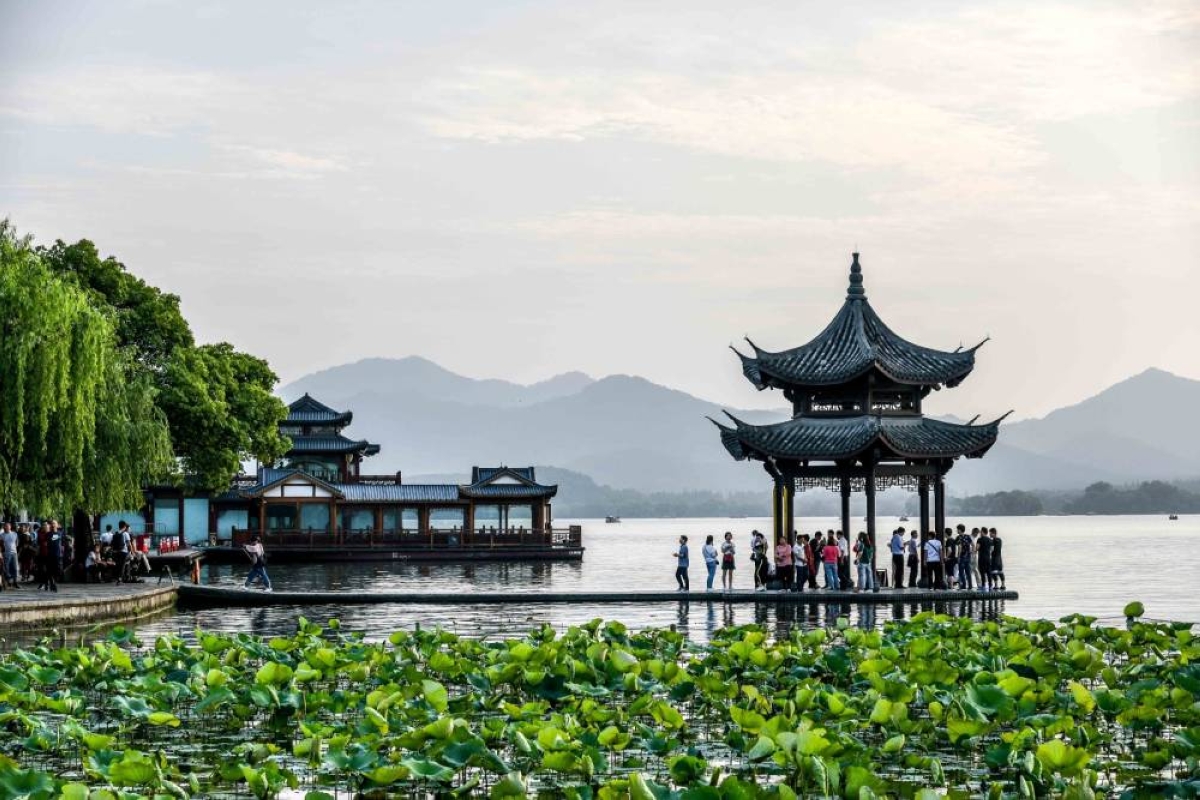
“No matter who you are or what kind of traveller you consider yourself to be, Hangzhou has a way of finding a place in your memory that lingers long after you leave. It is one of those rare cities where history does not sit behind glass in museums but flows gently through lakes, trees, bridges, and daily life. Often described as “paradise on earth,” Hangzhou, the capital of Zhejiang Province, feels less like a destination and more like a mood—calm, poetic, and quietly confident. It is a city that has mastered the balance between ancient China and a rapidly modernising world, where tea gardens and temples exist within reach of gleaming towers and global innovation hubs.My journey to this remarkable city began in Beijing, a place that carries the weight of dynasties, politics, and monumental architecture. Leaving the Chinese capital, I shifted from imperial grandeur to something more fluid and reflective. The transition itself became part of the story, as I made my way to Beijing South Railway Station, a vast and efficient gateway that mirrors China’s obsession with precision and scale. From there, I boarded Train G743, a high-speed service bound for Hangzhou East, and what unfolded over the next few hours felt like a quiet introduction to the country’s modern soul.The train itself was a reflection of contemporary China at its best - sleek, punctual, and remarkably smooth. As it departed the station, the cityscape of Beijing gradually gave way to open land, industrial corridors, farmland, and then distant clusters of urban development that appeared and disappeared like fleeting impressions. Covering more than 1,200 kilometres in roughly four and a half hours, the journey did not feel rushed; instead, it felt effortlessly efficient, almost like time had been compressed without losing comfort. There was a meditative quality to watching China pass by through large windows, entire provinces unfolding like chapters in a book, each with its own rhythm, colour, and identity. What struck me most was not just the speed, but the sense of connection it created. In a matter of hours, one moves from the political heart of the nation to one of its most aesthetically refined cities, as if the country itself is designed to be experienced in gradients rather than distances.Arriving at Hangzhou East Railway Station, the atmosphere subtly shifted. The air felt softer, the pace calmer, and even the light seemed to carry a different tone. Hangzhou does not overwhelm you; it eases you in. The city is famously anchored by West Lake, and it does not take long to understand why poets, painters, and emperors for centuries have tried to capture its essence. West Lake is not simply a body of water; it is a living landscape where every season reshapes its personality. Mist drifts across its surface in the early morning, willow branches lean gently toward the water as if listening to it, and distant pagodas rise like quiet witnesses to centuries of change. The most memorable way to experience West Lake is undeniably by boat. Stepping onto a traditional wooden vessel, there is an immediate sense of slowing down, as though the modern world has agreed to pause for a while. The boat glides without urgency, and the city begins to dissolve into reflections. The water carries stories, some real, some legendary, and every turn reveals a new frame that feels almost deliberately composed. The silhouette of Leifeng Pagoda rising against the sky, the gentle symmetry of causeways stretching into the distance, and the subtle mystery of islands appearing and disappearing through light mist all combine into a scene that feels less like sightseeing and more like entering a painting that is still being created. As the boat moves further, the city becomes a distant outline, and what remains is a sense of stillness that is increasingly rare in modern travel. By sunset, West Lake transforms again, as golden light spreads across its surface and the sky reflects in soft gradients of orange and blue. It is in these moments that the lake fully justifies its reputation as one of the most beautiful landscapes in China, not because it demands attention, but because it gently holds it.Beyond the lake, Hangzhou reveals another layer through its food culture, which is deeply rooted in Zhejiang cuisine. Dining here is an experience shaped by subtlety rather than intensity, where flavours are refined, balanced, and carefully composed. West Lake Fish in Vinegar Sauce is a local classic, presenting a delicate balance of sweet and sour that reflects the culinary philosophy of the region. Shrimp prepared with Longjing tea leaves brings together two of Hangzhou’s most iconic exports—its cuisine and its tea culture—resulting in a dish that feels both innovative and deeply traditional. Meals in Hangzhou often extend beyond food itself. They are accompanied by tea, particularly Longjing (Dragon Well) tea, which is cultivated in the hills surrounding the city. Sitting in a tea house overlooking greenery, the experience becomes less about consumption and more about pause. The act of drinking tea here is almost reflective, a reminder that simplicity can be profound when placed in the right setting. Yet Hangzhou is not only about tradition and nature. It is also one of China’s most dynamic modern cities, and this dual identity becomes especially visible in its urban spaces. Raffles City Hangzhou stands as a striking example of this transformation. Architecturally bold and visually contemporary, it represents the city’s global ambitions without abandoning its cultural roots. Inside, the environment shifts into a curated blend of luxury retail, lifestyle spaces, and international dining. Walking through its corridors, one moves from traditional Chinese aesthetics just a few streets away to a cosmopolitan world of fashion, design, and innovation. It is here that Hangzhou reveals its confidence—not by replacing its heritage, but by layering modern life over it in a seamless way. What makes Hangzhou truly remarkable is this constant dialogue between old and new. Ancient temples are never far from modern business districts, and serene lakes sit within reach of cutting-edge technology parks. It is a city that does not force you to choose between past and future; instead, it allows both to coexist naturally.
Original story
Continue reading at Gulf Times Education
www.gulf-times.com/community/education
Summary generated from the RSS feed of Gulf Times Education. All article rights belong to the original publisher. Click through to read the full piece on www.gulf-times.com/community/education.