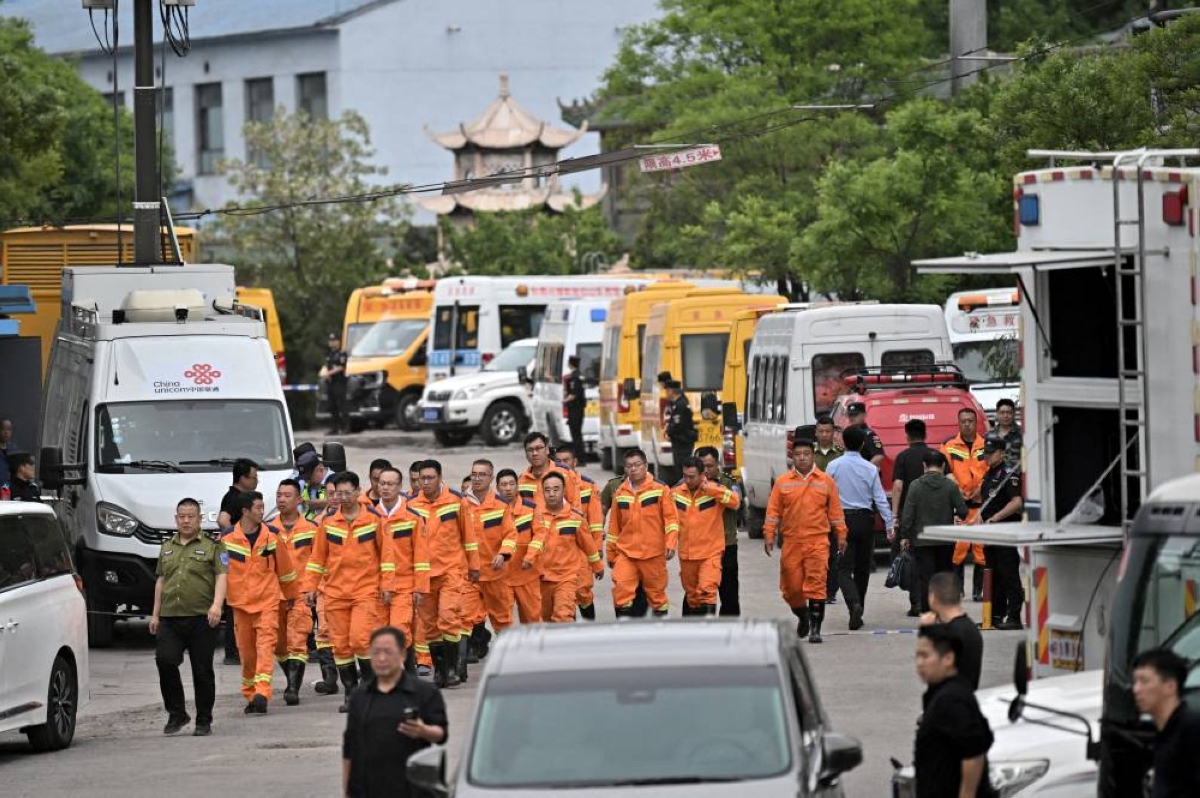
“Unmarked tunnels, missing trackers and fake doors have been uncovered during an initial probe into the deadliest mining tragedy in China in over 15 years, with the government vowing to leave no stone unturned, state media reported yesterday. At least 82 people were killed by a gas explosion late on Friday at the Liushenyu mine in the coal-rich province of Shanxi in northern China. Two remained unaccounted for with a further 128 hospitalised, state media said. The blast is the deadliest mining accident in China since 2009, when a gas explosion at the Xinxing Mine in Heilongjiang province killed 108 people. While the cause of Friday's incident remains under investigation, the official Xinhua news agency yesterday said concealed mining tunnels, falsified drawings and outsourced and unregistered miners, who had not been provided with required life-saving location trackers, were contributing factors to the deadly incident. 'YIN-YANG DRAWINGS' The mine, controlled by Shanxi Tongzhou Coal Coking Group, maintained two separate sets of plans and surveillance systems, Xinhua said. One set matched the actual operations while the other was used to deal with official inspections, with some mining areas hidden from regulatory oversight. Reuters was not able to contact officials from the company, as according to state media they have been detained. Coal mined from the concealed and unregulated tunnels is not included in the official production figures and went untaxed. The two sets of plans are known colloquially as 'yin-yang drawings': one kept in the open for inspectors to scrutinise and the other kept in the dark. Similar profit-driven practices are not uncommon in coal mines across China despite crackdowns, the national mine safety administration has said. The Liushenyu mine 'used wire mesh and woven plastic sacks sprayed with mortar, to make fake doors that looked very much like the rock wall of the mine tunnel,' Xinhua said. Workers would be tipped off by someone outside whenever inspectors came, and they would shut the fake doors, smear coal ash to blend them in with the rest of the underground passage. MISSING TRACKERS, ALARMS In order to evade detection, the mine operator hired subcontracted labour to work in the concealed tunnels without providing them with required identification-location trackers or logging them in the official entry record. Authorities would have been able to monitor where the miners were underground had they been equipped with trackers, including in emergency situations. When the blast occurred on Friday, the official log showed only 124 workers had gone underground, according to footage shown on state broadcaster CCTV on Monday. In fact a total of 247 workers were working in the mine, suggesting that 123 had been untracked in tunnels outside official purview. The lack of accurate maps and miners' location information has severely hampered rescue operations, state media said. The Liushenyu mine — classified as a 'high-gas mine' with elevated blast risk — also deliberately avoided installing gas-monitoring equipment to further evade authorities' supervision, the state radio broadcaster said in a separate report yesterday. The issues were not unknown to authorities before Friday's tragedy. In 2025, the mine operator was 'fined after regulators discovered concealed working faces, but the penalty failed to serve as an effective deterrent, and the company continued illegal production,' Xinhua said. Some mines across China have halted or reduced production following the incident for safety inspections.
Original story
Continue reading at Gulf Times Qatar
www.gulf-times.com/qatar
Summary generated from the RSS feed of Gulf Times Qatar. All article rights belong to the original publisher. Click through to read the full piece on www.gulf-times.com/qatar.

