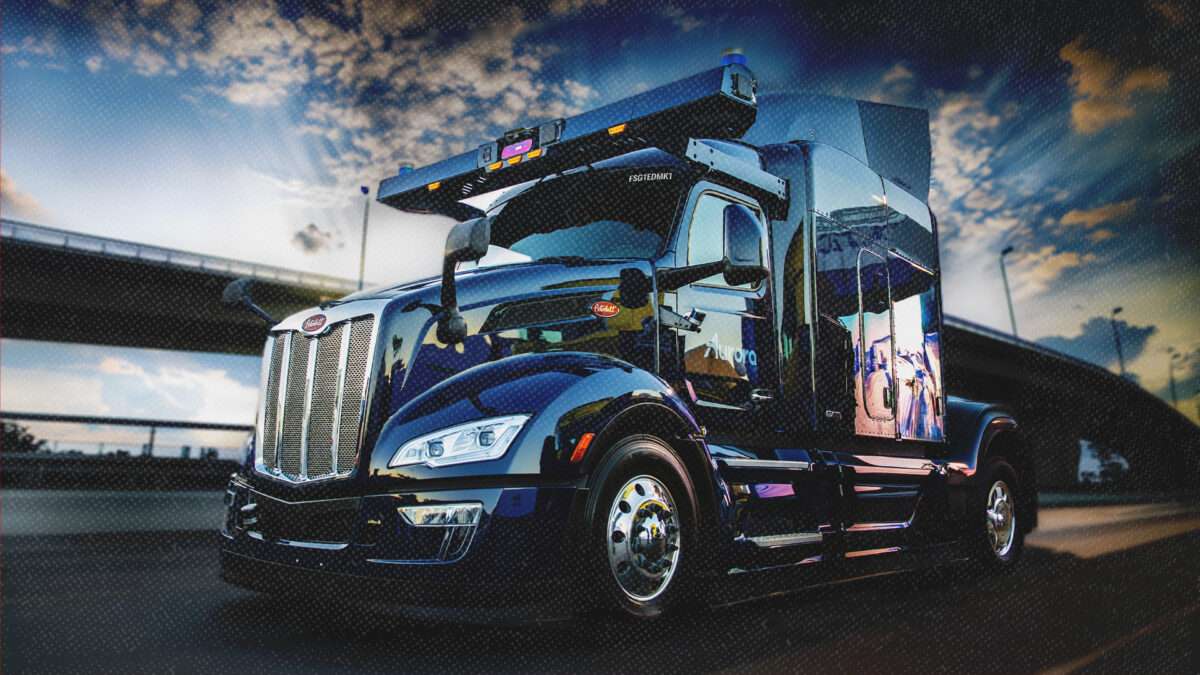
“The bipartisan surface transportation reauthorization bill released earlier this week by the House Transportation and Infrastructure Committee would reform an obscure safety rule that has served as a de facto ban on driverless commercial trucks. The BUILD America 250 Act would allow driverless truck operators to use cab-mounted beacons to warn drivers of a disabled truck on the road. Current federal regulations require that roadside warning placards be placed around disabled trucks. That requirement has been a serious source of grief for autonomous trucking companies, as it effectively requires a human operator to be on board to place those warning placards. For that reason, they've been agitating for a rule change that would allow cab-mounted warning beacons that wouldn't require a human to place them. In 2023, the autonomous trucking company Aurora and Waymo's now-shuttered driverless trucking division requested a waiver from the regulation from the Federal Motor Carrier Safety Administration (FMCSA). The Biden administration ultimately rejected that waiver request. The companies then challenged that denial in court. Last October, they reached a settlement with the Trump administration that granted Aurora a limited waiver allowing them to use cab-mounted warning beacons, provided they collect data on the safety efficacy of this alternative. This was still only a partial win for the industry. The terms of the waiver require it to be reapproved every three months. It also only applied to Aurora. Other companies seeking regulatory relief must apply for their own specific waiver. Under a new administration, FMCSA could also revoke the waiver. To give the industry greater regulatory certainty, Section 5405 of the BUILD America 250 Act declares that "cab-mounted warning beacons shall be considered permissible warning devices for a commercial motor vehicle stopped upon the traveled portion or the shoulder of a highway" and that they can be used in lieu of roadside placards. Section 5405 would also forbid the FMCSA from issuing rules in the future that disallow cab-mounted warning beacons. The safety case for requiring roadside warning placards has always been weak. The Biden administration conceded as such when, after denying Aurora's request for a waiver, it announced it would perform its own study on the efficacy of the warning devices. In support of their waiver request, Aurora and Waymo submitted their own safety studies showing drivers reacted similarly to cab-mounted warning beacons and roadside placards. In theory, the cab-mounted beacons could improve safety by relieving a driver from having to walk out onto the road to place physical warning placards. Beyond the warning device rule, the BUILD America 250 Act would also create a whole new framework for regulating autonomous trucks going forward. Traditional federal safety regulations establish objective "performance" standards that regulated commercial vehicles must meet. Marc Scribner, a transportation policy analyst at the Reason Foundation (which publishes this website), says performance standards are a poor fit for emerging driverless technologies. "There isn't agreement yet on what an appropriate performance standard is and how you'd test that," he says. The Transportation and Infrastructure Committee's bill would instead allow manufacturers to establish their own "safety case" showing that their technology is at least as safe as human-operated commercial vehicles. Scribner describes this more flexible approach as "a strong step in the right direction." A Transportation and Infrastructure Committee markup of the 1,000-page bill is scheduled for tomorrow. The post House Transportation Bill Eliminates Obscure Rule That Effectively Bans Driverless Trucks appeared first on Reason.com .
Original story
Continue reading at Reason
reason.com
Summary generated from the RSS feed of Reason. All article rights belong to the original publisher. Click through to read the full piece on reason.com.