
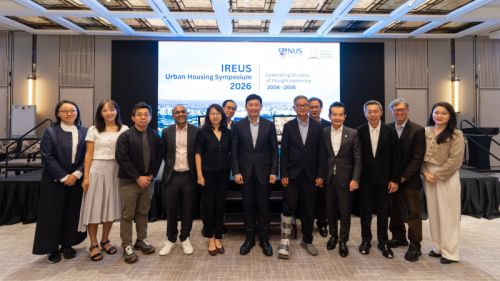
“Singapore has come a long way in housing its population. Today, 8 in 10 residents live in HDB flats, and 9 in 10 own their homes – but the journey isn’t over. Speaking at the opening of the recent IREUS Urban Housing Symposium 2026, Singapore’s Minister for National Development Mr Chee Hong Tat reflected on how far the country has come, and how challenges have evolved. “When we first started more than 60 years ago, our task was more straightforward: we wanted to move people out of overcrowded and unsafe slums, by building homes, and building them quickly. Our housing challenges have since grown far more complex beyond just building enough flats,” said Mr Chee. The IREUS Urban Housing Symposium 2026, held to mark the 20th anniversary of the NUS Institute of Real Estate and Urban Studies (IREUS), could not have come at a more timely moment. While Singapore’s housing policies and success are the envy of many nations, the work is far from done. Each generation brings new challenges, from keeping homes affordable, to rejuvenating ageing towns, while land becomes increasingly scarce. Mr Chee also highlighted that housing is more than just brick and mortar – it is a key part of Singapore’s social compact. “There is a saying that home is where the heart is, and in our case, we believe the reverse is true as well, heart is where the home is. So when you have high home ownership, people have a sense of rootedness and a sense of collective stake in Singapore,” he said. More than a roof over one’s head Bringing together some 160 policymakers, researchers, and industry practitioners to examine the challenges shaping Singapore’s housing landscape, the IREUS Urban Housing Symposium 2026 was the opportune platform to dive deep into what the next chapter of housing should look like. For instance, does Singapore’s public housing system do more than put a roof over people’s heads? Research by Associate Professor Fan Yi from the NUS Business School’s Department of Real Estate showed that affordable public housing creates a powerful intergenerational mobility effect. Data from two decades of financial transactions show that when parents redirect their surpluses from housing into their children’s education, it becomes a significant investment into the next generation, an effect that is strongest among lower-income households. But sustaining this intergenerational transfer of wealth is not straightforward, said Associate Professor Sing Tien Foo, also from the Department of Real Estate. While the effectiveness of Singapore’s public housing policy ensures that the price-to-income ratio for median housing remains relatively affordable despite periodic price spikes, property represents around 58 per cent of total wealth for most Singaporean households. This presents a dilemma for policymakers, who must balance asset growth with affordability. Said Assoc Prof Sing: “For those who already own their housing, how do you preserve their wealth? At the same time, how do you ensure housing remains affordable for new buyers?” The more pressing long-term question is what happens when the system itself needs to change, said Mr Christopher Gee, Deputy Director and Senior Research Fellow at the Institute of Policy Studies (IPS) . Singapore’s public housing serves four purposes simultaneously: it is a shelter, a mark of citizenship, a financial safety net, and a financial asset. But these intertwined objectives will be severely tested when the Voluntary Early Redevelopment Scheme (VERS), which allows owners to sell homes back to the Government before the lease of their homes ends, begins its first exercises in the early 2030s. Said Mr Gee: “That will be the moment when residents will be asked to reveal which of these purposes they actually prioritise, and when the tensions between them have to be reconciled.” The compensation frameworks and consent thresholds established in these first exercises will set precedents that shape subsequent redevelopment for decades, he added. As such, it is critical that the design of VERS be carefully thought through to maintain the social compact that public housing represents in Singapore. Housing in a changing world Turning to private developers, the forum also explored the role of private housing in the building of Singapore’s urban landscape. In his presentation, Chief Executive Officer of CapitaLand Development Jonathan Yap said that developers face increasingly complex challenges. They must build homes that are not just efficient but community-centred, sustainable, and adaptable to changing needs. And as Singapore matures, redevelopment is inevitable and everyone has a role to play. “It’s not just about developers,” he said. “It’s about government, agencies, consultants, academia and consumers themselves. That’s a multi-level conversation that needs to happen for real change to happen.” The symposium also looked at the impact of climate change on housing prices. A study by Associate Professor Qin Yu of the Department of Real Estate showed that climate risk is already being priced into Singapore’s residential market. According to her research, Housing and Development Board (HDB) prices in high-risk areas fell 4.7 per cent in the four years following the government’s 2019 disclosure of flood risk maps. But areas covered by credible adaptation commitments saw a far smaller decline of just 1 per cent. Said Assoc Prof Qin: “Even though disclosing climate risk may lead to a devaluation of real estate assets, pairing this disclosure with credible adaptation details would actually mitigate the negative impact.” Comparative research on Singapore and Hong Kong from Associate Professor Lee Kwan Ok, also of the Department of Real Estate, meanwhile, found that green spaces are not merely pleasant amenities but measurable contributors to mental well-being. At the same time, accessibility, and not just size, determines whether residents use and benefit from them. In other words, a smaller park within walking distance does more for residents’ well-being than a larger one they cannot easily reach. Ultimately, the symposium made clear that housing is not just a matter of land, supply or prices. It is about how people live, age, belong and build their futures. As IREUS marks its 20th anniversary, its work remains as relevant as ever — helping Singapore better understand the forces shaping its urban future, and how homes can continue to support the aspirations of generations to come.
Original story
Continue reading at NUS Newsroom
news.nus.edu.sg
Summary generated from the RSS feed of NUS Newsroom. All article rights belong to the original publisher. Click through to read the full piece on news.nus.edu.sg.

