
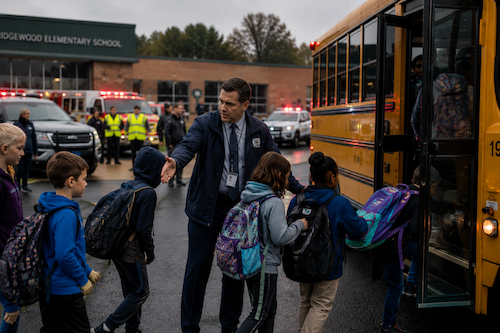
“Key points: Families trust educators and school leaders not only to educate their children, but also to protect them Why in-building coverage is a lifeline for school safety Location precision enhances safety, reduces response times in emergencies For more news on school safety, visit eSN’s Educational Leadership hub When people outside of education talk about comprehensive school safety planning, it can sometimes sound theoretical: A checklist of protocols or a compliance exercise. For those of us working in schools every day, it is anything but abstract. It is personal, practical, and in critical moments, it can mean the difference between chaos and coordination. I know this because I’ve lived it. In September 2025, during dismissal at S.L. Mason Elementary School, what began as our routine end-of-day transition quickly escalated into an emergency. Students were filtering outside to buses, car lines, after-school activities, and pickup. Some buses were already loaded and preparing to leave campus. Families were arriving, and staff members were focused on managing one of the busiest parts of the school day. I was at the bus loading area, sending our students off for the day. That’s when gunfire erupted just outside our campus. Within seconds, what could have become chaotic instead became a coordinated response because of the systems, training, and preparation we had in place. Planning for the moments you hope never come In education, we spend a lot of time preparing for what we can predict: lesson plans, assessments, and schedules. Comprehensive school safety planning requires us to prepare for the unpredictable. In our district, that planning is layered. It is not just one protocol or one tool. It is a combination of clearly defined procedures, regular drills, strong communication, and the ability to act quickly without hesitation. That preparation was tested in real time. After hearing gunshots, a school resource officer (SRO) and another local law enforcement officer who were patrolling the perimeter of our campus immediately responded to the gunman, who was moving toward the school entrance. At the bus loading area, I initiated a campus-wide lockdown within 37 seconds using a CENTEGIX wearable panic button . Pressing the button on my badge activated a full lockdown, including strobes, our intercom system, and emergency messages sent to every campus computer. Why speed and clarity matter In any emergency, time changes. Seconds feel like minutes, and even small delays can have consequences. One of the most important lessons from that day is that speed alone is not enough. Clarity matters just as much. A fast response only works if everyone understands what the alert means and knows what to do next. Teachers and staff did not need to interpret vague instructions. They followed a plan they already knew. Transitions that could have become disorganized stayed controlled. At the same time, having a system that could instantly communicate across the entire campus ensured everyone was informed about what was happening. This coordination allowed multiple actions to happen simultaneously. Staff moved students indoors, classrooms secured their doors, and buses that were already loaded departed campus safely to remove students from potential danger. There was no time to debate or second-guess, and everyone knew their role. Training turns plans into action A plan sitting in a binder does not protect anyone. We invest time in drills not because we expect emergencies to happen, but because we know that if they do, people will rely on what they have practiced. Muscle memory matters. Training is what makes comprehensive school safety plans work in practice. On the day of this threat to our campus, our SRO and the nearby officer were able to respond immediately, and that did not happen by chance. That is why we train for different scenarios, including lockdowns, weather emergencies, reunification procedures, communication protocols, and coordination with local law enforcement. When additional officers arrived within three minutes of our lockdown initiation, they were stepping into a situation that was already being managed within a clear structure. Building a culture of safety There is often a tendency to think about school safety in terms of either people or technology. In reality, the most effective and comprehensive approach combines both. Tools that enable rapid communication and response can make a significant difference, but only when they are integrated into a broader, layered safety strategy. Technology should support and empower staff. At the same time, safety is not just about what happens during an emergency. It is about what happens every day leading up to it. Do teachers and staff feel confident in the procedures? Do they trust that leadership prioritizes safety? Are expectations clear and consistently reinforced? Do students feel confident that teachers and staff know the best course of action because they have practiced it? In our case, the ability to quickly initiate a lockdown and alert the entire campus helped eliminate delays and ensured everyone received the same message at the same time. Consistency is critical in high-stress situations. Our response during this threat was strengthened by preparation, training, and a shared commitment to safety. When safety becomes part of the culture, responses become more instinctive and less reactive. Lessons for school leaders Every school is different, but there are several takeaways from our experience that can apply broadly: Plan in layers. No single measure is enough on its own. Effective comprehensive school safety planning connects procedures, training, communication, and coordination. Practice regularly. Training should be consistent and meaningful, not just procedural. Prioritize clarity. In an emergency, simple and well-understood instructions are more effective than complex ones. Collaborate locally. Strong relationships with law enforcement and first responders are essential. Evaluate and adapt. After any incident or drill, take time to review what worked and identify opportunities for improvement. That day in September, no students, staff members, or families were injured. For that, we are incredibly grateful. Moments like that reinforce the responsibility we carry as educators and leaders. Families trust us not only to educate their children, but also to protect them. Comprehensive school safety planning and training help schools prepare to respond effectively when it matters most.
Original story
Continue reading at eSchool News
www.eschoolnews.com
Summary generated from the RSS feed of eSchool News. All article rights belong to the original publisher. Click through to read the full piece on www.eschoolnews.com.
