
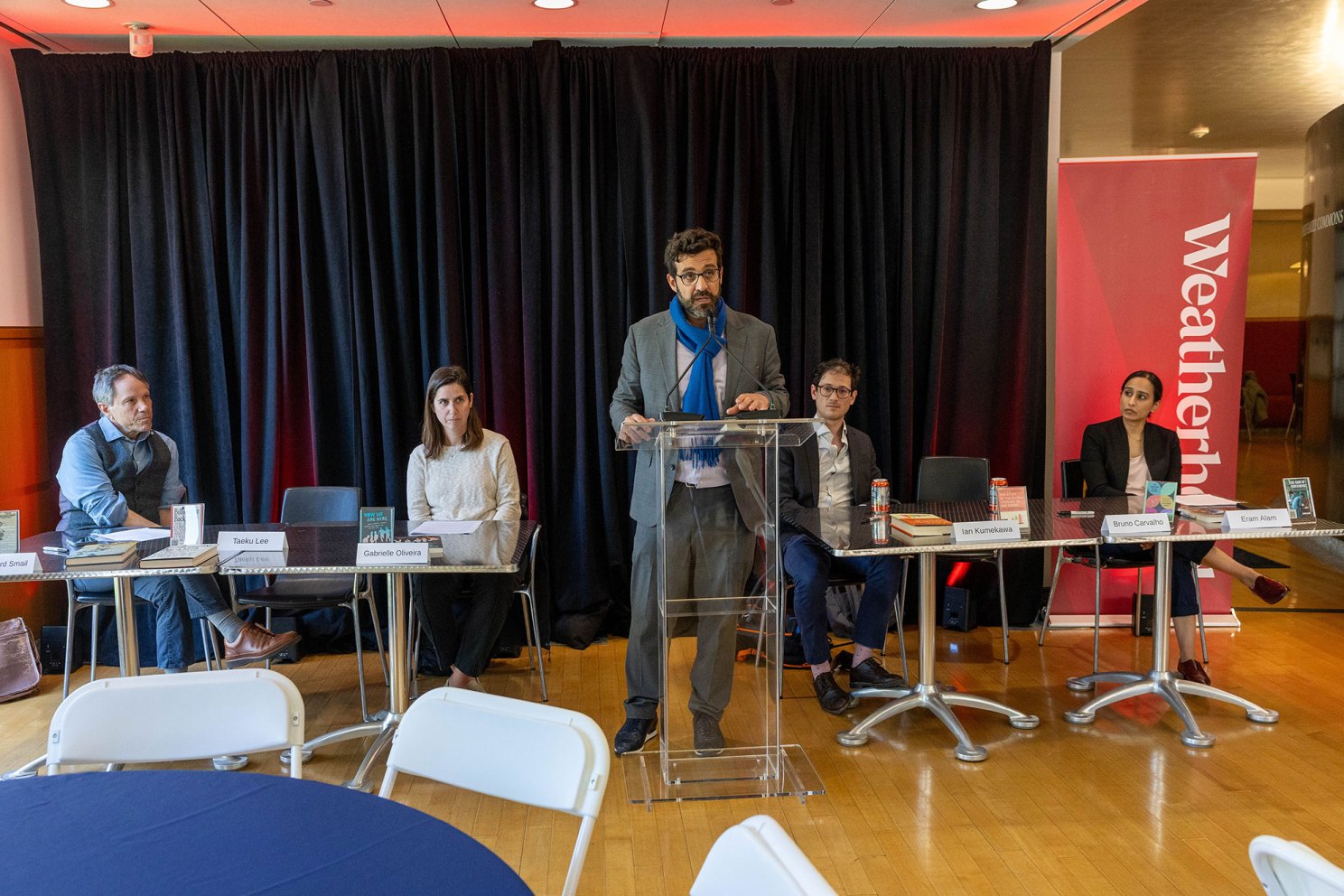
“Campus & Community How immigrant doctors propped up U.S. healthcare, the tale of America’s last prison ship, and other stories Daniel Lord Smail (from left), Gabrielle Oliveira, Bruno Carvalho, Ian Kumekawa, and Eram Alam. Photo by Bethany Versoy Clea Simon Harvard Correspondent May 7, 2026 7 min read Faculty authors discuss books at Weatherhead Center’s annual International Book Blitz Immigrant physicians have quietly supported healthcare in underserved portions of urban and rural America for about six decades amid the rise of government-sponsored medical programs and a nationwide shortage of primary care providers. And they have not always been welcomed. Eram Alam chronicled their story in her 2025 book, “The Care of Foreigners: How Immigrant Physicians Changed U.S. Healthcare.” The associate professor in the history of medicine detailed her findings as part of the Weatherhead Center for International Affairs ’ fifth annual International Book Blitz on Monday. Starting in the 1960s, she said, professionals from foreign countries, particularly in Asia and Africa, were recruited to work in the U.S. “Lawmakers feared that these emergent post-colonial Asian and African nations would get seduced by the communist sphere of influence instead of joining the United States,” she said. This fear coincided with the creation of Medicare and Medicaid, as well as the desegregation of hospitals due to the Civil Rights Movement, compounding the need for physicians. The result: “For the last 60 years, roughly a quarter of the physicians in the United States have been immigrants who disproportionately work as primary care providers in America’s neglected urban and rural communities.” However, these medical professionals faced racism from a medical establishment “weary of these non-white professionals with accented English who were claiming the status and authority of a physician.” Examining both the individual experience of such caregivers and the larger social movements that have both bolstered and sought to exclude them, Alam said that her book makes the case for “bold, coordinated, comprehensive reform of both healthcare and immigration to secure reliable medical care for everybody in this country.” Bruno Carvalho was next up at the blitz, a celebration of current and former Weatherhead affiliates whose books were published within the last 12 months. The professor of Romance languages and literatures and of African and African American studies spoke about his January 2026 work, “The Invention of the Future: A History of Cities in the Modern World.” The book moves from 1755 Lisbon, which was rebuilt after an earthquake to become a center of the Enlightenment, through post-World War II Lagos and Brasilia. Carvalho, who also serves as co-director of the Harvard Mellon Urban Initiative, said that in the 1700s people began for the first time to imagine a future that “would no longer be predetermined by divine or supernatural forces” but be “built by humans.” He said his aim was to “rethink the history of the modern world as a set of competing visions over what the future ought to be like.” Drawing on everything from official records to oral histories, or “data and deities, statistics and stories,” the book also traces how urban planning is “full of unintended consequences,” he said. He noted how population density in cities came to be viewed as a public health issue in past centuries. But today some urban planners argue increasing density — building higher and allowing more infill development — may actually help ease today’s national housing crisis. “Sometimes conversely, yesterday’s problems can become today’s solutions,” he said. Describing “Empty Vessel: The Story of the Global Economy in One Barge,” Ian Kumekawa began by saying that his book was a COVID-era project. During lockdown, the Anniversary Fellow at the Center for History and Economics became fascinated by the fact that his wife, a public defender, was working with clients who were incarcerated on “The Boat,” as it was called: a jail barge anchored in New York’s East River that was the last remaining prison ship in the U.S. “My own training is in British imperial history,” he said, explaining that this floating prison brought to mind “the British carceral system in centuries gone by.” With the luxury of time that COVID provided, he began researching the ship and found it had replaced an earlier prison barge. “Unprepossessing” and painted “a very dull grey,” the flat-bottomed, steel-hulled boat had five layers of what are essentially shipping containers, he said. Technically classified as a “dumb pontoon,” the barge was built in Sweden and first served to house offshore oil workers, then moved to the Falklands, where it housed British soldiers, and then to Germany, for workers in a VW plant. Following the boat to New York, Nigeria, and ultimately back to New York, Kumekawa began to see it as a player in a larger movement: the rise of offshore industries and global trade. “Over the years, as it moved around, it became involved in almost every aspect of the offshore world” and globalization, he said. This allowed him to write a “a global microhistory” of “these unbelievably transformative, important, economic transformations that have shaped our world over the last 50 years,” from a “barge-eye view.” Gabrielle Oliveira introduced her book “Now We’re Here: Family Migration, Children’s Education and Dreams for a Better Life,” by reading from it. Quoting a 15-year-old from Brazil, she read: “When people ask me, ‘Why did you come here?’ I tell them, ‘That’s the wrong question. The right question is, ‘Do I have the right to have a good life to dream?’” That excerpt, said Oliveira, the Jorge Paulo Lemann Associate Professor of Education and of Brazil Studies, embodied the theme of her work, stressing the ordinary respect and dignity that children and families deserve, no matter their origins. Based on three years of ethnographic research, the book weaves together stories of parental sacrifice and children’s experiences of migration and the difficulties of crossing the border. Speaking of these experiences, she illustrated how trauma lasts, influencing the experience of families who simply seek a better life and education for their children. “Adriana, the 15-year-old I quote in the beginning, knew this. She was asking whether she had the right to dream and to ask for better education,” said Oliveira. “She gave us the answer, ‘Yes, unconditionally.’ And this work bears witness to the families who have been living that truth quietly, daily, powerfully all along.” Daniel Lord Smail , Frank B. Baird Jr. Professor of History, closed the event by discussing “Magdalena Coline: A Life Beyond Slavery in Mediterranean Europe.” “Magdalena Coline” grew out of research that Smail, also the interim chair of the history department, was doing in Marseille in 1998. He was exploring court records from around the year 1400 when he came across “this utterly amazing case.” The case files, which ran to 300 pages, involved a formerly enslaved African woman who was suing her former enslaver over a small debt. He set the project aside, and in the intervening years, he said, scholars’ views on the history of slavery shifted. Previously slavery in Europe had been dismissed as relatively minor. It has since become understood as part of a longer and larger global trade. In this context, his discovery of those records made more sense. “We now know that the scale of the slave trade in the later Middle Ages was anything but insignificant,” he said. It was also complicated, with links to the Mongol empire. Starting around 1300, he said, many enslaved people came from the Black Sea area they controlled, and their trade accelerated in the 1350s following civil war in part of the empire known as the “Golden Horde.” “This flooded the market with a dramatically increased population of slaves,” he said, “And it created a context that was navigated by the protagonist of my story” — Coline, who dared to sue her enslaver. In her, Smail said, he found a lens to explore the trade and resale trade of enslaved people in the period. “You have to imagine interconnections sending enslaved people, almost invariably women, multiple times from city to city, all over the Western Mediterranean basin,” he said.
Original story
Continue reading at Harvard Gazette
news.harvard.edu
Summary generated from the RSS feed of Harvard Gazette. All article rights belong to the original publisher. Click through to read the full piece on news.harvard.edu.

