
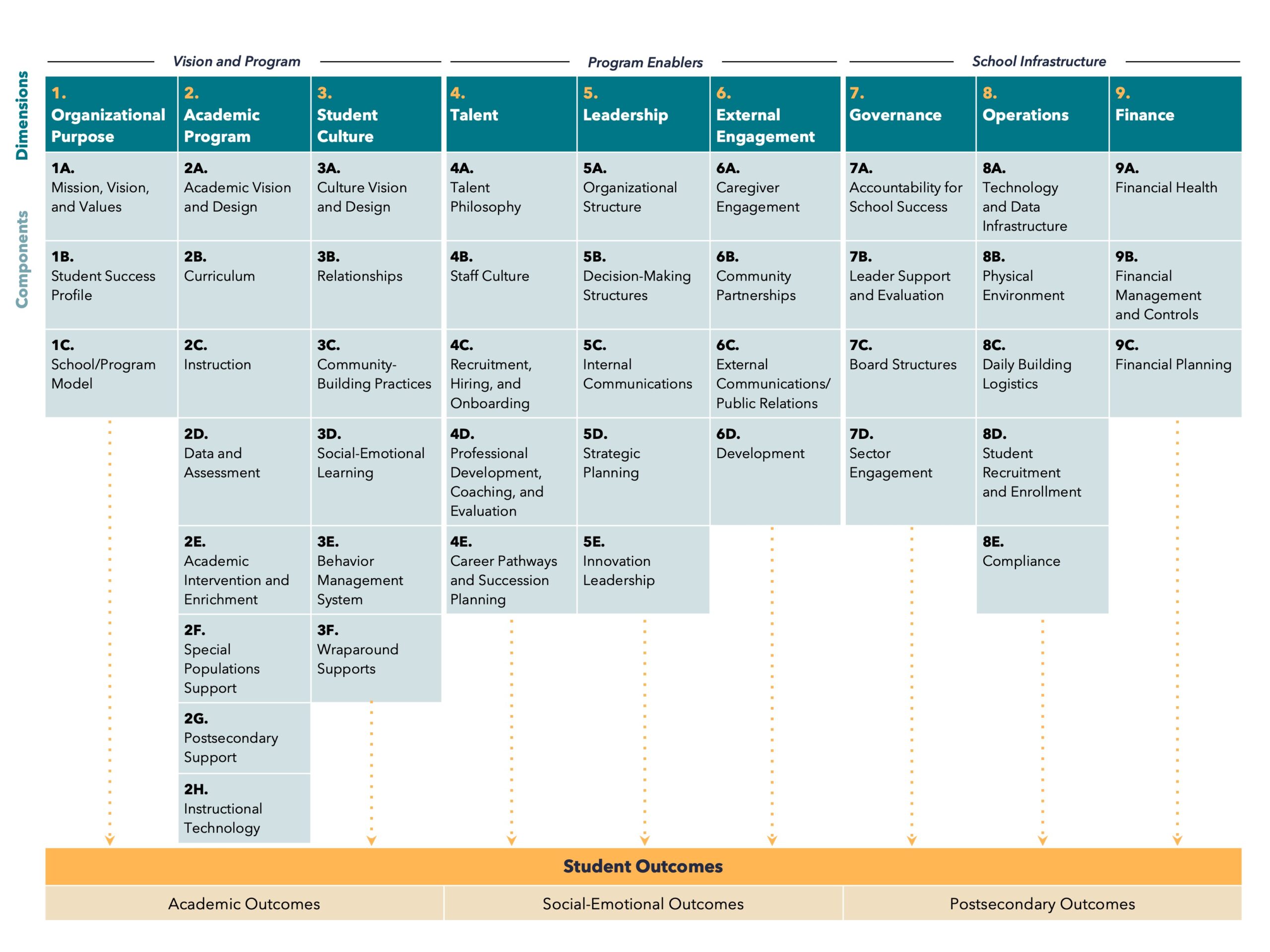
“This is the fourth post in a series on Bellwether’s School Quality Framework , highlighting schools and systems that exemplify key components of the recently redesigned resource. Bellwether’s School Quality Framework (SQF) defines nine dimensions of school excellence — from academics to student culture to operations — and breaks them down into clear, actionable components for schools and school leaders. Bellwether’s School Quality Framework (click to enlarge) Each element of the SQF enables school, district, and network leaders to deploy their school’s program in a sustainable way to deliver on their promise to students and families. Underpinning much of that work is sound financial planning and the overall health and sustainability it creates for a school to execute its program to drive student success. Charter school leaders are navigating a difficult financial landscape. Enrollment fluctuations can make revenue hard to predict, per-pupil funding hasn’t kept pace with rising costs, and the expiration of federal COVID-19 relief dollars has left many schools with leaner budgets and less certainty about what comes next. For single-site charter operators especially, these pressures leave little room for error and make it harder to sustain the academic programs, staffing, and student supports that families count on. Managing school finances well isn’t just about keeping the lights on — it’s also about protecting the quality of what happens in classrooms and building the internal capacity and training to ensure resources are used effectively. Dimension 9 of the SQF gives school leaders a practical framework for doing exactly that. Component 9A asks leaders to take stock of where their school stands financially — examining metrics such as cash on hand, operating margins, and debt levels to build a clear picture of current health. Component 9C pushes leaders to look ahead — modeling future scenarios, stress-testing assumptions, and mapping trade-offs so they can make proactive decisions rather than reactive ones. Together, they equip school leaders to make financial decisions that sustain their school and serve their students well. Component 9A. Financial Health Component 9C. Financial Planning To unpack what this looks like in practice, we recently met with two Nevada-based education leaders: Emily Bassier , principal of a single-site charter middle and high school, Equipo Academy, and Ray Fraser , managing director of operations at a nonprofit intermediary that supports high-quality school options, Opportunity 180. We discussed how Bellwether supported sound financial and programmatic planning to strengthen the future financial health and sustainability of the school and the role intermediary education champions play in that improvement process. Their answers have been edited for clarity and length. First up, Emily Bassier from Equipo Academy shares reflections on how a challenging situation with a charter authorizer led to stronger financial operations for her school. Nick Allen (Bellwether): Emily, tell our readers about your school, where it’s located, grade levels it serves, and how you came to join its leadership team. Emily Bassier (Equipo Academy) : Equipo Academy is in its 11th year of operation in the current 2025-26 school year, serving east Las Vegas students in Grades 6-12. We’re a single-site charter operator with a middle school that feeds into our high school. I started on the leadership team as a dean when we opened the school and am currently in my second year of taking over for the founding principal. Our school formed directly within the community of east Las Vegas and that community spirit continues to grow. We have frequent family communications — at times daily from our team updating parents on how students are doing and asking for their support. We also have a strong academic model and want all students to graduate college ready. We focus on pre-Advanced Placement (AP) and AP coursework along with things like dual enrollment classes so students get college-level work before they graduate. We do all of this work amid an environment with huge academic gaps left over from the COVID-19 pandemic as well as struggles kids face now. We work hard to balance rigorous grade-level work with filling in those gaps through supports like tutoring, small-group instruction, targeted interventions, and more. NA: What circumstances led to your team’s partnership with Opportunity 180 and Bellwether? Give our readers context behind the partnership. EB : Opportunity 180 is a state-level organization that works to ensure all kids in Nevada graduate high school college- and career-ready. We’d been in partnership with them for years and they recently connected us to Bellwether for strategic planning, financial modeling, and some leadership coaching. In my first call, I was hesitant about having an external strategic partner because we’d never done that before. I was also a first-year principal at the time and worried about having a “stranger” in the mix who didn’t know our school community. Phase 1 of the work focused on strategic planning with Equipo’s academic model. We originally didn’t have enough funds to tackle the financial part of strategic planning, so Opportunity 180 stepped in and got us access to the financial modeling services Bellwether provides. For broader context, our entire existence has lived close to the bone financially and put students first since day one. We’d spend money toward hiring, growing, or retaining good people who could help our students be really successful. Our primary funding comes from Nevada’s per-pupil allotment and it’s a number that doesn’t shift much from year to year. In a world where those funds don’t keep up with inflation at times, we’ve had relatively stagnant funding. As a team, we’d worked in the past to apply for grants and partnered with Opportunity 180 to help use our limited resources to do right by our kids. In my first year as a principal, our finances were in a poor position according to state metrics and we were notified that we were up for a potential notice of breach from our charter authorizer. We got a notice of concern given the amount of cash we had on hand since we operated so closely to our budget despite having good financial practices in place. We suddenly found ourselves at real risk of charter revocation even though we have great academic data. It was scary to think that the financial position could close our building. Faced with this challenge, Bellwether helped us get on top of everything to prevent the financial side of things from threatening the awesome academic results in our building. Through our partnership with Bellwether and Opportunity 180, my leadership team and I developed a firmer understanding of not only financial metrics but also how to make choices that were right for kids and financially sound to have a healthy school in terms of how the state viewed us. We’ve been working with various teams at Bellwether for over a year now on strategic planning, financial planning, governance, and leadership coaching. The amount I’ve learned has been immense. Where I was one year ago as a first-year principal to where I am today thanks in part to Bellwether’s support is incredible. I’m happy to say that one year out from the risk of charter revocation, all our state-reviewed financial metrics are now green. We’ve done tremendous rightsizing in just one calendar year and this process really pushed us to think about finances through a different lens. NA: Let’s go a bit deeper on Opportunity 180’s role. How did an education champion like them guide Equipo through this rebuilding process? EB : I can’t overstate the impact of Opportunity 180 in my first two years as principal of Equipo Academy. When we got our notice of potential breach, they were the first people I talked to because I was scared and needed expertise. Early on, I connected with Opportunity 180 via the training, resources, and thought partnership they provide. They also provided funding for our work with Bellwether as I mentioned, but it’s about so much more than money. Opportunity 180 knows Bellwether’s track record and work in our state and was able to recommend your team with confidence and a level of tie-in with our local community, which really mattered to me and my leadership team. What’s more, Bellwether could support us with implementation. While Opportunity 180 and Bellwether helped with the short-term fix, they’ve also helped with a longer-term professional development experience so our team grows and gets better. Bellwether has now trained about five of Equipo’s leaders through fellowships Opportunity 180 provides with Bellwether and others. And if I ever need something or face a challenge, I can call Opportunity 180 or Bellwether and know I’ll get a quick response with expert support. It’s a true partnership. NA: How does the financial planning process connect back to everyday strategic decisions about instruction, staffing, and/or student supports at Equipo? EB : The best tool is the financial model from Bellwether. It takes all our numbers and puts them into a spreadsheet and becomes a sandbox where I can model different decisions and their impact. If I’m grappling with a tough decision, I make a copy of that spreadsheet and run a few variations of decision-making through it in preparation for meetings with my board. For example, if I were considering increasing enrollment for Grade 9 next fall, I could do one model about increasing staffing and expenses flowing from that and another predicting what remaining at our current level would do. At the end of the day, both decision streams are relatively budget neutral since we wouldn’t add enrollment just to make money but rather to serve more kids, but it’s useful to help me and my leadership team model an array of real-world decisions. NA: Was there an “aha” moment when you recognized what “good” looks like in school finance? EB : As a principal, I have frequent touch points with our CFO. In the budgeting process, we recently pulled up the financial model and used the Bellwether tool to map and connect choices for next year to what was happening in the model and the overall bottom line and financial health of our school. The process enables me to get to a solid number which makes me more confident as a leader and clearer with the board on key decisions. The work Bellwether’s done with us on financial modeling allows us to get down to a level of nuance where we know where we can find the money if need be. It’s very empowering for my leadership team and enables them to come to me with confidence in what they’re asking for with clarity. I definitely have scars from the past and am still leery of taking a financial risk. The difference is that after working with Bellwether, I now know where to go to find the numbers to keep our school healthy, safe, and more sustainable. NA: Do you have any advice for other school leaders facing a similarly tough situation as Equipo did a year ago, either financially or otherwise? EB : If you’re a new school leader like I was, lean into strategic planning work versus relying on your own thoughts. The work we did with Bellwether via Opportunity 180 broadened my perspective at a time in my leadership tenure when I really needed it. Bellwether’s partnership also strengthened my understanding of and ability to navigate some of the budget and financial issues that come up. I have a CFO to help me understand the nuances, but due to the work with Bellwether, I now think about all aspects of running a school, not just the instructional realm which was always my bread and butter. I can also communicate financials with my team and board. It really helps to have that level of financial confidence and it’s often hard to get from a traditional administrative or education degree. Bellwether’s depth of knowledge on financial modeling for a single-site school like mine will make me a better leader and create a solid foundation for future leaders who come to Equipo Academy. Next up, Ray Fraser shares insights on how Opportunity 180 supports schools like Equipo Academy and brings in outside expertise to solve thorny operational and financial issues. Bill Durbin (Bellwether): Describe Opportunity 180 and how it works with schools and school leaders. What kinds of schools does your team support across Nevada? Ray Fraser (Opportunity 180) : We’re an education support organization based in Las Vegas, primarily focused on schools in Clark County. We also represent Nevada on the federal Charter Schools Program State Entities (SE) grant. Our North Star mission and goal is to have kids graduate high school college- and career-ready to pursue the life they dream. We do our work through a variety of levers and are often a “connector” in setting schools up with experts. But we’re not a direct service provider. We don’t coach a school or board on how to manage or operate. We find experts we think are best-in-class on business and systems thinking to help ensure a school works at its best along the lines of school performance, operations, financial systems, and governance, on behalf of kids. Our work with school leaders is focused on finding support and resources for their learning environments to thrive and from there, we act as a facilitator and funder. Since our founding in 2015, we’ve worked with over 40 schools. And as a CSP SE, we’ve awarded 25 subgrants across the state to help either launch new schools, replicate existing programs, or expand high-quality schools and seat counts. In the latest wave of this grant, we’ll add 11 new schools to our list of federally supported CSP sites across Nevada this year. We tend to support single-site charter school leaders and founders who’ve started independent charters for students from underserved communities in Las Vegas and southern Nevada. These leaders don’t have a huge charter management organization backing and often face resource constraints. We support these schools via direct grants or by facilitating and paying outside experts to come in and help the school leader. BD: As an education champion, tell us more about how your team collaborates with schools that face financial challenges? RF : It begins by working directly with a school leader. With a number of schools in our portfolio, we engage with leaders and have monthly or quarterly catch-up meetings to see how things are progressing in their school(s). These conversations are usually prescriptive and we talk through any pain points a leader is experiencing around things like operations, finance, and/or governance and work with them to develop different tools and resources. Sometimes, our support is in service of a leader launching a school, so we work with them to ensure that they have a strong foundation, with strong systems in place that enable launch and ongoing growth — including scaling accounting systems and oversight. As they grow, and those elements get more complex, systems need to be strong from the outset. It’s much harder if a school leader hits a growth phase, has existing complex challenges, and is suddenly trying to backfill staff, for example, without that strong foundation. When we see those pain points emerging, that’s when we bring in outside partners like Bellwether to help support school leaders in our portfolio. BD: How does effective board and authorizer oversight impact your work with schools and school leaders? What do you wish more leaders realized when it comes to this relationship? RF : Board oversight is absolutely essential to strong management of a school. Financial and operational management, and governance, go hand in hand. When we see schools that have failed for financial purposes, and dig in, we start to see big gaps in governance as well. Finance and governance don’t exist in silos — figuring out a comprehensive approach to making sure you have both of these things in place complementing each other is important. It’s vital to have strong governance oversight to create an environment with strong financial systems that act as benchmarks a school and leader are measured against by the board on an ongoing basis, and not just once a year by an authorizer. Strong collaboration among an organization like Opportunity 180, an authorizer, and a school creates the conditions to proactively identify challenges and hurdles and work together. All of this helps get a school over challenging thresholds. BD: It’s much easier to make tough decisions when you have forethought and time. What do you wish more leaders realized with this relationship? RF: Identify risks early and work toward contingency plans early on. The contingency-planning process is really critical from the outset so that if enrollment targets lag by X amount, a school leader already has their “if/then” statement and response strategy mapped out to respond to barriers that arise — for example, if enrollment targets aren’t met or if a teacher leaves midyear. We work with schools to think proactively about likely scenario planning, contingency planning, and as warning signs arise, we work with leaders to monitor if X is on the horizon, we’re tracking Y and ensuring things don’t progress too rapidly. This process can be as simple as emails, in-person meetings, and/or calls with board members and authorizers. BD: How did your team work with Equipo Academy to help improve its financial position as well as its strategic financial management? RF : Equipo Academy is an incredibly strong school from a culture, academic performance, and leadership standpoint. But amid all these great things, a few of their finances and indicators weren’t set up for strong long-term accountability. In Equipo’s case, foundational systems were set up in a way that weren’t as sustainable for ongoing growth. As the school faced more complex challenges around growing enrollment, staff, operations, and finance, their management and oversight systems for things like talent, salary bands, financial management, and leveraging grants needed more oversight. As we saw some of these challenges emerge, we leaned in and brought Bellwether in to help diagnose and break down root causes. With Equipo Academy, the ability to build trust and demonstrate value with the school leader was instrumental. We were able to paint a clear and strategic picture of “when X is done, here are the short- and long-term Y benefits.” Throughout our collaboration with Equipo Academy and Bellwether, the relational piece was critical. School leaders have a lot on their plate, so doing something big like a financial management systems overhaul or restructure takes a lot of time and effort. Having expert partners in place like Bellwether to demonstrate expertise and provide a value proposition to guide and shape that work is so important. BD: What are key lessons in your work at Opportunity 180 that education champions in other states can learn from? RF : It’s critical to have a strong relationship and buy-in from the school leader and the board. When we approach something at a systems level, it takes everybody. I’ve seen a real interplay between strong financial systems and board governance. Financial systems inform the kinds of reports a school leader pulls and articulates to the board, who in turn uses them to assess the health of a school in the short and long term. As a school thinks about its financial health and building that up, that strong relationship isn’t just “here’s a new budget tool,” but rather an ongoing partnership with the school leader and board to ensure members are aware of what’s happening, the desired set of outcomes, and how they will drive impact and improve the school. I’d also say that engagement with a school leader can’t be transactional. You need that strong relational piece as a built-in support system that enables co-creation, co-work, and support. Finally, you need a mindset change. When we think about student performance, we often think about mindset changes for a teacher in a classroom or a curricular leader or coach. With finances and governance, it’s not just a rote task or exercise in compliance. There’s very much a mindset embedded in there as well, and building it up is just as critical as a good accounting or data-tracking tool for a school. BD: What are three things you recommend all school leaders think about in their approach to financial planning, and overall financial health and sustainability? RF : First, be conservative. Establish conservative growth metrics, enrollment targets, and revenue assumptions. Second, build contingency plans spanning the most-to-least likely scenarios to map ways to prepare for challenges. It’s an important step in allowing a school leader to prepare so that if something goes wrong, we can use the plan to pivot, adjust, react, and support. The planning process is the foundation. Third, identify and communicate risks early. If a school leader has good systems built out, they can see early indicators of distress or warning signs. If we can name those early on, it reduces time urgency that might pressure a school leader into a decision that doesn’t serve the long-term needs of the school. Early flagging helps leaders anticipate and balance the big decisions. BD: Schools are often optimistic about revenue (enrollment) and spend accordingly on staffing. But if an enrollment target isn’t met, a school leader is suddenly in a tough management position. Obviously, the goal is to avoid that with contingency planning. What’s effective in helping new leaders or schools make those tough staffing decisions when realities of enrollment and revenue sink in? RF : It’s never easy. No leader wants to be in a situation where they have to think about reducing staff at their school facility. It’s prudent for a school leader to compile and have clarity in finances on the front end with a staffing plan that can accommodate multiple scenarios, including things like low enrollment and merging classrooms and the implications for talent. We’re always trying to build a network for our schools and school leaders — for every overstaffed school in a tough spot, we also see understaffed schools that face similar issues. Building a network is critical for managing and navigating these unknowns and enables leaders to connect with peers from other schools. Often, we see value in a leader from School A connecting with School B to see how they can help each other out. BD: Is there anything else you would like to underscore when you think about financial health, sustainability, and planning at the K-12 education champion level? RF: A school leader must know where they’re at and have a crystal-clear view of their financial health. Often, school leaders we work with are folks with deep expertise in designing educational programs who get into this work because they’re passionate about advancing and providing diverse learning environments for kids who don’t already have access. They’re not usually CPAs or business leaders. Sometimes, they delegate financial and oversight responsibilities to staff, but lose the transparency lens of their school’s financial health. As much as a school leader might rely on those experts, they still have to understand and manage the big picture for a school. And that includes finances. I’d also reinforce the importance of really strong board governance and financial systems. When a school’s board governance and financial systems work together, it provides clarity for a school leader to see where they’re at, where they’re going, and what opportunities lie ahead. With that viewpoint, things like expansion are inherently well-planned and achievable to serve more kids. To learn more about Bellwether’s School Quality Framework, reach out to Bill Durbin at bill.durbin@bellwether.org or Anson Jackson at anson.jackson@bellwether.org . The post How Strategic Financial Planning Strengthened a Charter School’s Path to Health, Stability, and Long-Term Sustainability appeared first on Bellwether .
Original story
Continue reading at Bellwether
bellwether.org
Summary generated from the RSS feed of Bellwether. All article rights belong to the original publisher. Click through to read the full piece on bellwether.org.


