
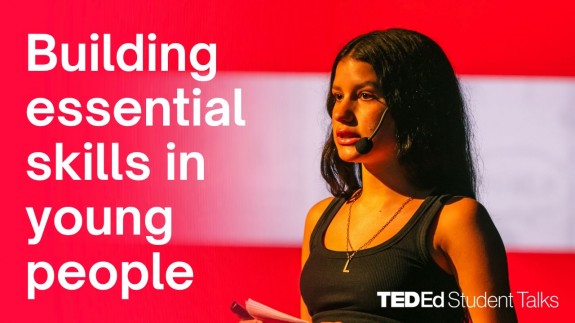
“Xixi Wang In a world increasingly shaped by AI, the skills it can’t replicate — like communicating, collaborating, and connecting — are more valuable than ever. The Future of Jobs Report (2025), published by the World Economic Forum, ranks skills like empathy, communication, and leadership among the most critical for the future workforce. Yet these skills are also some of the hardest to teach in a traditional classroom setting. That’s where TED-Ed Student Talks comes in. The program gives students ages 6 to 18 a structured, supportive space to start building these essential skills now. Through guided activities, students discover ideas that matter to them, develop those ideas through shared conversation and feedback, and learn how to effectively share them with each other and the world. Recently, we asked some of our student speakers to reflect on the skills they built through the program — ones that go far beyond a single moment on stage. Fostering Empathy Empathy isn’t a fixed trait — it’s a skill that can be developed and built. When people practice sharing their own stories and listening to others’ , they develop stronger empathy and a deeper understanding of perspectives different from their own. Through Student Talks, students have the opportunity to share something deeply personal and to listen to others, which fosters empathy and connection with their classmates, educators, and audience members. For Shrutarjo Ray, the experience revealed what happens when you share an idea out loud. “Student Talks showed me that ideas get life when they are shared,” he says. “I’ve realized that even a simple, meaningful story can spark connection, build courage, and change the perspective of the audience.” Wong Kean Jee discovered something similar from the listener’s side. “When we share, we realize we’re not alone, and other people may also relate to what we’re going through,” he reflects. “Everyone has different experiences worth listening to. Every person you talk to can teach you something new or give you a different perspective.” Lia Costa presented about her cousin’s experience with Autism Spectrum Disorder, weaving his story and his drawings into her talk. “When I present my cousin’s story, I hope that people will open their eyes to see stories and lives that they wouldn’t notice on a daily basis,” she says. “Most of my audience does not have this disability, but most know someone who does. They will be able to rethink the way they treat these individuals and hopefully act more compassionately toward them.” Lia Costa Communicating Complex Ideas Communication is more than speaking clearly. It’s the ability to translate complex thoughts, emotions, and insights into something an audience can understand and connect with. Communication skills are consistently ranked by employers as one of the most important qualities they look for in candidates. Whether it’s scientific research or a solution to a problem, Student Talks helps students learn to communicate complex ideas thoughtfully and confidently, a skill that is essential for their personal, academic, and professional success. Owen Hawthorne came into the program with a topic many adults would find intimidating: CRISPR and genetic editing as an alternative to chemotherapy. And his goal was just as ambitious. To inspire hope. He wanted to help people see “a really cool and interesting approach to cancer treatment” and walk away more hopeful than before, or even be moved to contribute to the research. Lareen Abdelwahed faced a different kind of challenge: turning private, tangled emotions into something an audience could understand and feel. “My favorite part of Student Talks was the process of putting my thoughts together and turning something I’ve always felt but never really said into a talk,” she says. “It was honestly hard at first because I had to really sit with my experiences instead of just brushing them off like I usually do, [...] it felt good to take something personal and shape it into something I could share in a clear way, instead of just leaving it stuck in my head.” Kira Aryslanova saw her communication skills shift in a concrete way too. “Before this, I might have focused too much on facts,” she says. “Through this process, I learned how to combine storytelling, data, and questions to make people think. This skill will help me not only in public speaking, but in any situation where I need to influence or inspire others.” Lareen Abdelwahed Advocating for Change Young people are often told their voices matter, but are rarely given a real platform to use them. Studies on youth civic engagement show that when students are given meaningful opportunities to speak on issues they care about (and are taken seriously when they do), they develop a stronger sense of agency and a lasting commitment to making a difference. Student Talks gives students the structure and confidence to shape their passions into powerful talks with the potential to change how others think, feel, and act. Kira Aryslanova’s talk on language monopoly was a call to action. “I wanted to give my audience a new way of seeing language, as something much deeper,” she mentions. “I hoped people would start questioning the idea that English is ‘enough’ and realize that every language carries its own worldview, culture, and identity.” She wanted her audience to leave with curiosity, “maybe even a little discomfort,” and ask themselves what they might be missing by limiting themselves to just one language. For Arush P, Student Talks transformed his relationship to a cause he has cared about since the fifth grade. “I feel most proud of discovering the resonance of my own voice as I became an advocate for the ‘unheard,’ the environment itself. I think I am no longer just a student but a speaker for our planet’s survival,” he says. “It taught me that an idea, when shared, ceases to be a private concern and becomes a catalyst for collective resilience.” Malak Youssef spoke about inner self-talk, and gave her audience permission to stop labeling themselves negatively for traits that might actually be strengths. Her reflection captures something at the heart of Student Talks: “Your voice doesn’t have to be loud to be powerful. It just has to be honest. When you speak about something you genuinely care about, people feel it. And sometimes, that’s enough to make them think differently.” Malak Youssef Looking Ahead Students come into the program with different backgrounds, skill sets, and goals. They leave with the conviction that their unique perspective matters, and importantly, the skills to share it effectively. Whether they’re opening up about a personal struggle, translating complex science for an entire audience, or speaking up for a cause they believe in, these are the skills that will nurture their personal, academic, and professional growth now and in the future. TED-Ed Student Talks offers free, customizable activities for educators who work with students ages 6-18 in classrooms, schools, extracurricular settings and youth organizations. Submit an application to join today !
Original story
Continue reading at TED-Ed Blog
blog.ed.ted.com
Summary generated from the RSS feed of TED-Ed Blog. All article rights belong to the original publisher. Click through to read the full piece on blog.ed.ted.com.
