
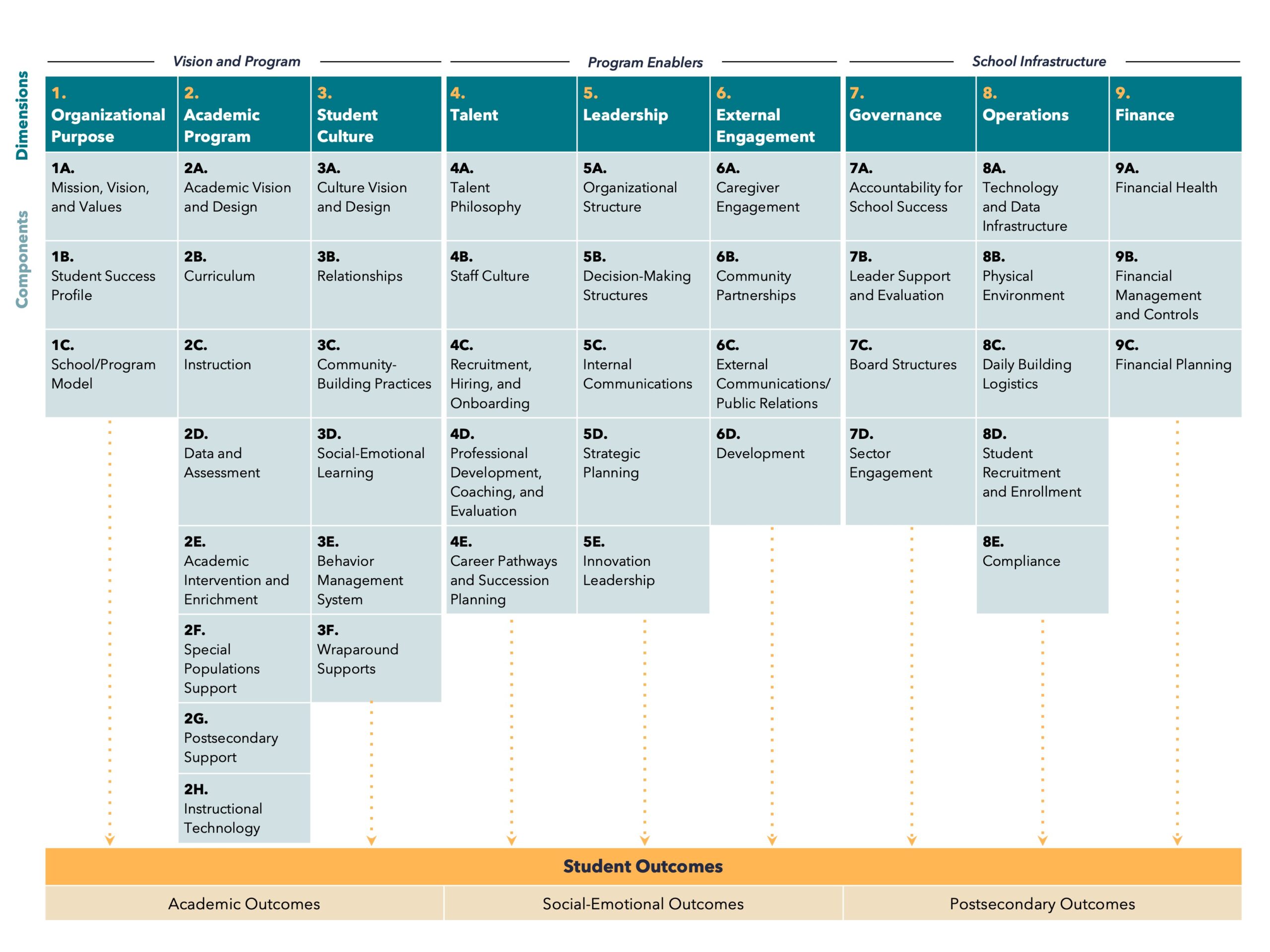
“This is the fifth post in a series on Bellwether’s School Quality Framework , highlighting schools and systems that exemplify key components of the recently redesigned resource. Bellwether’s School Quality Framework (SQF) defines nine dimensions of school excellence — from academics to student culture to operations — and breaks them down into clear, actionable components for schools and school leaders. Bellwether’s School Quality Framework (click to enlarge) Each element of the SQF enables school, district, and network leaders to implement their school’s program in a sustainable way to deliver on their promise to students and families. Underpinning much of that work is sound financial planning and the overall health and sustainability it creates for a school to consider growing its model to serve more students. As public funding streams like federal Charter Schools Program (CSP) grants continue to fuel expansion in states across the country, the real differentiator isn’t just opening more schools — it’s building leaders and systems capable of scaling quality responsibly, with the financial discipline to sustain growth. However, the prospect of scaling up to serve more students often comes with a range of unanticipated challenges and pressures for many school and network leaders and their boards. Some pursue expansion without a viable financial model or with weak pre-planning elements that inhibit growth and require fixing mistakes to get back on track. Others can be constrained by the very strengths that have driven their success — strong academic outcomes and a solid financial footing — which often foster a more cautious approach to expansion and risk-taking. High-quality school growth is not only about replication and access to funding but also about integrated program design, facilities strategy, and rigorous financial planning from the start. Bellwether’s SQF guides school leaders through these critical growth phases by treating them as a unified, cross-functional effort — one that combines cohort support, operational feasibility, and finance — to ensure that replication and growth are mission-aligned, sustainable, and clear-eyed about trade-offs. Dimensions 7 and 9 of the SQF provide a practical framework for school leaders to grow thoughtfully and responsibly to serve more students with good governance and sound financial planning and practices in mind. Component 7A brings the board in on key strategic decision-making for their school or network; sets clear metrics for academic, operational, and financial success along the way; and creates clear lanes of accountability. Component 9A gives leaders a clearer picture of their school or network’s financial standing — examining metrics such as cash on hand, operating margins, and debt levels to assess current health. Component 9C is forward-looking and forecasts scenario planning, scrutinizes assumptions, and sets a foundation for school leaders to both anticipate and make proactive, informed decisions. Collectively, these SQF components equip school leaders to make financial decisions that sustain their school and serve their students well. Component 7A. Accountability for School Success Component 9A. Financial Health Component 9C. Financial Planning To set school leaders up for successful growth planning, Bellwether often partners with education champions — intermediary organizations that provide resources and funding to help school leaders and boards consider a range of strategic decisions — as we prepare them for growth. It sounds simple enough. But what does this process look like in practice? A set of three case studies illustrates how these components of the SQF come together to support expansion and growth in school communities across the country, bolstered by education champion partnerships. From a single-site charter in the Southwest looking to grow its high-quality model to a K-12 network in the South navigating a facilities deal that created long-term risk to an established high-performing network in a major Southern city looking to pressure-test their expansion approach, Bellwether’s SQF provided the strategic governance and financial planning necessary to carry each entity through a range of growth opportunities and challenges. Case Study #1: A single-site charter high school explored opening a middle school SCHOOL OVERVIEW A well-established single-site charter high school in the Southwest served approximately 435 students across a major metropolitan area. With its track record of strong academic outcomes and sustained demand, the school often carried a waitlist. Leadership saw an opportunity to expand its impact by launching a middle school to increase early access, strengthen student readiness, and build a stronger pipeline into its high school. This expansion planning arose amid a statewide shift in the K-12 formula with funding weight changes that would decrease schools’ per-pupil funding. School leadership had a clear impact plan, defined risk mitigation strategies, and active support from both a local education champion and national funders, giving them confidence that the time was right to expand. CONTEXT AND OPPORTUNITY School leaders planned a phased middle school launch in a new facility adjacent to their existing campus. While facilities planning was underway, program design, staffing, and financial assumptions had largely been developed separately, which limited visibility into what high-quality growth would require. Leadership needed to understand what the program would require as the school scaled, and whether expansion was financially sustainable. Expansion also demanded alignment among leadership, the board, and their supporting education champion around investment needs and timing. What’s more, belt-tightening at the state level added urgency to plan for sustainable growth. RESULTS In partnership with a statewide education champion, Bellwether built a growth financial model that tested the school’s program assumptions in tandem with its financial feasibility. Our team’s work helped shift the school’s planning from facilities viability alone to an integrated growth plan across program, staffing, and finance. In the process, we helped leadership determine how many new teaching positions to phase in each year and how to align those hires to the school’s program model as it expanded. And we also supported alignment across leadership, board, and the education champion organization on investment needs and trade-offs, including short-term investments to bridge the transition. The growth financial model planning ultimately enabled the school to expand to serve middle school students in the community, with enrollment open for sixth graders in fall 2026. KEY TAKEAWAYS Expansion often requires thoughtful resource trade-offs, particularly when schools have limited reserves. Alignment among internal leadership, board members, and external partners is critical to balance financial cushion with one-time investments that set up long-term quality and sustainability. Facilities loan feasibility alone is important but not sufficient. High-quality growth requires testing program design, staffing, and operational assumptions alongside financial planning. Case Study #2: A K-12 charter school navigated financial pressures from expansion into a new facility amid leadership and board transitions SCHOOL OVERVIEW A K-12 language immersion charter school in the South had historically strong enrollment in its urban community. School leadership pursued a new high school facility to support long-term growth and program expansion. The expansion, however, came amid leadership and board transitions, leaving school leaders stretched thin. CONTEXT AND OPPORTUNITY A local education champion partnered with Bellwether and the school to help address its emerging financial pressures. The school’s leaders had some awareness of the risks, but the facility deal moved quickly and justifications accumulated along the way. No single decision felt unreasonable in the moment, but school leadership and the board did not consider the full weight of the future obligations, making it difficult for them to fully assess the long-term trade-offs between facilities investments and program sustainability. At the same time, the school faced rising staffing and transportation costs, stagnant enrollment, and increased competition in a shrinking charter sector. Uncertainty around state and local funding added additional pressure. Stakeholders understood that challenges were emerging, but there was no shared understanding of the full magnitude. Without intervention, the school was projected to face a cumulative $1.5 million financial gap over four years, growing to an annual gap of roughly $700,000 — 5% of its operating revenue — by year four. Debt service costs alone were projected to increase by over 25%, with refinancing needs on the horizon that would be difficult to execute for a school in a weakening financial position. Perhaps most striking, projected days of cash on hand were on track to fall below 15 days from a high of 170+ just two years prior. No one had visibility into how all of these pieces fit together or their combined impact until Bellwether brought them into a single, unified view. While no one wants to decrease staff, cut back on transportation, or downsize a facility, there was no path to financial sustainability without making a change in one of these key areas. School leadership lacked a clear framework for prioritizing costs and making these tough financial and programmatic decisions. Each of these factors contributed to school leaders not having a clear, shared understanding of their financial picture. Without a unified view of its bottom line, the school’s long-term planning began to drift out of alignment with its near-term financial commitments. RESULTS Bellwether worked with leadership and the bo ard to build a clear picture of the school’s financial outlook. This process included developing a long-term financial projection that brought together facilities obligations, staffing costs, and enrollment assumptions into one view. For the first time, stakeholders could see the full magnitude and timing of the financial challenges ahead. Our team also analyzed spending relative to peer schools using public data to help provide context on cost structures and identify where trade-offs might be needed. This helped leadership and the board begin to prioritize — identifying what was most critical to preserve and where adjustments could be made. Alongside this analysis, we supported alignment between school leadership and the board around the urgency of the situation and the need for coordinated action. With a shared understanding, school leadership was better positioned to communicate with staff and families about the financial realities and the need for change. Ultimately, the board approved near-term cost reductions to stabilize finances. In the months after the project, the school also began exploring longer-term facilities adjustments to move toward a more sustainable financial path to better serve its school community. KEY TAKEAWAYS Education champions play a critical role in raising sectorwide trends and emerging challenges, but translating those trends into concrete actions for school leaders is equally important. In this case, signals of sector contraction and financial pressure required timely action. But the scarcity of time means data alone is insufficient without clear action steps. Education champions serve as strong partners by providing information and thought leadership that help school leaders identify and prioritize timely actions. Strong board and leadership alignment is essential when making financial trade-offs. A unified voice grounded in shared understanding of the financial picture helps school leaders communicate changes clearly and navigate difficult decisions. When a facilities deal moves quickly, the full picture of long-term obligations can get lost in the momentum. Building in structured pause points to assess total future costs before commitments are made helps ensure that individually reasonable decisions don’t collectively create unsustainable risk. Breaking out of year-to-year budgeting is critical. Some financial challenges take time to address, and without multiyear visibility, schools risk making short-term decisions that significantly impact the program or delay action until options become limited. Facilities and programmatic financial decisions require school leaders to take a long-term view and be disciplined about ongoing costs to achieve stability. With full context and a clear understanding of obligations and risks, including how spending compares to peers, leaders can make more thoughtful trade-offs and deliberate choices aligned to strategic priorities. Although unexpected staffing changes can complicate this work, they underscore the importance of planning ahead to avoid overextending on costs that could negatively affect the academic program. Case Study #3: A high-performing charter network looked to strengthen its financial practices and grow with sustainability in mind SCHOOL OVERVIEW A high-performing charter network in the South had expanded in recent years, adding two campuses and continuing to grow, amid strong academic outcomes and enrollment demand across all three schools. Like many growing networks, each urban campus served different communities within a city and faced different operating conditions, including varying facilities costs and student needs. CONTEXT AND OPPORTUNITY Leadership and its education champion partner engaged Bellwether for an exploratory project to strengthen financial practices and identify opportunities to support sustainable growth. Although the network’s leaders already had a strong handle on finances, they wanted to get even better. Bellwether stepped in to pressure-test their approach before additional growth occurred. Our team’s early analysis focused on per-student costs across the three schools, which revealed meaningful differences in how resources were allocated. Facilities costs varied significantly across campuses, leaving different levels of funding available for programmatic investments. These differences had implications for student experience and program supports, but had not previously been discussed in a structured way. The network’s leaders faced a big strategic question: How could they provide an equitable student experience across schools while accounting for differences in costs, student needs, and growth stages? RESULTS Bellwether set out to answer that question by conducting a per-student cost analysis across the three schools, which helped illuminate how facilities costs and other structural differences shaped program resources at each campus. While leadership understood some of these differences, the analysis created a clearer, shared understanding of how they affected program delivery and student supports. This triggered a series of conversations with network leadership, including the executive director and CFO, about how to balance twin realities. Each school had different unit economics, but the network was committed to providing a consistent and equitable level of support for all students. These tough conversations surfaced trade-offs around resource allocation, growth timelines, and differences in student populations. Through this work, the network began to more intentionally align central resources and school-level budgets with both equity goals and financial sustainability. The conversations led to several concrete decisions, including the establishment of a shared model for program support staff, special education, interventionists, and instructional coaching. These resources are now allocated across schools using consistent ratios, regardless of each campus’s cost structures. The network also committed to addressing remaining disparities in facilities and other structural costs over time. Ultimately, the project helped leadership move from implicit assumptions to more explicit, strategic decisions about how resources should be distributed across schools. KEY TAKEAWAYS As networks grow, differences in facilities costs, student needs, and growth timelines can create meaningful variation in campus-level resources. Per-student cost analyses can help make these differences visible and support more intentional decision-making. Networks often need to balance two truths: School-level unit economics may differ, while the goal of providing equitable student experiences remains consistent. Central leadership plays a key role in navigating trade-offs and aligning resource allocation with both equity and sustainability. It’s important not to overlook high-performing schools and networks, which also benefit from this type of open financial analysis. Strong enrollment and financial performance can mask opportunities to better align resources with program priorities that center students. Because these schools already have a solid foundation, targeted support can unlock their ability to better serve all students and expand impact relatively quickly, making them especially high-leverage opportunities for education champions’ support. It’s often easier to move a good school to great with the right support. Education champions can play an important intermediary role in supporting strong schools to get even better. Because finance is often siloed, an external perspective can help surface opportunities for school or network leaders to strengthen resource alignment, sustainability, and long-term growth. As high-quality charter schools and networks consider growth planning, long-term sustainability often comes from strong governance and finance alignment that third-party education champions and nonprofits like Bellwether can provide. Bellwether’s unique value lies in our team’s deep expertise across program, governance, and finance — and in understanding how the intersection of all three drives sustainability, organizational health, and responsible growth. An outsider’s perspective can surface opportunities for schools to get stronger, be more aligned, and be better equipped to grow when the time and financial circumstances are right. These case studies underscore that successful expansion isn’t driven by a single decision or resource, but by a leadership team’s ability to bring their school’s or network’s program, operations, governance, and finance into alignment at critical moments. When school leaders and boards have a clear view of trade-offs, shared accountability, and the financial discipline to plan ahead, they’re better positioned to grow with fidelity to their mission and deliver for students and families. To learn more about Bellwether’s School Quality Framework, reach out to Bill Durbin at bill.durbin@bellwether.org or Anson Jackson at anson.jackson@bellwether.org . The post How to Plan School Growth: A Cross-Functional Approach to Sustainable Expansion appeared first on Bellwether .
Original story
Continue reading at Bellwether
bellwether.org
Summary generated from the RSS feed of Bellwether. All article rights belong to the original publisher. Click through to read the full piece on bellwether.org.