
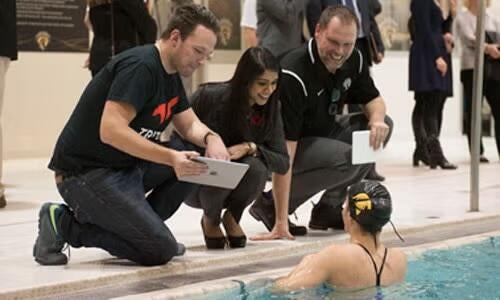
“Share From professional training and injury prevention to health care and human performance, these startups and research projects are using sport as a launchpad for technologies with global impact Sport continues to be one of the most effective proving grounds for technology that can scale into health care, defence and human performance. At the University of Waterloo, student projects and research-driven ideas are serving as a foundation for sport tech startups. With the support of the University’s entrepreneurial ecosystem, including its flagship incubator Velocity, these companies are each demonstrating how performance innovation at Waterloo travels far beyond the game. During Toronto Tech Week (May 25 to 29, 2026), Velocity is hosting a sport tech and human performance event at Left Field Brewery, bringing together Waterloo founders, investors and industry leaders to explore how performance-driven technologies extend beyond the game. Powering modern hospitality Register now Here are a sample of Waterloo founded sports tech companies and research: Trajekt Sports What they do: AI powered baseball pitching simulation Founded by: Joshua Pope (BASc ’19) Rowan Ferrabee (BASc ’19) Watch video on YouTube Trajekt Sports was founded while Pope and Ferrabee were engineering students at Waterloo. Their robotic pitching system recreates the velocity, spin and visual cues of professional pitchers, allowing batters to train against precise real-world conditions. Developed with support from Velocity, Trajekt is now used by dozens of professional baseball teams worldwide, including the Toronto Blue Jays. While built for elite sport, the underlying robotics and simulation technology has broader implications for training systems and human-machine interaction beyond athletics. TritonWear What they do: Wearable performance analytics for competitive swimming Founded by: Tristan Lehari (BASc ’11) Darius Gai (BASc ’11) (Right to Left) TritonWear co-founder and CEO Tristan Lehari, Minister of Small Business and Tourism Bardish Chagger, and Warrior Head Coach Jeff Slater TritonWear develops wearable technology and analytics for competitive swimming, providing real-time performance data that helps swimmers and coaches optimize training and race strategy. The company’s small, goggle-mounted devices capture metrics such as stroke rate, splits, turns and distance per stroke, transmitting data instantly to poolside tablets for immediate feedback. The company developed the early prototypes while Lehari captained the University of Waterloo varsity swim team. TritonWear emerged from research and testing conducted at Waterloo and received early support through Velocity, scaling from pilot trials in the campus pool to adoption by elite teams worldwide. TritonWear has been used by athletes in more than 60 countries, including Olympians and national team swimmers. HeadFirst What they do: Rapid, objective concussion detection Founded by: Andrew Cordssen-David (BSc ’22, MBET ’23) Dr. Shazia Tanvir, professor of chemical engineering Watch video on YouTube HeadFirst is developing a saliva-based concussion screening test that delivers results within minutes at the point of care. The goal is to remove subjectivity from concussion diagnosis, particularly in contact sports. Working alongside University researchers, Cordssen-David founded the company while completing graduate studies at Waterloo. While piloted in athletic settings, the technology has potential uses in emergency response, military health and clinical care. PitcherNet What they do: AI-based biomechanics analysis for baseball pitching Developed by: Dr. John Zelek (BASc ’85), professor of systems design engineering Jerrin Bright (MASc ’24, PhD in progress) PitcherNet is an artificial intelligence system developed at Waterloo’s Vision and Image Processing (VIP) Lab. The system analyzes baseball pitching mechanics by converting low-resolution video into a two-dimensional pose model and then extrapolating three-dimensional biomechanical data, including pitch velocity, release point and joint motion. The project was created in partnership with Major League Baseball’s Baltimore Orioles, who sought a way to evaluate pitchers during away games, minor league contests and scouting sessions where high-end camera systems such as HawkEye are unavailable. While PitcherNet is currently a research-driven collaboration rather than a standalone commercial startup, it represents a clear example of how Waterloo’s strengths in computer vision, AI and human-motion analysis are being applied directly to elite sport, with potential move into commercialization and performance platforms. Strivonix What they do: Wearable compression therapy and recovery technology Founded by: Jordan Savage (BASc ’22, MASc ’24) Caleb Horst (BASc ’02, MASc ’04), cofounder and CEO (Right to Left) TritonWear co-founder Jordan Savage works in the lab with and co-founder and CEO Caleb Horst Strivonix applies research in soft robotics and microfluidics to wearable recovery garments designed for athletes and medical users. Its compression systems deliver therapeutic benefits while allowing mobility during use. Savage developed the core technology as a Waterloo graduate student, and the company has grown with support from Velocity and WatCo, the University’s IP and commercialization services. Strivonix sits at the intersection of sport performance, rehabilitation and long-term mobility care. Sport generates dense, high-stakes performance data under real-world pressure. At Waterloo, founders use that environment as a starting point, not an endpoint, to align with many other sectors. At the elite or professional level, sport serves as a testbed for innovation in health and human performance. Therefore, it makes sense that sport tech is often the gateway for the applications of companies to support health care, defence and human performance. Sport technology is also part of a larger innovation story unfolding across the Toronto-Waterloo Corridor. The Waterloo alum helping power the Blue Jays Build what you believe in at Velocity Designing the Future of Sports Fan Engagement With 5G Engineering Science Entrepreneurship Global Futures Health Futures Technological Futures Share
Original story
Continue reading at University of Waterloo News
uwaterloo.ca/news
Summary generated from the RSS feed of University of Waterloo News. All article rights belong to the original publisher. Click through to read the full piece on uwaterloo.ca/news.

