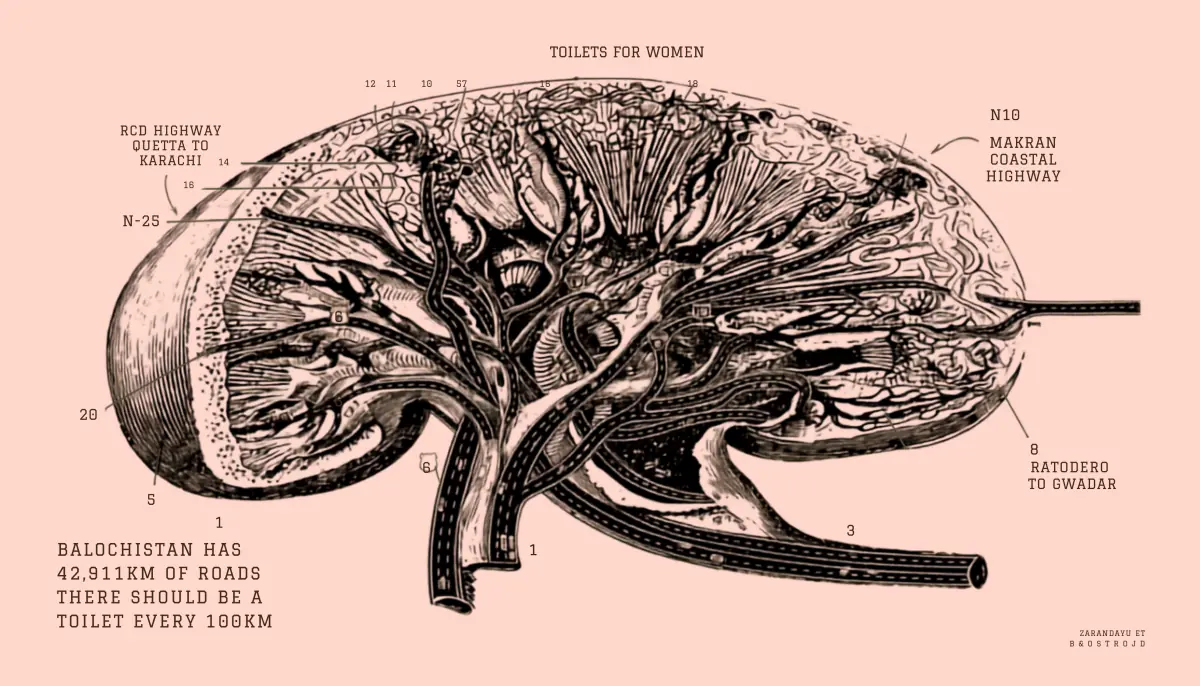
“The bus lurched to a halt on the long, dry highway that takes you from Gwadar to Turbat. A clutch of men jumped out and sprinted towards the makeshift bathroom by the road. Some of them scattered into the bushes. Back in the bus, anchored to their seats, women stared out of the windows stiffly. They must have done the math before boarding: drink enough water to bear the heat, but not so much that you need to empty your bladder. Gwadar to Turbat is a short two hours. But it is eight long ones if you are heading to Karachi. A washroom on the Makran Coastal Highway between Turbat and Gwadar Balochistan’s new and smooth highways are praised as corridors of connectivity and trade and promise progress for a place that has long been politically and geographically distant from the rest of Pakistan. Motorway 8 goes from Ratodero to Gwadar, the N-10 runs along the Makran coast, the N-25 RCD Highway connects Quetta to Karachi and the N-40 that meanders towards the Iran border from Quetta to Taftan. But the praise for this network does not make up for the lack of safe and accessible public bathrooms for hundreds of kilometers. Where you do find one, it is rudimentary at best, a hole in the ground, a door that won’t close or lock and almost never any running water. To make matters worse, the women’s toilets are usually located in male-dominated spaces, such as roadside motels, dhabas, and bus stops. In Surab, washrooms are attached to the mosques and are strictly off limits for women. This neglect is now being challenged in court by Kulsoom Baloch, Fauzia Shaheen and Dr Quratulain Bakhtiari. They filed a complaint in the Balochistan High Court, arguing that the highways are deliberately designed to prioritise the cold mechanics of commerce at the expense of human safety, accessibility and equity. They said that the long stretch between Mastung and Kalat is the worst affected. There isn’t a single restroom for women when you travel from Quetta to Makran through Kalat and Mastung. The Karachi to Quetta-Chaman N-25 Highway is being widened into a double carriageway but toilets for women are missing from the plan. The government has to provide sanitation which is a constitutional right as Article 9 guarantees the right to life and dignity, 14 protects the dignity of the people and privacy at home, and 15 ensures the right to movement. “Men are socially free,” says Kulsoom. “They can go anywhere for nature’s call. Women are restricted socially and culturally, and their biological needs are different.” Unusable washrooms in Ormara and Gwadar Fatima, 46, describes one of her experiences. She was travelling from Turbat to Karachi for eye surgery with her husband and daughter. The bus had been on the road for a couple of hours until it stopped near a roadside hotel in Ormara. Ormara, located in Gwadar along the Makran Coastal Highway, is often the first and only major stop for buses travelling from Turbat and Gwadar to Karachi. During this journey, the first stop is usually this deserted hotel in Ormara, where bus drivers and conductors often receive free meals in exchange for bringing passengers. There were four bathrooms, supposedly for men and women both, and all of them were broken, dirty, and without door locks. She entered the dingy bathroom but her eyes kept darting towards the ajar door. Her daughter came to the rescue. “She held the door while I was inside … we had no other choice,” she says. “There’s a lingering fear that men nearby can see you. It feels humiliating.” At Gwadar’s Zero Point, which is about 90km from Hub town, there are two bathrooms, but both are unusable. “When the vehicle stops for security checks,” says Kulsoom, “women looking to use a bathroom are told to, ‘go as far as you can’.” The story is the same from Yousuf Goth Terminal in Karachi, used by passengers from Balochistan daily, to Khuzdar’s Chamrock Hotel and Restaurant (another bus stop). Dozens of women line up inside warehouses, waiting their turn to use the few available toilets. Women who regularly need to travel fall sick with urinary tract infections, diarrhoea and dehydration. Urologists warn that holding urine for hours on end causes bladder infections and serious kidney problems. In many parts blanket bans on night-time public transport are imposed when there is a threat of violence. Protests, road blockades, security checks and insurgent raids often leave women stranded for hours, if not days. A student, Saadia, was stuck on the M-8 Motorway for two days last year. “We did not have proper food, water or basic facilities. At one point, we walked several kilometres to a nearby bazaar just to use a bathroom,” she says. The only washroom at the Talaar Checkpost, featuring proper signage and running water Saif owns a hotel on the Makran Coastal Highway at Ormara. He handles 15 to 20 buses daily with each bus carrying roughly 400 passengers. This means up to 800 travellers use his 19 bathrooms every single day. “Business is very weak these days, and on top of that, there is a major water issue,” he says. A broken sewerage system and chronic power failures cripple his efforts to maintain hygiene. He tried introducing a Rs10 upkeep fee to pay a dedicated cleaner but most passengers cannot afford to pay even this amount. He appealed to the transport companies to subsidise the maintenance cost as their passengers benefit from the stopovers without contributing towards sanitation. “The buses only stop for meals and then leave. We have spoken to bus operators time and again but they don’t cooperate,“ he says. It would cost around Rs300,000 to Rs400,000 to build good quality bathrooms. The local authorities hardly help small business owners like Saif who they fine instead of assisting with infrastructure grants or water tankers. “The Assistant Commissioner came once and fined me without any prior warning,” says Saif. He ordered him to build a chabutra (a raised platform) in the bathrooms but didn’t offer any financial support. The Balochistan Development Statistics report of 2018-2019 says the province has 42,911 kilometres of roads, with national and provincial highways connecting districts and towns. International highway design guidelines say that key rest areas should be constructed every 80km to 100km, with smaller stop points at every 50km. Washrooms along the route from Quetta to Makran, which lack running water If such designs were applied, the 653km Makran Coastal Highway for instance, would need at least seven rest stops. The 892km M-8 would need eight and the 487km N-85 Surab-Panjgur-Hoshab highway would need five. To pull this off, safe gender-segregated resting areas should be built in towns along these routes such as Awaran, Turbat, Gwadar, Chaghi, Pasni, and Ormara. In more isolated stretches, eco-friendly and water-efficient technologies could be viable alternatives to provide these spaces lighting, clear signage and proper maintenance systems. And infrastructure is only as good as the insight behind it. If women are not included in the designing, the facilities will fall short of their needs. As Kulsoom Baloch says, “True development begins with the basics. In Balochistan, it is always the opposite. Roads are constructed first, celebrated as progress.” No one even thinks of toilets.
Original story
Continue reading at Dawn Pakistan
www.dawn.com
Summary generated from the RSS feed of Dawn Pakistan. All article rights belong to the original publisher. Click through to read the full piece on www.dawn.com.
