
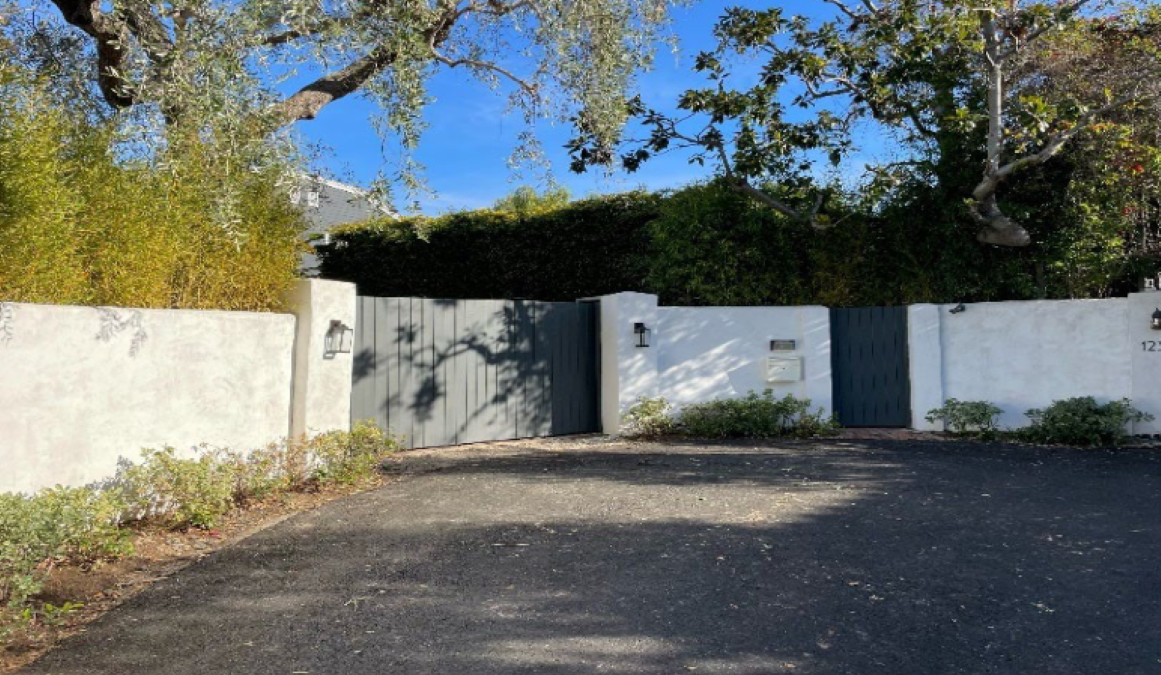
“Property once owned by Marilyn Monroe in Los Angeles. (Pacific Legal Foundation/Latham & Watkins) In Milstein v. City of Los Angeles , an important case currently before a federal court in California, property owners are challenging the use of a historic preservation to block virtually all development on their land. The Pacific Legal Foundation - a public interest law firm that works extensively on constitutional property rights issues - is representing the owners, and has a helpful description of the case (PLF is also my wife's employer, but she is not involved in this case): In April 2026, Pacific Legal Foundation joined a federal lawsuit over a home once owned by Marilyn Monroe. The lawsuit aims to prevent the government from forcing individual property owners to shoulder the financial burden of public historic monuments. The case began in 2023, when a California couple bought an unoccupied, deteriorating property on a dead-end residential street, intending to demolish and redevelop it after purchase. They applied for the appropriate permits, which the City of Los Angeles granted without objection after a standard 30-day hold. One day later, a local government official filed paperwork to designate the property a historic monument. The City then revoked the permits and approved the historic designation, rendering the property untouchable to its new owners, Brinah Milstein and Roy Bank. To justify abruptly declaring the property a public monument, Los Angeles cited a former resident. Marilyn Monroe had owned the home for 157 days before her death in 1962. But few traces of the star remain today because the City ignored the property for over 60 years—without once raising a preservation concern—while 14 successive owners freely renovated both the home and grounds, eradicating any trace of Monroe's time there. The new historical designation prohibited the homeowners from using their own property—even banning repairs to damaged features without the approval of the City's historical commission. It also left the homeowners facing a litany of threats to their safety. Although the City had declared the entire property a public monument, there was no way for the public to access the derelict house within its gates. Undeterred, fans flew drones overhead, trespassers scaled the walls, and burglars broke in hunting for traces of the property's celebrated former tenant. Milstein and Bank tried to work with the City to restore their property rights, offering to personally pay to relocate the home to create an accessible public museum. The City refused, leaving no remedy but the courts. In January 2026, the homeowners filed a federal lawsuit arguing that the City had violated their Fifth Amendment rights by failing to provide them just compensation for turning their property into a public monument, eradicating all viable economic uses for the property, and causing the public to trespass to view the new "monument." Historic preservation laws exist in numerous jurisdictions around the country, and are often used by "NIMBY" activists to block development, thereby preventing construction of affordable housin g, and exacerbating racial segregation . In many cases - including this one - the sites in question actually have little or no genuine historical value . This case is a particularly egregious one because the "monument" designation destroys virtually all the property's economic value, and that site has no genuine historical value, because subsequent owners destroyed virtually all trace of Marilyn Monroe's brief occupation of the house. As the plaintiffs' complaint explains, the former circumstance renders the designation a taking requiring payment of compensation under the Supreme Court's 1992 ruling in Lucas v. South Carolina Coastal Council , which held that regulations that forbid all economically valuable uses of a property automatically qualify as "per se" takings. In addition, as outlined in my article on " The Constitutional Case Against Exclusionary Zoning " (coauthored with Joshua Braver), the property right protected by the Takings Clause of the Fifth Amendment includes the right to use property, which in turn includes the right to build various types of new housing. Thus, most regulations severely restricting housing construction should be considered takings under the original meaning of the Takings Clause, and also from the standpoint of various living Constitution theories of interpretation. I furthered covered the importance of the right to use in this recent book chapter . Hopefully, this case will be the beginning of stronger efforts to enforce constitutional constraints on historic preservation laws. That's essential both to protect the rights of property owners, and to eliminate obstacles to the construction of badly needed new housing in many communities. What about the (comparatively rare) cases where local governments seek to preserve a property with genuinely great historical importance? The answer is they can use eminent domain to take such property, so long as they pay compensation. For example, in United States v. Gettysburg Electric Railway Co. (1896), the Supreme Court ruled that the federal government can use eminent domain to take property in order to preserve the Gettysburg Civil War battlefield. The requirement of paying "just compensation" both helps protect the rights of property owners, and incentivizes government to limit historic preservation mandates to those areas where there really is a great historic value to protect. Gettysburg qualifies, while the property at issue in the Milstein case does. People interested in constitutional property rights and housing policy would do well to keep an eye on this case. The post Important Takings Challenge to Los Angeles Historic Preservation Law "Monument" Designation appeared first on Reason.com .
Original story
Continue reading at Reason
reason.com
Summary generated from the RSS feed of Reason. All article rights belong to the original publisher. Click through to read the full piece on reason.com.


