
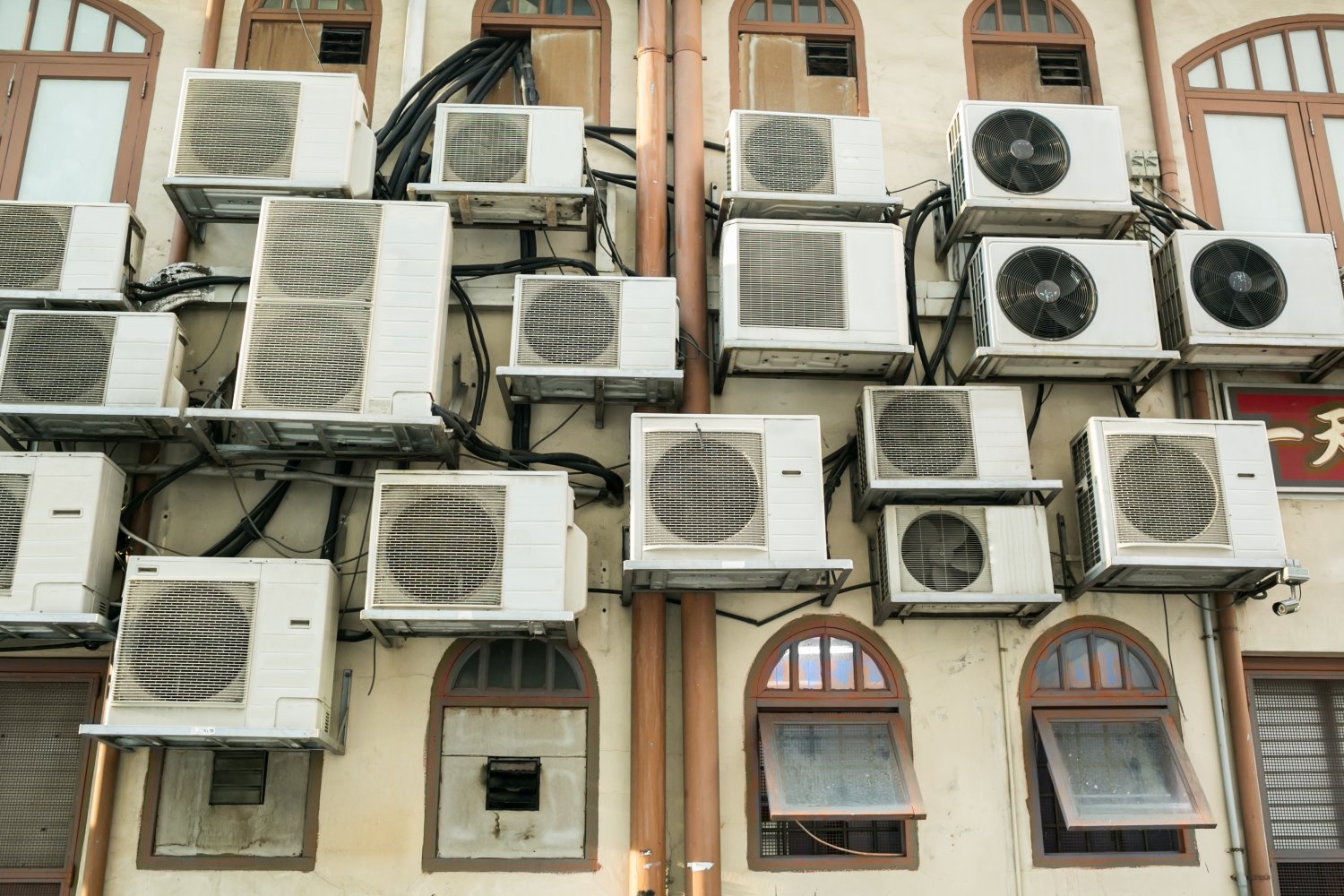
“When MIT mechanical engineering Professor Kripa Varanasi landed in New Delhi in the middle of the night in June 2024 to attend a conference, he found himself in 104-degree Fahrenheit heat. “This was June, and it was crazy. It was so hot for the whole meeting that I never left the hotel,” with daytime temperatures nearing 122 F. It didn’t used to be that way. “When I grew up in India, it was not like this,” Varanasi says. “That kind of inspired me.” He found a way to begin tackling the issue through a grant from the MIT Climate Project that provided seed funding to develop a proof-of-concept prototype of a wearable personal cooling system. The grant was one of four that were part of a Critical Cooling initiative for which the Climate Project requested proposals last year. The projects, which received grants totaling $450,000, are now complete. All have showed promise, and are now exploring ways to further develop their concepts. Another MIT researcher, Yet-Ming Chiang , the Kyocera Professor of Materials Science and Engineering, looked into the potential of subsurface wells with heat-absorbing materials to supply spaces with air far below peak ambient temperatures while using much less energy than evaporation-compression heat pumps. The aim would be to use such systems in both small apartment buildings and single-family homes in India and other parts of the Global South. Meanwhile, Asegun Henry , the George N. Hatsopoulos Professor in Thermodynamics, studied the use of an alternative approach to air conditioning to be more energy efficient and eliminate hydrofluorocarbon refrigerants that are potent greenhouse gases. His approach uses a cheap, widely abundant solid “caloric” material — rubber — to obtain a cooling effect, and then uses plain water as an efficient heat transfer fluid. The initial target market is single-family houses and apartment buildings, although larger systems could also serve data centers. And Gang Chen , the Carl Richard Soderberg Professor of Power Engineering, addressed the tendency of existing air conditioning units being expensive and power hungry. They also use refrigerants that are far more potent greenhouse gases than carbon dioxide — and the coolants are likely to leak out when the devices are ultimately disposed of, adding to their global warming contribution. To help address that, Chen’s approach is to use a completely different kind of chemical refrigerant that has no greenhouse impact. Christoph Reinhart, the Terri and Alan Spoon Professor of Architecture and Climate who leads MIT’s Sustainable Design Lab (SDL), championed the seed fund effort and served as faculty lead. “The term ‘critical cooling’ stems from a collaboration between SDL and Harvard’s Human Rights Entrepreneurs Clinic,” he says. “It is motivated by the fact that climate change increasingly causes heat fatalities, primarily among vulnerable populations, who lack access to active cooling. The impact that MIT can have by ‘cooling people, not spaces’ is enormous.” This vision led to the creation of the grant program, where each of the teams received funding for six months to see what they could do and explore really innovative approaches to the problem. In collaboration with the Abdul Latif Jameel Poverty Action Lab (J-PAL), led on J-PAL’s side by Senior Policy Manager Andre Zollinger, the teams started with a workshop that brought together representatives from the World Bank, leaders from the Global South and industry, and engineers with ideas to suggest. All of the teams made progress and most produced initial prototypes, says Liana Frey, a managing director at the MIT Climate Project, and an effort will be made to further develop and fund these ideas. “We’re continuing to look at different ways of proceeding with the work.” One of these ways is through air conditioning. Worldwide, air conditioning is only available to about 8 percent of people — and that amount already contributes between 3 and 4 percent of global warming emissions — explains Chen. Meanwhile, the need for air conditioning and other ways of addressing extreme heat is steadily growing as the planet steadily warms up, and many of the people who will be most affected live in regions with limited access to reliable or affordable power and with high levels of poverty. The market for air conditioners is expected to triple or quadruple in coming years, he says, and their contribution to global warming will grow accordingly. Chen says that he already had some ideas, but he hadn’t had a chance to test them out in experiments, which the grant enabled him to do. After building three prototypes and testing them out, he says, “I’m not at the stage where I can say that I know this will work.” But based on the experiments, he’d like to proceed to build a further prototype. If it works as well as expected, it would make a dramatic difference in air conditioning technology worldwide, including for the intensive cooling needs of new data centers. Meanwhile, Varanasi’s way of looking at the problem was to consider individuals, not spaces. His devices work through the same principle as how an elephant uses its huge ears to dissipate heat and cool its blood. The wearable device only consumes about 33 watts, he says, whereas a typical room air conditioner consumes around 1,000 watts. At U.S. material prices, the prototype device would cost about $20, he says, but if sourced with local material in India, he estimates it could be produced at a cost of less than $1 each. Such garments could be bought in large quantities by the government and distributed to communities, where local entrepreneurs could set up charging stations to recharge the devices after a night’s wear, and other locals could set up businesses to manufacture the systems. The socks themselves would be washable, separately from the cooling material itself. This could enable people to at least get a good night’s sleep even in the extreme heat, he says. The proof of concept he built used a simulated foot containing a heater, and measured the cooling effect. “We were able to keep it in the zone that we need for the body to stay cool,” he says. “So our initial prototype that we were able to build with this funding showed that this can become a viable solution.” The same material could be used in other ways, such as to make sleeping bags with built-in cooling, he says. The raw material is widely available, but would be treated in a way that they developed. “It was a fundamental science bottleneck that we were able to overcome, which makes it possible.” Varanasi says he is exploring various possibilities for how to develop his novel cooling material into a commercial product. “Ultimately, to make anything work, it has to be a business, otherwise good ideas can die,” he says. “It has to be a good business and a sustainable business.” Luckily, there’s still support for advancing this work. “There are a lot of people interested in this heat-stress question,” says Frey. “It’s just becoming more and more urgent.”
Original story
Continue reading at MIT News
news.mit.edu
Summary generated from the RSS feed of MIT News. All article rights belong to the original publisher. Click through to read the full piece on news.mit.edu.
