
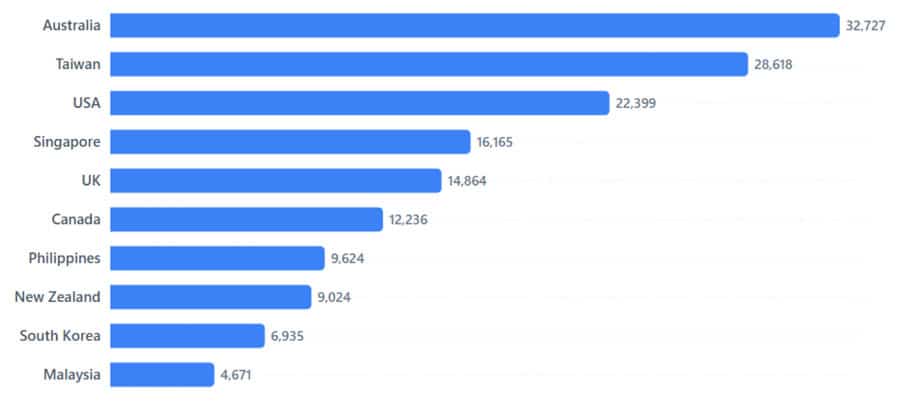
“Nearly 170,000 Japanese students studied abroad using one of 41 service providers in Japan in 2025, with the vast majority choosing to do so via group tours or educational study trips. The data comes from the JAOS Research Institute and is based on a survey in 2025 of 41 of its members. Unlike data from Japan Student Services Organization (JASSO) and the Japanese government (MEXT), which focuses primarily on degree-seeking and/or exchange students, JAOS’s survey broadens the focus to include working professionals and K-12 students. In doing so, it rounds out the JASSO and MEXT numbers for a comprehensive understanding of Japanese student mobility. The government target for outbound mobility is to have 500,000 Japanese students studying abroad by 2033. There has been progress towards this goal, and group-based educational travel – versus individual travel – is the main reason for this. Group travel is on the rise, individual outbound is down Collectively, the 41 service providers surveyed sent 168,930 students abroad in 2025, of whom 138,420 went for “Overseas Educational Travel” (e.g., group tours and study trips). The remainder (30,510) opted for going abroad on their own to study in a language school, participate in a working holiday, or pursue a degree. Two trends emerged in 2025: educational travel is becoming a more popular option in Japan (82% of the market), while significantly fewer students are going abroad for individual studies (-43.5% in 2025 compared with 2024). This decline, says JAOS, is largely due to two reasons: Students no longer have to study abroad to learn English. This has turned into an option rather than a need because the International Baccalaureate (IB) as well as Cambridge International programmes are now widely available in Japanese schools. Dual diploma programmes and foundation courses are now common in the country, and so students can prepare for foreign degrees at home before travelling abroad. JAOS notes: “These options have turned study abroad into a diverse path rather than a simple binary choice of ‘going or staying.’ A younger crowd Students from junior high schools, high schools, and local governments made up 85% of the education travel segment for JAOS member schools in 2025, with the remainder from universities and vocational schools. Top destinations overall Australia is the favoured destination, followed by Taiwan and the US (Chart 1). Significant numbers of students also travel to Singapore, the UK, Canada, the Philippines, New Zealand, South Korea, and Malaysia. Of Australia’s draw, JAOS says: “Australia’s popularity is attributed to the widespread availability of Japanese language education and a school calendar that aligns well with Japanese travel seasons. It is also viewed as a stable and safe English-speaking alternative to the USA amidst policy uncertainties and safety concerns.” The survey also found rising interest in Asian destinations including Taiwan, Singapore, Philippines, and Malaysia. Reasons for this, says JAOS, include “proximity, lower costs, and the availability of English-taught programmes at international branch campuses.” The association adds that students are aware of tightened international student policies in Canada and Australia and of the anti-immigration rhetoric of the current US administration. These conditions are also propelling Asia’s rise in popularity among Japanese students. Chart 1: Top 10 destinations for Japanese students in 2025. Source: JAOS Destination preferences across different market segments For educational travel, there are distinct preferences depending on students’ age (Chart 2). Among younger students – a much larger sample segment than university/vocational students – Taiwan and Australia are where the largest numbers study. University and vocational students are more spread out across destinations for educational travel, with Australia, the UK, and US in the top three positions Chart 2: Top destinations for educational travel, by segment. Source: JAOS As for Japanese students going abroad on their own (Chart 3), most are language students (65%) who enrol in programmes of under three months. The next-largest segment (16%) is also language-focused, but for studies lasting for longer than three months. Just under 9% are high-school students. New Zealand is the main draw for junior high and high-school students participating in private or exchange programmes rather than language-specific programmes, commanding 54.5% of this niche market. Canada and Australia round out the top three, and JAOS says all three countries have good reputations for providing strong student supports – which is of course very important for younger students. Chart 3: Purposes of Japanese students going abroad (excluding group travel). Source: JAOS Other factors influencing Japanese student mobility Affordability is ever-more a concern in Japan. The yen has been weak against the US dollar for months, making travel to many destinations more expensive. And, as in Europe, Japan is facing inflationary pressures due to the US–Israel/Iran war and its effect on oil supply and prices. Costs are rising, household purchasing power is eroding, and consumer confidence is fragile. More affordable Asian and EU destinations are increasingly appealing in this context. Students also have more reason than ever to remain in Japan for university studies. Japan has an exceptionally low youth unemployment rate (3.9% in 2025), thanks in large part to its rapidly ageing population. This demographic shift is the main reason that young Japanese have excellent job prospects right out of university, in contrast to recent graduates in many other countries. There are widespread skills shortages across the Japanese economy, creating a strong position for young Japanese graduates to not only to land a desirable job, but also to negotiate salaries and positions. Despite these trends, there is enduring motivation for Japanese students to go abroad both for English-language and degree studies. Speaking with the Japan Times last year, Tatsuhiko Hoshino, an international relations officer at (JAOS) said: “Many Japanese people feel both admiration and a sense of inferiority when it comes to acquiring English proficiency. They keenly recognize that studying English domestically does not sufficiently build their language skills, and as a result, they are strongly motivated to improve their English through studying abroad.” This suggests that if Japanese students have the option of study abroad for English in particular, they prefer this to study at home. But price sensitivity is increasing due to foreign currency issues and the conflict in the Middle East. Understanding which prospects have become more influenced by the costs of studying and living abroad will be key to remaining competitive in Japan. For additional background, please see: “ Japan surpassed its foreign enrolment target of 400,000 in 2025 ” “ Japanese outbound numbers reached 90% of pre-pandemic levels in 2024 ” The post Japan: Greater availability of in-country English programmes is exerting some downward pressure on outbound mobility appeared first on ICEF Monitor - Market intelligence for international student recruitment .
Original story
Continue reading at ICEF Monitor
monitor.icef.com
Summary generated from the RSS feed of ICEF Monitor. All article rights belong to the original publisher. Click through to read the full piece on monitor.icef.com.

