
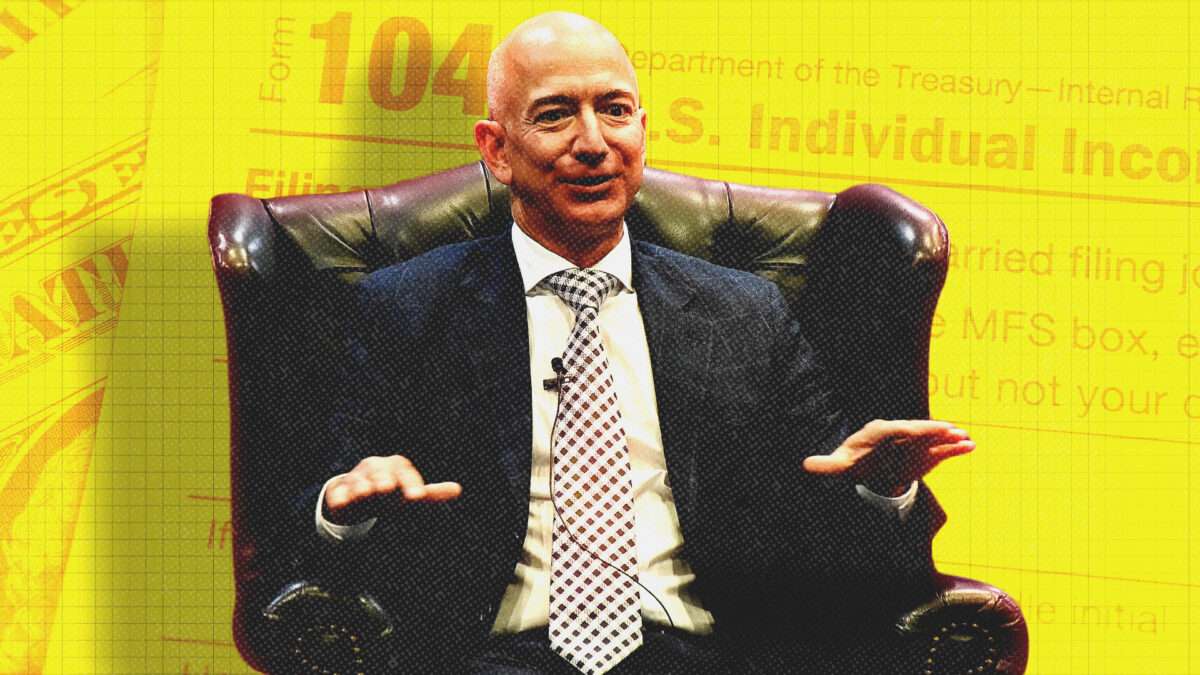
“In a wide-ranging interview on CNBC's Squawk Box on Wednesday, Jeff Bezos, founder of Amazon and the fourth-richest man in the world, disputed claims that solving America's affordability crisis starts with increasing taxes on the wealthiest people in the country. "When you don't know how to solve a problem, create a villain, blame them, but it won't solve the problem," Bezos said , referring to New York City Mayor Zohran Mamdani's pied-à-terre tax proposal. The idea would generate between $340 to $510 million in annual revenue, according to City Comptroller Mark Levine. Bezos also floated the idea of low-income earners paying nothing in individual income tax, which is already the case for about 40 percent of American households (many of which are low-income), according to a 2025 report from the Tax Policy Center. The U.S. tax system is highly progressive. The top 10 percent of earners—households earning more than $228,000—take home 45.7 percent of all income but pay 61.3 percent of all federal taxes, according to the latest available data from the U.S. Treasury. In contrast, the bottom 50 percent of earners collectively pay very little, with the lowest income groups actually receiving more in credits than they pay in taxes. When progressive politicians talk about an unfair tax system, they're ostensibly referencing the difference between one's effective and statutory tax rates. With exemptions, deductions, and credits unequally distributed—even amongst taxpayers with similar incomes—tax liability often boils down to which provision a filer qualifies for. Differing tax rates for capital gains, business profits, mortgage interest, and family size mean that those at either end of the statutory rate can end up with a higher effective tax rate than others in their tax bracket. Taxes such as the estate tax, gift tax, and payroll and corporate taxes are also paid almost entirely by the wealthy, who are more likely to have non-wage income. At the same time, policies like the Child Tax Credit and the Earned Income Tax Credit favor low- and middle-income families. Bezos is right when he says higher taxes on the rich won't solve the affordability crisis; more revenue for the government doesn't mean wiser spending. So far, the federal government has collected $3.32 trillion in FY 2026, a $210 billion increase from the same period last year, according to the latest available data from the U.S. Treasury. With 53 percent of that funding coming from income taxes, it's fair to wonder how the money has been spent. Not well, according to the Government Accountability Office (GAO), which has found about $3 trillion in "improper payments" by the federal government since 2003. In FY 2025, GAO found $186 billion in improper payments, often caused by the government overpaying for services. It was an increase of $24 billion over the prior fiscal year, including $21 billion in improper payments due to the Earned Income Tax Credit. Meanwhile, the Trump administration has waged a war in Iran that has reportedly cost taxpayers over $72 billion in its first 60 days. Framing a tax hike on the wealthy as the solution to rising costs overlooks that the drivers of inflation are often excessive government spending and policy decisions, such as tariffs, that raise production costs while limiting the supply of goods and services. Instead of increasing the burden on wealth-generating taxpayers who already pay their fair share, lawmakers could focus on reducing the size, scope, and pocketbook of a government that continues to waste taxpayer dollars. The post Jeff Bezos Is Right: Taxing Billionaires Won't Solve the Affordability Crisis appeared first on Reason.com .
Original story
Continue reading at Reason
reason.com
Summary generated from the RSS feed of Reason. All article rights belong to the original publisher. Click through to read the full piece on reason.com.