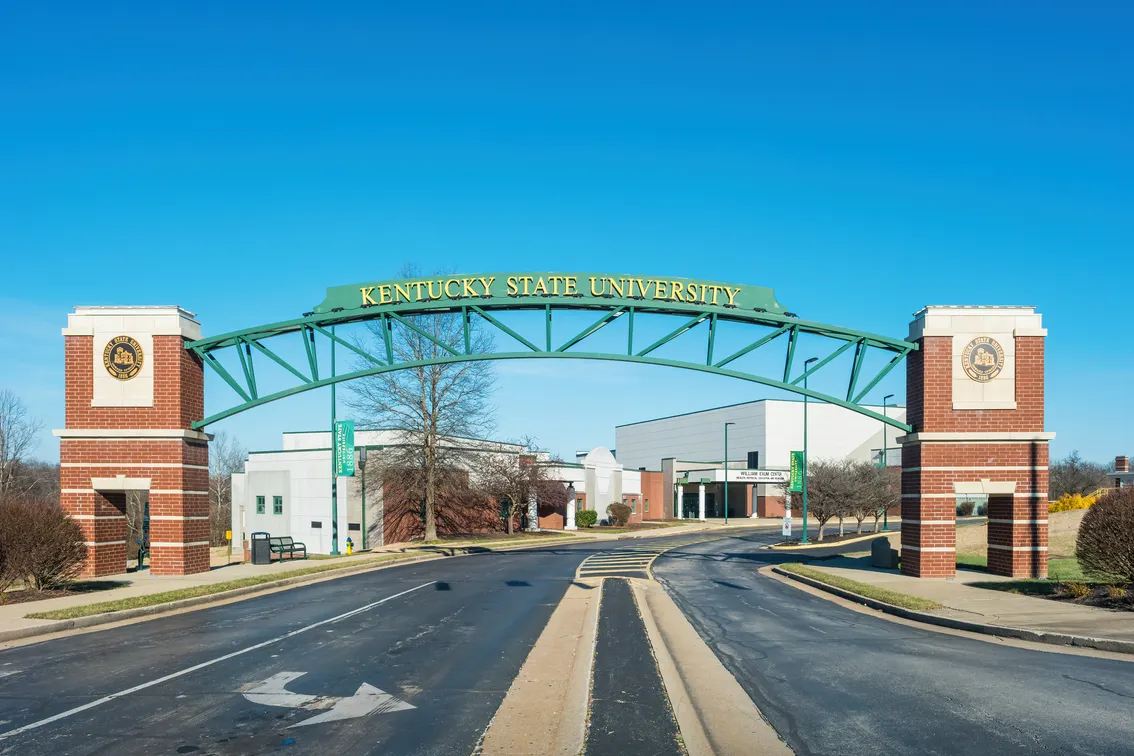
“Dive Brief: Kentucky State University last week moved closer to implementing a state-mandated and legally disputed overhaul of the public historically Black institution that would turn it from a liberal arts university into a polytechnic institution. On Friday, the Kentucky Council on Postsecondary Education approved Kentucky State’s plan to pare back its offerings to 28 programs across six areas of study. The council also approved a request to cut four programs. The restructuring is required by a law enacted in April. Students and alumni sued last month to block the mandated changes, alleging that they violate civil rights law after decades of underinvestment in Kentucky State going back to the segregation era. Dive Insight: Under the plan, Kentucky State’s 28 remaining programs would fit under a narrowed set of study areas, all but one in the STEM fields. Those areas would be: Applied Sciences. Engineering. Health Sciences. Humanities. Natural Sciences. Technology. “These areas will help organize the University’s academic portfolio around highly technical, industry-based applied learning aligned with Kentucky’s workforce needs, while preserving Kentucky State’s historic mission as the Commonwealth’s only public HBCU and an 1890 land-grant university,” the university said. For now, the university has clearance from the council to wind down its programs in music education, music performance, political science, and child development and family studies. Kentucky State said it would provide teach-out plans for affected students. The changes are mandated by SB 185, which requires Kentucky State to declare financial exigency for up to five years — allowing the university president to fire any employee with 30 days’ notice — and to limit its academic areas and programs. As Kentucky State begins its planned transformation, it expects to have a substantially smaller student body next year. Its budget for fiscal year 2027 projects 20% fewer students next spring than this year, Kentucky State President Koffi Akakpo said Friday in a public message. As Akakpo explained, that projection is based on enrollment and persistence data, applications, financial factors , national trends and new restrictions on outstanding student balances that could prevent some students from enrolling. “Let me be clear,” he added. “These are conservative assumptions for budgeting purposes only, not predetermined outcomes. We hope and intend to exceed them.” In the lawsuit filed last month against top state and university officials, plaintiffs asked a federal court to stop any layoffs or program cuts made to comply with SB 185. They pointed to a history of underinvestment in Kentucky State , which was founded in 1886 as part of a segregated higher education system. In 1890, it became one of 19 land-grant HBCUs in the U.S. created under the Second Morrill Act, which directed states to establish such institutions if their existing land-grant universities excluded Black students. Despite multiple federal directives to equitably fund Kentucky State since civil rights legislation passed in the 1960s, Kentucky lawmakers have yet to do so, plaintiffs argued. “Rather than make [Kentucky State] whole, adopt a parity plan, or build a court-reviewable remediation process, Kentucky enacted Senate Bill 185,” the complaint states. Moreover, current and future students could be harmed if “academic breadth, institutional mission, and educational character are narrowed before the Commonwealth remedies the federally identified funding disparities,” according to plaintiffs. State officials, including the Council on Postsecondary Education, have moved to dismiss the case, alleging that the students and alumni lack standing and haven’t shown concrete harm that might befall them under SB 185’s implementation. More broadly, they argued in court documents earlier this month that the bill aimed to save the long-financially troubled Kentucky State after some legislators mulled closing the university entirely. “SB 185 is not, as the Plaintiffs seem to suggest, the final nail in Kentucky State’s coffin,” the state higher education council and other defendants said in court documents . “Instead, it protects and invests in Kentucky State’s wellbeing as the Commonwealth’s only public HBCU.”
Original story
Continue reading at Higher Ed Dive Finance
www.highereddive.com
Summary generated from the RSS feed of Higher Ed Dive Finance. All article rights belong to the original publisher. Click through to read the full piece on www.highereddive.com.


