
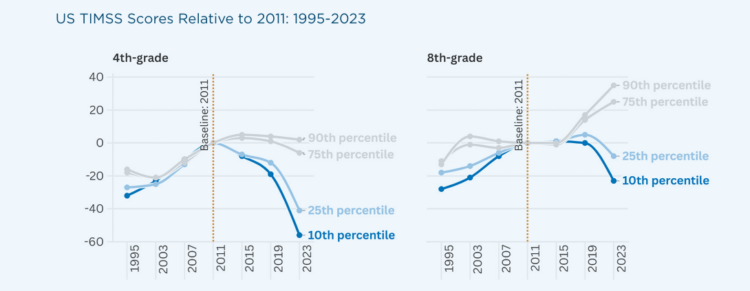
“Almost all states have seen their average K-12 math proficiency rates on the National Assessment of Educational Progress (NAEP) slide downward since 2013, with a pronounced dip in 2022. In addition, gaps across student, income, and percentile groups have widened (figure 1). [1] Drawing a page from their plans to improve literacy rates, leading states have been launching or expanding plans to bolster students’ math learning. Figure 1. Gaps in Math Have Been Widening Since the 2010s “State of the Student 2025: Getting US Students Back on Track in Math” (CRPE, 2025), figure 2, based on data from the Trends in International Math and Science Study (TIMSS), conducted in the US by the National Center for Education Statistics. “There has been such a focus on literacy in our state that I feel like we’ve kind of said, ‘If we get literacy right, then we’ll pick up math next,’ ” said Jennie Earle, member of the Utah State Board of Education. “But I don’t think that’s the right narrative…. The two go hand in hand.” State plans routinely emphasize making math learning more engaging, accessible, and career relevant. Informed by leading research and policy organizations, [2] these plans stress aligning standards better across grade bands, devising effective interventions to catch up struggling students, seeking balance between teaching math procedures and conceptual understanding, and advancing real-world problem-solving and analytic skills across preK-12. Above all, the plans seek to ensure that all students believe they can become proficient and all educators are equipped to teach math effectively. State plans routinely emphasize making math learning more engaging, accessible, and career relevant. Standards Progression and Playing Catchup Focusing on key skills that students have not mastered by sixth grade is more effective for catching them up in grade 7 than a focus on either grade-level algebra alone or repeating all missed skills from grade 6, according to research from nonprofit TNTP. [3] Recognizing this, many state plans are seeking more coherence in the standards across grades so that learning builds more tightly on what came before. North Carolina is one such state. Originally, a chart of the progression of K-12 math standards was intended to guide standards revision, said Charles Aiken, section chief for math, science, and STEM at the North Carolina Department of Public Instruction. Now he hopes the chart will help teachers too. A third grade teacher with students who are not doing well in math, for instance, may struggle to diagnose the difficulty because they do not know which skills and concepts were covered earlier but missed. Aiken added that state law requires every district to have a K-2 math screener, but that each district can choose its own. Thus there is as yet no ability to compare early math assessment results statewide. Both/And State plans often underscore the need for K-12 math instruction to encompass procedural fluency, conceptual understanding, and application in real-world scenarios. No one element comes first. “I think that what we’re trying to convey is it’s not linear necessarily, but it’s more circular,” said Ronda Dawson, executive director of teaching and learning at the Illinois State Board of Education, whose statewide numeracy plan is expected to be completed by June 2026. State plans often underscore the need for K-12 math instruction to encompass procedural fluency, conceptual understanding, and application in real-world scenarios. Balance is key. “What we observed … is that procedural fluency has been neglected,” said Dr. Joshua Michael, state board president, with more weight given to understanding the “why” than to math facts and procedures. Consequently, revised standards in Maryland have in some cases renewed emphasis on systematic instruction in K-8, he said. Teacher Preparation and Training In 2025, the National Council on Teacher Quality noted that only 21 states clearly steer educator preparation programs toward what they should teach in core math content areas. It gave top marks to Alabama, which requires all early childhood and elementary candidates to complete four courses on teaching math effectively. [4] Alabama also invested in math coaching, using federal funding for proof of concept. [5] “A lot of our problem in mathematics has to do with inconsistent Tier 1 instruction,” Michael said. “We have to … teach really well every day in Tier 1. And that requires teachers to know the content. That requires us to have strong instructional materials. That requires strong teaming and developing of math teacher practice.” Louisiana leaders doubled down on professional training in 2023, requiring all grade 4–8 teachers to pass a course developed with the Dana Center at the University of Texas–Austin. Similarly, Texas leaders required K-3 teachers to attend a math academy. Illinois’s latest draft of its numeracy plan stresses the need for high-quality educator and leader preparation and in-service training. [6] “[W]hatever the instructional practice, whatever the curriculum resource, it must be supported by differentiated, targeted professional learning for educators and especially for leaders,” Dawson said. Illinois’s latest draft of its numeracy plan stresses the need for high-quality educator and leader preparation and in-service training. Aiken reported that North Carolina math teachers who reviewed the initial state plan draft expressed nervousness about the added emphasis on statistics and data science and how to prepare to teach those subjects effectively. The question becomes, for Aiken, “once the standards are finalized and I know exactly what’s going to be in what courses, how quickly can we begin to work … to develop teacher classroom-level supports?” Access and Relevance in High School Many US secondary schools maintain traditional course sequences: a single domain every year, beginning with algebra and culminating in calculus. But only an estimated 16 percent of the class of 2019 completed calculus in high school, and even smaller percentages of Black and Hispanic students. [7] For many, Algebra 2 is their last math course, and those who do not take Algebra 1 by grade 8 cannot take advanced coursework in high school. [8] At NASBE’s 2025 annual conference, California state board chair Linda Darling-Hammond noted that in countries whose students are highest achieving in math, content is taught differently than in the US. Rather than segregating math domains such algebra and geometry by year, they teach them in an integrated fashion, with data science infused across grades, and all students get the same curriculum. In 2023, the California state board approved a framework for math instruction that integrates math domains across grade bands, draws connections between math concepts across domains, and provides multidimensional tasks using real-world examples to build problem-solving ability. The California state board approved a framework for math instruction that integrates math domains across grade bands. To make advanced math available to more students, North Carolina passed a law in 2018 requiring automatic enrollment in advanced learning of all students who scored well on preceding-grade or end-of-course tests. [9] Some states have been taking a fresh look at their math sequences. “A lot of students were sitting in their high school math courses and could not figure out why they were there or what they were ever going to do with that information,” said North Carolina’s Aiken. North Carolina is revising its math pathways to be more career facing. The department heard from business and industry, who said that while calculus is still useful in some areas, there was an overwhelming need to improve students’ understanding of statistics and probability, data science, and data literacy, Aiken said. North Carolina is revising its math pathways to be more career facing. Maryland’s new two-year Integrated Algebra course combines algebra, geometry, and statistics “to showcase their interconnected nature,” according to the plan the state board approved in 2025. [10] State leaders sought universities and community colleges’ advice on how to synthesize the old core sequence into two years, Michael said. “They helped us determine which standards were most needed,” he said. “The buy-in that we’ve had from them has been critical.” As in North Carolina, Maryland will still require four credits of high school math, but students can choose which advanced math to take, with options in quantitative reasoning, data and data analytics, calculus, and statistics. Advice for State Boards State board leaders who have developed statewide plans for improving numeracy stress that identifying key partners, including postsecondary institutions, is essential. Those who are rethinking secondary math have also leaned on the Launch Years Initiative, run by the Dana Center at the University of Texas at Austin. Boards with members who have taught math have leveraged that expertise to support their math planning. Identifying key partners, including postsecondary institutions, is essential. Just as math learning is something every student can do, state board leaders stress, advancing math learning is something that all state boards can do. “Every state board is a little bit different in terms of the policy levers we have,” Michael said. “But … all of this can be done—at any state board. It is first about saying that math achievement is a priority.” Paolo DeMaria is president and CEO and Valerie Norville is editorial director at NASBE. Notes [1] “State of the Student 2025: Getting US Students Back on Track in Math ” (CRPE, 2025). [2] Launch Years Initiative, Charting the Course : The State of Mathematics Pathways for Student Success (ESG and Dana Center, July 2025); “ Charting a Course for Success: America’s Strategy for STEM Education ” (National Science & Technology Council, 2018); Council of Chief State School Officers, “ A Nation of Problem-Solvers : How State Leaders Can Help Every Student Achieve in Math” (2024); ExcelinEd, “Comprehensive K-8 Math Policy,” model policy (2025); National Conference of State Legislatures, “ Pathways to Mathematics Proficiency : State Policy Options for Personalized, Coherent Math Learning” (October 2025). [3] TNTP, “Unlocking Algebra: What the Data Tells Us about Helping Students Catch Up,” report (May 2025). [4] Effective classroom conditions and pedagogical practices, as well as teachers’ content knowledge, lead to better learning outcomes for students. Julie Fitz and Heather Price, “Positive Conditions for Mathematics Learning: An Overview of the Research,” report (Learning Policy Institute, June 6, 2025). [5] National Council on Teacher Quality, “Alabama’s Bold Action: Turning the Tide with High-Quality Instructional Materials, Professional Learning, and Coaching,” research (June 2025). [6] Illinois State Board of Education, Illinois Comprehensive Numeracy Plan , draft 2 (February 2026). [7] National Center for Education Statistics, “High School Mathematics and Science Course Completion,” web page , updated May 2022. [8] Rebecca L. Wolfe , Elizabeth D. Steiner , Jonathan Schweig , “Getting Students to (and through) Advanced Math ” (Rand, 2023); Daniel Long , Megan Kuhfeld , Scott J. Peters , “Unequal Access to 8th-Grade Algebra : How School Offerings and Placement Practices Limit Opportunity” (NWEA, November 2025). [9] Jonathan A. Plucker, Brenda Berg, and Heena Kuwayama, “ Automatic Enrollment in Advanced Courses: A Bipartisan Approach to Excellence and Equity in K-12 Schools” (Johns Hopkins School of Education, 2024). [10] Maryland State Department of Education, “Maryland PreK-12 Mathematics Policy ,” (March 2025).
Original story
Continue reading at NASBE
www.nasbe.org
Summary generated from the RSS feed of NASBE. All article rights belong to the original publisher. Click through to read the full piece on www.nasbe.org.
