
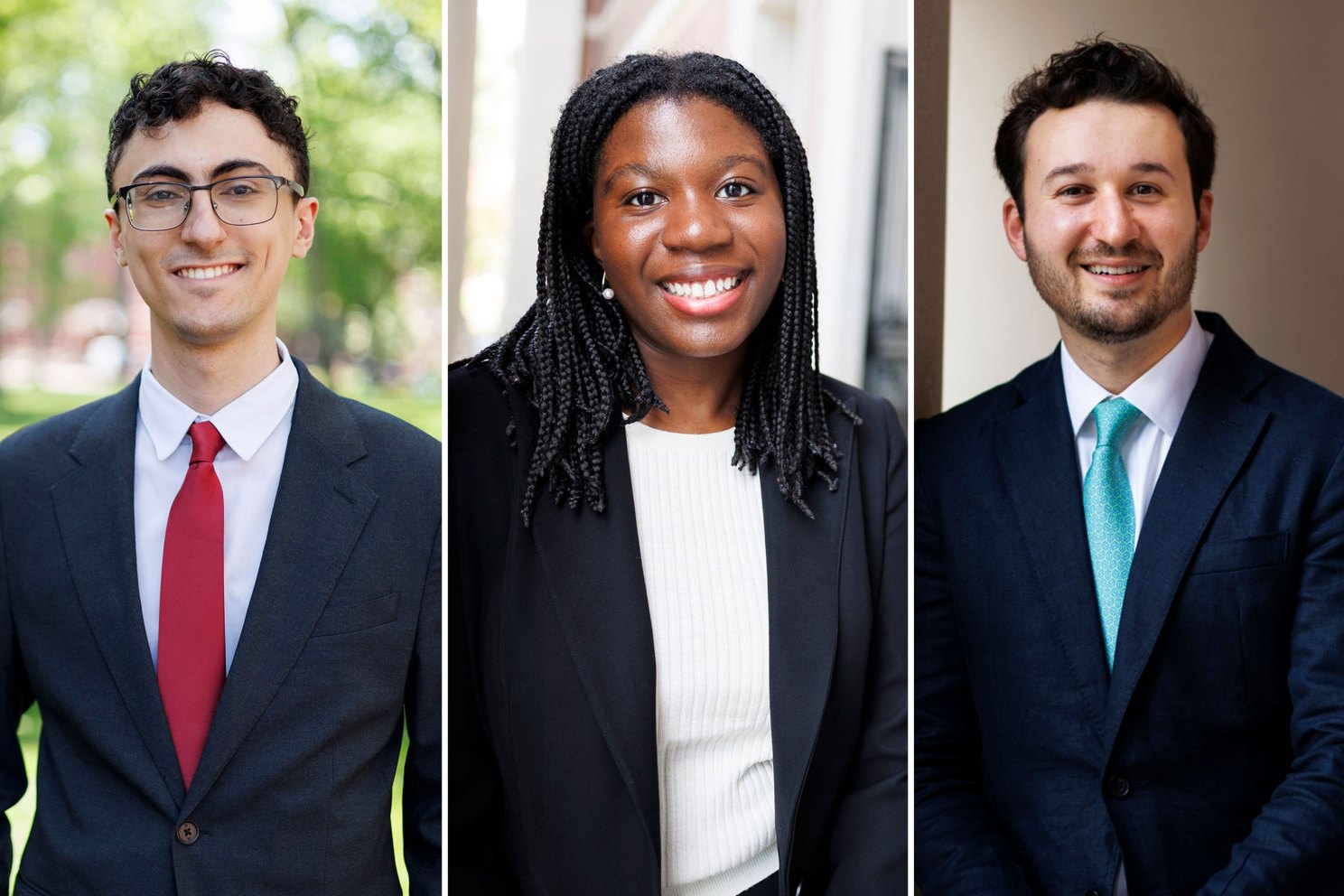
“Campus & Community Lessons from ancient, modern, quantum worlds Orators Noah Eckstein (from left), Kiesse Nanor, and Andrew O’Donohue. Photos by Grace DuVal; Stephanie Mitchell and Niles Singer/Harvard Staff Photographers Jacob Sweet Harvard Staff Writer May 27, 2026 long read Student speakers focus on celebrating difference while embracing ties that bind Part of the Commencement 2026 series A collection of features and graduate profiles covering Harvard’s 375th Commencement. Three graduating students selected in a University-wide competition with their peers will deliver speeches Thursday at Tercentenary Theatre in one of Harvard’s oldest Commencement traditions. Kiesse Nanor, a senior, will deliver the Latin Salutatory; Andrew O’Donohue, doctoral candidate in political science, will present the Graduate English Address; and Noah Eckstein, also a senior, will give the Senior English Address. ‘To Be a Harvardian’ Kiesse Nanor Kiesse Nanor has long been drawn to the lessons of the ancient world. She was just 12 years old when she purchased “The Ancient Greek Hero in 24 Hours.” She’d grown up listening to Greek myths, but the book — written by Gregory Nagy, Francis Jones Professor of Classical Greek Literature — made her think about how intertwined they were and what they said about what it means to be a hero. “Taking stories and looking at them as something that can be analyzed really productively — that was just really cool for me,” she said. When she entered high school at Exeter, she considered taking French, which she’d grown up speaking with her mom, but opted for Latin instead. “I’d never encountered a language that was so grammatically precise,” she said. Every word seemed to have an implication behind it. As a junior, she fell in love with Virgil’s poetry. Beyond translating the text, she liked having an opportunity to discuss it in class and with the school’s Classics Club on Friday evenings (“pretty bad for our social lives,” she said, but lots of fun). When she arrived at Harvard, she took the course that inspired Nagy’s book. “I sat in the first row of the Gen Ed course, like, ‘Oh my gosh, this is the professor whose book I’ve read for the past six years!’” she said. The department was so small the classics concentrator got to work closely with Nagy and several other professors as she studied the deep connections between ancient texts. Along the way, she added an economics concentration, especially enjoying learning about the incentives and reasoning (logical or not) behind how people make decisions. But Nanor’s time at the College was not all work. She had a longstanding interest in music, having studied piano since age 5, so she made time to get involved in several musical endeavors and theater. After about 20 years of mostly solo piano, she enjoyed coming to rehearsals and knowing she “wouldn’t be the only person there.” The focus on the value of being part of a group also affected how she chose to lead. As music director of the Din & Tonics, she steered the jazz a cappella group toward arrangements that highlighted the group’s new voices and range since going co-ed in 2018, taking advantage of diversity instead of just trying to fit new members into the old sound. Nanor thought she’d write a thesis on Latin texts but challenged herself to write it in Ancient Greek ones instead. She studied the poets Sappho and Alcaeus, who both lived on Lesbos around the same time. While many scholars use the poets’ works to decipher what it was like living on Lesbos at the time, Nanor was more interested in studying the poetic relationship between their works. She found they were complementary, and the tendency to separate their output into a binary of war and politics for Alcaeus and women loving women for Sappho didn’t capture their complexity. After graduation Nanor will attend law school at New York University but said she’ll always have some Greek and Latin books on the shelf to come back to for pleasure and comfort, even when she’s studying something completely different. In her oration, she hopes to demonstrate part of what drew her to Latin as a child. “These aren’t just dead languages,” she said. “These are things that have real relevance and still resonate with people today.” And, she said, “I think my 12-year-old self would be very excited to see that I’m the one doing that for people.” ‘Losing Our Education’ Andrew O’Donohue Growing up with a twin sister in a family with two sets of twins, Andrew O’Donohue quickly learned the art of compromise. “You don’t always get to pick the movie every night,” he joked. “You have to think about ways of coming up with solutions that work for everyone.” This focus on finding solutions helped drive him toward studying political science as an undergraduate at Harvard College. An interest in languages and his Armenian relatives’ history escaping from Turkey helped draw him to study political systems outside of the U.S. He became interested in studying democracy while interning with the State Department in Turkey in 2016. Working near the Bosporous, he and his colleagues watched in confusion, and then panic, as tanks started blockading a nearby bridge — part of a coup attempt by a faction of Turkey’s military. When the uprising was foiled, he watched as some citizens celebrated while thousands of others were arrested after the president used emergency powers to purge judges and imprison opponents. The State Department assigned O’Donohue to write a human rights report. But some people his group wanted to work with were in prison. Others didn’t want to speak with American diplomats because the U.S. had been accused of planning the coup. He wanted to understand why democracy seems on shaky ground around the world — and what people could do to protect it. The desire brought him back to Harvard as a Ph.D. student. “The traditional model of thinking about democracy was that we, the United States, have lessons to share with the rest of the world,” said O’Donohue. “Over the course of my Ph.D., I’ve tried to put that in reverse and think about what the rest of the world can teach the United States.” O’Donohue’s research focuses on the courts. While U.S. citizens tend to think of the courts as defenders of democracy, his experience studying countries like Turkey and Israel helped him understand how courts can sometimes undermine it. During his Ph.D., O’Donohue conducted interviews with high-ranking judges on Turkey’s Constitutional Court and Israel’s Supreme Court and analyzed thousands of decisions by both bodies. In his dissertation, which he plans to turn into a book as a fellow at Princeton University and at the Carnegie Endowment for International Peace, O’Donohue highlights how politicians are sometimes able to bend courts to their will and how courts depend on allies, protestors, and politicians to make decisions that help bolster democracies. O’Donohue never had ambitions to be a Commencement speaker but felt compelled to speak to the value of the University amid divisive times. He’s seen students over the past few years attempt to avoid civic involvement by refusing leadership positions or refusing to sign petitions, and he argues these seemingly small expressions of free speech are crucial to democracy. “Our universities and our democracy depend on one another,” he says in his oration. “We must speak in defense of both.” ‘The Punchline’ Noah Eckstein Noah Eckstein remembers listening to a Bruce Springsteen album on television as a child. The screen simply displayed a picture of Springsteen holding a guitar. “Five-year-old me was like, ‘That’s cool,’” Eckstein said. So he began classical guitar lessons — not exactly the style Eckstein had imagined, but cool nonetheless. More than a decade later, picking which college to attend hinged on whether he could continue practicing and performing music alongside a degree in physics. This other passion came about during freshman year in high school. Oddly enough he failed his first exam in the subject (a classical mechanics test Eckstein still remembers in great detail), but quickly embraced the challenge and grew to love the field. By the time he finished high school as a home-schooled student in Bedford, Texas, he had taken every physics class available at the local community college. Eckstein was attracted to Harvard College because of the Harvard-Berklee Joint Studies Program, which allowed him to do work at both places. Before starting College, Eckstein briefly considered other concentrations besides physics. But things became clearer after he took Physics 19 in his first semester. The course steeled his interest in the subject — and introduced him to Jacob Barandes, senior preceptor in physics, who would become a mentor. “Jacob has this funny trick that he plays,” Eckstein said, “which is he teaches you a lot of things without you realizing it.” After Physics 19, Eckstein jumped into Quantum Mechanics I, typically taken by sophomores. Eckstein approached Barandes “dazed and confused” during the second week of class, not sure whether he would continue. “Every physicist has to take quantum mechanics when they’re ready — only when they’re ready, not before, not after, but when they’re ready,” Barandes told him, “and you’re ready.” He stuck with it. Soon, he began doing research and eventually enrolled in a concurrent master’s program. Susanne Yelin, professor of physics in residence, introduced Eckstein to a first-year graduate student with a shared academic backstory and interest in quantum physics. They started working together after Eckstein returned from doing research at the University of Tokyo in his junior year. “Utopia,” Eckstein called the program. The two began working together on quantum simulation of gauge theories, figuring out how to use quantum systems to simulate other quantum systems — like particle physics and black hole dynamics — that classical computers struggle to imitate. All the while, Eckstein managed to keep up his music composition classes at Berklee and contribute to what he called Harvard’s “Musicians Underground” of student projects that could always use a guitarist. Eckstein valued all of the opportunities available to him at the College, so he always tried to push himself as hard as he could. “I don’t necessarily recommend this approach,” he said, half-joking, “but I definitely found my limits. You learn a lot about yourself.” He’s excited to begin his Ph.D. in physics next fall at Harvard’s Kenneth C. Griffin Graduate School of Arts and Sciences, where he’ll continue studying quantum physics. He also plans to continue pursuing music. This summer, he’ll be working as an audio director with a video game studio. “I thought for sure after graduating I would have to choose one path,” he said. “I found a way to kind of make it work, and nobody’s stopped me yet.” In his oration, Eckstein reflects on the need to build understanding in a world where people are often pushed to choose a side and vociferously defend it. Born to a family of Muslims, Christians, and Jews, Eckstein shares a lesson his relatives taught him: “The counter to division isn’t necessarily agreement,” he writes, “it’s understanding.”
Original story
Continue reading at Harvard Gazette
news.harvard.edu
Summary generated from the RSS feed of Harvard Gazette. All article rights belong to the original publisher. Click through to read the full piece on news.harvard.edu.
