
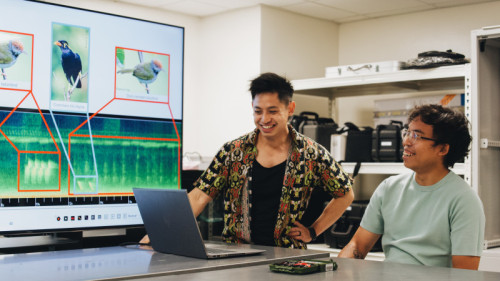
“In tropical forests, much of biodiversity can be heard before it is seen. Birds call, insects buzz and frogs croak, creating complex soundscapes that reflect the presence of different species. Dr Sean Yap, Research Fellow at the Centre for Nature-based Climate Solutions (CNCS) under the NUS Faculty of Science , is studying how these soundscapes can be used to monitor biodiversity. His work at the Lab for Advancing Protection of biodiversity with Innovative Solutions (LAPIS) ,combines bioacoustics — the study of animal sounds — with artificial intelligence (AI) to analyse large volumes of recordings collected in forest environments. “Bioacoustics uses animal vocalisations to identify species and study ecological patterns,” Dr Yap explained. “These recordings can help us compare species communities between sites, track animal activity patterns, and even locate individual animals.” His research currently focuses on two questions: how human-generated noise, such as traffic, affects animal activity in forests, and whether microforests, or small restored forest patches, can help improve ecological connectivity in urban landscapes. Listening to ecosystems To collect data, researchers place small autonomous recorders equipped with microphones tuned to specific frequencies to capture sound in the forest. The set-up itself is relatively simple; the challenge lies in analysing the vast amounts of audio data generated. The recordings are then converted into spectrograms or visual representations of sound, which AI systems analyse to identify patterns linked to different sources. Some models can distinguish broad categories of sound, such as traffic noise and animal calls, while others can classify bird vocalisations to the species level or differentiate between anthropogenic noise and wildlife sounds. This allows researchers to assess levels of human disturbance and measure the presence and activity of different species across study areas. Complementing traditional field surveys Traditional biodiversity surveys often rely on researchers spending limited time in the field observing wildlife, with results varying depending on the observer’s experience and the duration of the survey. Bioacoustic monitoring offers a different approach. Recorders can be programmed to collect data continuously or at specific times of day, producing more standardised datasets. Because the devices remain in place, they can also capture species that might avoid human presence. As Dr Yap noted, human observers are often the main limiting factor in traditional surveys, whereas autonomous recorders can collect data over much longer periods and with greater consistency. Challenges in using AI for biodiversity monitoring Despite its advantages, AI-based monitoring still faces limitations. Dr Yap’s team found that algorithms tend to perform well for species with distinctive vocalisations, such as songbirds. However, species with lower-frequency calls, including pigeons, doves and owls, are harder for AI models to detect accurately. In some cases, recordings initially flagged as owl calls were later found to be traffic noise. Many existing sound-recognition models are trained primarily on species from North America and Europe, Dr Yap explained, which can make them less reliable for species found in Southeast Asia. To address this, researchers at NUS are exploring ways to refine models using locally collected data, allowing AI systems to improve as regional biodiversity datasets expand. Technology and the future of conservation While these technologies are transforming ecological monitoring, Dr Yap emphasised that AI complements rather than replaces traditional field research. He sees AI as a powerful tool that could help scientists gather information efficiently and monitor ecosystems over longer periods. “AI tools depend on good training data and ecological expertise,” he said. “They help us collect and analyse information more efficiently, but they still rely on the knowledge of scientists who study these ecosystems.” For biodiversity-rich regions such as Southeast Asia, this could make a significant difference. Tropical forests in the region are dense and exceptionally diverse, making it difficult for researchers to spend extended periods surveying species in the field. Technologies such as bioacoustics allow scientists to collect more comprehensive datasets and gain a better understanding of how these ecosystems function. In the future, Dr Yap hopes to expand AI-based monitoring beyond birds, which are currently prioritised due to the availability of labelled call databases. He plans to work with researchers studying frogs, insects, bats and other mammals to develop locally trained algorithms, improving the accuracy of biodiversity monitoring in Southeast Asia.
Original story
Continue reading at NUS Newsroom
news.nus.edu.sg
Summary generated from the RSS feed of NUS Newsroom. All article rights belong to the original publisher. Click through to read the full piece on news.nus.edu.sg.
