
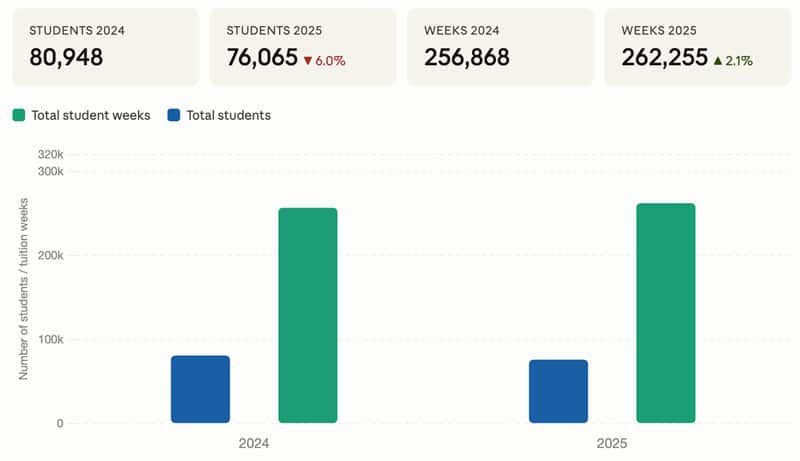
“Data from Malta’s National Statistics Office shows that the characteristics of Malta’s English Language Teaching (ELT) sector are evolving. The number of students coming from top European markets including Italy, France, and Spain is declining, but several non-European markets are helping to mitigate this trend. European students make up the largest share of all ELT learners in Malta (72%). Modest uptick in student weeks but numbers are down In 2025, total student weeks in Malta increased to 262,255, up +2.1% compared with 2024 levels. This is the second-highest level of weeks for the country’s 34 licensed ELT schools, and weeks are +9.6% higher than they were pre-pandemic in 2019. Also up was the average length of stay: 3.4 weeks. This is a significant increase from 2.8% in 2019. However, schools hosted -6% fewer students in 2025 compared with 2024, and the decline is -10% since 2019. In total, there were 76,065 ELT students in Malta in 2025, a decline of 5,000 students from 2024. Total student numbers and student weeks in Malta’s ELT sector, 2024 and 2025. Source: National Statistics Office Of the students enrolled in 2025, 29% were under the age of 15, while 21% were 16 to 17 years of age. The 50+ age bracket was the only one to grow (+8.3% on 2024). Malta is particularly popular among women, who account for nearly two-thirds of all learners (63%). Regional trends Given that weeks and average stay are up, and student numbers are down, there is a trend of students choosing longer courses versus shorter ones. This is because of the mix of student nationalities: Malta is becoming more popular in non-EU markets such as Brazil, Türkiye, and China. Because students from outside of Europe have to travel farther to get to Malta, they often stay for longer than EU students. Non-EU numbers increased slightly from 21,125 to 21,430, while EU numbers dropped from 59,820 to 54,635. Malta experienced notable year-over-year losses in students from its top market in Europe: Italy (-13.2%). This is significant given that Italians send so many more students to Malta than other countries do; they represent almost a quarter (23%) of all students. In 2025, there were 17,525 Italians in ELT courses, a slip from 20,180 the year before. Student numbers and student weeks from top sending markets for Malta’s ELT sector, 2025. Source: National Statistics Office Non-European countries send fewer students than European countries, but non-EU students contribute a large proportion of weeks. Here, a worrisome sign was that Colombians spent -10.3% fewer weeks in Malta in 2025 (32,780) than in 2024. However, Brazil and France were up in weeks by +15.1% and +7.9%, respectively, helping to mitigate the drop from Colombia. Top contributors of student weeks to Malta’s ELT schools in 2025 Source: National Statistics Office Students who stayed the longest in 2025 were Colombians, Chileans, and South Koreans (whose average stay was 12.1 weeks, 11.9 weeks, and 8.6 weeks, respectively). A new challenge ahead Malta’s ELT sector will soon feel the effect of two major EU border systems: the Entry/Exit System (EES), which launched last month, and the European Travel Information and Authorisation System (ETIAS) that is expected to become operational in Q4 2026. ETIAS explains on its website how this will affect non-EU students considering Malta for ELT: “EU nationals sit outside the scope of both systems … the new rules will bite on the non-EU learners who are currently propping up Malta’s weeks total. Students from Colombia, Brazil, Türkiye, Switzerland, China, and South Korea will face biometric registration on every entry and exit under EES. Most of these nationalities also fall within the 59 visa-exempt countries that will need an ETIAS authorisation from late 2026.” ETIAS offers this advice to Malta’s schools and agents: “Agents and schools will need to brief non-EU students, particularly older learners unfamiliar with online applications, about the €20 ETIAS fee and processing windows that can stretch to 30 days for applicants called to interview.” For additional background, please see: “ Student weeks for Malta’s ELT sector surpassed pre-pandemic levels in 2023 ” “ Non-EU markets boosting recovery of Malta’s English language training sector ” The post Malta: Non-EU students keeping ELT weeks stable in the face of falling enrolment from Europe appeared first on ICEF Monitor - Market intelligence for international student recruitment .
Original story
Continue reading at ICEF Monitor
monitor.icef.com
Summary generated from the RSS feed of ICEF Monitor. All article rights belong to the original publisher. Click through to read the full piece on monitor.icef.com.