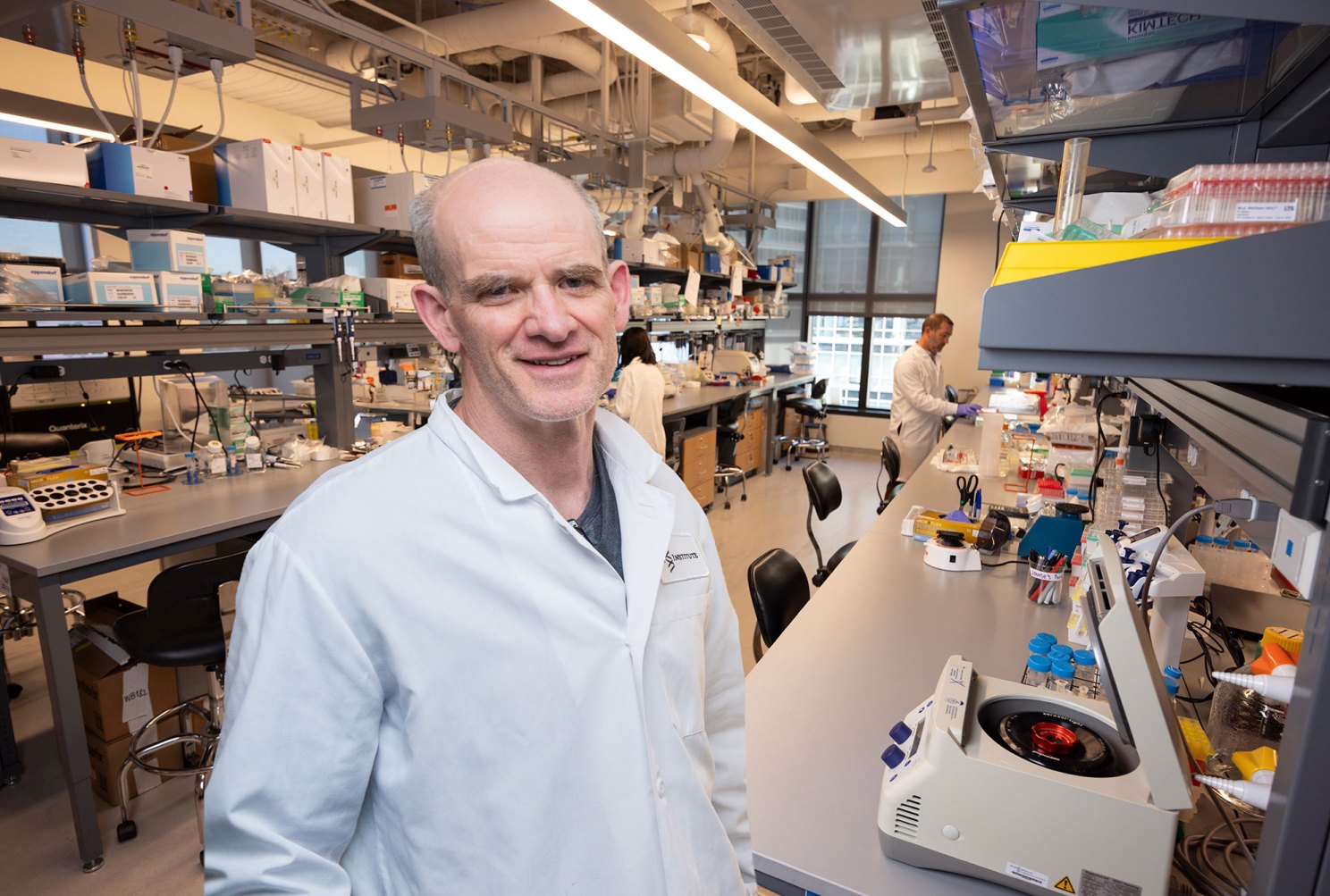
“David Mooney in his lab. Mooney led the research team. Credit: Wyss Institute Health Materializing safe, on-demand living therapeutics Implantable Living Materials platform offers novel avenues for deploying future microbial medicines May 14, 2026 4 min read Patient recovery from debilitating conditions and diseases could be faster and more effective if drugs and therapeutic molecules were delivered right to where they are needed in the body. One way to achieve this is the use of implantable, synthetically engineered, living cells that can sense injury or disease-associated conditions in their environment and respond by producing the right amount of a therapeutic molecule. Bacteria, in particular, are promising as they can thrive in harsh physiological environments within the body, such as infected or inflamed tissues, tissues undergoing mechanical movements, and tumors. Some of the microbial therapies have advanced into clinical trials, failing, however, because the microbes could not be contained at specific sites in the body. Now, a research team at Harvard’s Wyss Institute and John A. Paulson School of Engineering and Applied Sciences has developed an “Implantable Living Materials” (ILM) platform that offers a compelling solution to this problem. The team, led by Wyss Founding Core Faculty member David Mooney , the Robert P. Pinkas Family Professor of Bioengineering at SEAS, encapsulated a genetically engineered, therapeutic strain of E. coli bacteria within a biomaterial designed to regulate bacterial growth and resist mechanical stresses. The E. coli bacteria were equipped with a synthetic gene circuit that allowed them to sense pathogenic Pseudomonas aeruginosa bacteria causing infections and then respond by releasing a therapeutic molecule that killed the nearby pathogens. Implanted into the joints of mice next to a specialized orthopedic implant designed to help heal femoral injuries, the ILM autonomously and effectively treated infections. The findings were published in Science. “With this new strategy combining both, an engineered material with designed mechanical features, and genetically engineered microbes that produce therapeutic payloads on-demand, we provide a generalizable framework for deploying future microbial medicines,” said Mooney. “The precision, safety, and therapeutic durability afforded by this ILM strategy could be a potential solution for treating a wider range of diseases and infections, enabling therapeutic efficacies that might surpass those of other drug delivery strategies.” An illustration of Implantable Living Materials (ILMs) as a living therapeutic. Combined with the synthetically engineered bacteria, the new approach becomes a safe and autonomous functioning drug delivery device. Credit: Wyss Institute at Harvard University Breathing life into therapeutic materials “In the beginning, we asked the seemingly simple question, what if we could design a material that safely encapsulates drug-delivering bacteria inside and allows therapeutic drugs to pass through to where they are needed,” said first-author Tetsuhiro Harimoto , who spearheaded the project as a postdoctoral fellow in Mooney’s group. “This was a big ask since the encapsulating material had to reconcile two often contradictory features: it needed to be sufficiently ‘stiff’ so that bacteria pushing against it from the inside can’t break it apart, and sufficiently ‘tough’ to provide an enclosure that protects against external physical stresses in mechanically active tissues.” To realize ILMs, the team started with polyvinyl alcohol (PVA), which is already used clinically, and processed it to form nanoscale interactive crystalline domains. Due to the tiny pore sizes within the PVA material, the bacteria remain constrained while soluble molecules they produce can travel to other sites in the body. The resulting ILM safely contained the bacteria over extended time intervals of up to six months and was resistant to repeated mechanical stresses. Building in sense-and-response behavior To provide proof-of-concept for ILMs, the team homed in on the infection from a periprosthetic fracture (a broken bone occurring around an orthopedic implant). To effectively treat this and other types of infection, the therapy-delivering bacteria within the ILM needed to be genetically engineered to function as a drug depot with autonomous “sense-and-respond” capabilities. “When we tethered a therapeutic ILM to a stainless steel periprosthetic device that was infected with a pathogenic P. aeruginosa strain isolated from a patient’s wound and implanted next to the femur bone of mice, it significantly reduced the pathogen burden while safely containing its engineered bacteria over a three-day treatment course,” said Harimoto. “In contrast, in mice that we treated with a non-therapeutic control ILM that did not produce ChPy, the numbers of P. aeruginosa bacteria continued to rise over the same time interval. This demonstrated the ability of therapeutic ILMs to autonomously sense and treat periprosthetic infection in vivo .” The researchers think that specifically engineered ILMs as a novel class of therapeutics with excellent safety features and locally targeted drug release capabilities have broad potential, ranging from tissue regeneration to immune modulation in a variety of disease settings. A patent application describing the use of ILMs for drug delivery has been filed. Adapted from a Wyss Institute press release.
Original story
Continue reading at Harvard Gazette
news.harvard.edu
Summary generated from the RSS feed of Harvard Gazette. All article rights belong to the original publisher. Click through to read the full piece on news.harvard.edu.
