
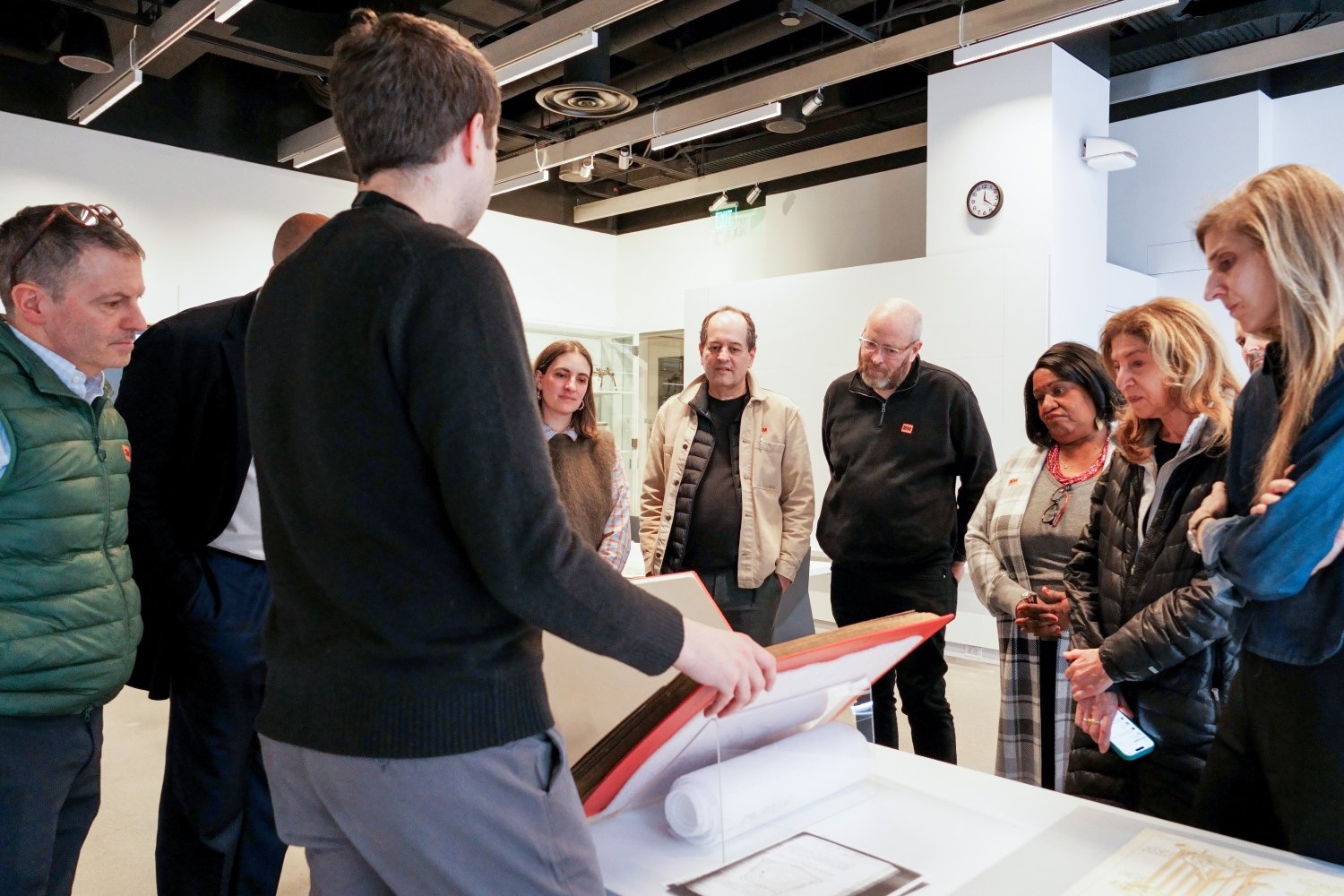
“On April 10, MIT marked its first official Robert R. Taylor Day with a program centered on the life and work of Robert Robinson Taylor (Class of 1892), the Institute’s first Black graduate and the first academically trained Black architect in the United States. After graduating from MIT, Taylor joined Tuskegee Institute (now Tuskegee University), where he designed campus buildings, developed a curriculum, and helped establish an approach to architectural education grounded in making and community life — an orientation that continues to shape the relationship between MIT and Tuskegee today. Taylor returned to MIT on April 10, 1911, to speak at the 50th anniversary of the Institute’s founding — the date now observed as Robert R. Taylor Day. Reflecting on his education, he credited MIT with the “methods and plans” he carried to Tuskegee Institute. “Certainly the spirit,” he said, was found “in the love of doing things correctly, of putting logical ways of thinking into the humblest task … to build up the immediate community in which the persons live.” One hundred fifteen years later, at the MIT Museum , students and faculty gathered around Taylor’s original thesis, “ A Soldiers Home .” The work was presented alongside archival materials from Taylor’s time at MIT by Jonathan Duval, assistant curator of architecture and design. Rather than framing Taylor as a distant historical figure, the encounter with the work itself — its drawings, assumptions, and ambitions — set the terms for the day, bringing forward not only his accomplishments but the ideas and methods that continue to inform teaching and collaboration today. Attendees then gathered for a lunch-and-learn session including a hybrid panel involving MIT and Tuskegee University faculty. “It is so important to continue to develop the MIT-Tuskegee relationship begun by Robert R. Taylor,” says Kwesi Daniels, associate professor and head of the architecture department at Tuskegee University. “MIT students are provided an opportunity to experience the campus Taylor designed and his ethos of social architecture. For the Tuskegee students, they are able to appreciate the foundation Taylor received at MIT. The engagement epitomizes the ‘mind and hand’ philosophy of MIT and the head, hand, heart philosophy of Tuskegee.” An ongoing exchange Student and faculty exchanges, launched by the architecture departments at both institutions, have extended these connections in recent years. MIT students travel to Tuskegee for work in historic preservation and community engagement, sampling Daniels’ scanning and drone equipment, while Tuskegee students come to MIT to engage with digital fabrication and entrepreneurship. For Nicholas de Monchaux, professor and head of the Department of Architecture at MIT , the relationship reflects continuity. “We are not uniting. We’re reuniting,” he says. “This year’s celebration should really be seen as the kickoff of a year of reflecting on Robert Taylor’s legacy and imagining what the day, and his legacy, can become over time.” The day’s program — the vision for which originally emerged from a suggestion made by MIT literature professor Joshua Bennett during a meeting at Tuskegee with de Monchaux, Daniels, and Tuskegee President Mark Brown — moved into a broader effort among faculty and collaborators across architecture, history, and the humanities. As Bennett put it, “The primary aim of Robert R. Taylor Day is to lift up not only Taylor’s accomplishments, but his ideas — and the fact that his ideas live on in those of us who have inherited his legacy.” That emphasis is also visible in the dedicated coursework and research that has accompanied the exchange since 2022. In class 4.s12 (Brick x Brick: Drawing a Particular Survey) , taught by Carrie Norman, assistant professor in architecture at MIT, students document buildings on the Tuskegee campus through measured drawings and archival interpretation. Working from limited historical material, they reconstruct both form and intent. “My role has been to structure this work pedagogically,” Norman says, “guiding students in methods of close looking, measured drawing, and archival interpretation.” She describes Taylor’s work as “an ongoing research agenda,” adding that “the broader aim is not only to deepen engagement with Taylor’s legacy, but to build on it through new forms of design research.” Related work has contributed to a recent exhibition on the Tuskegee Chapel at the National Building Museum, curated by Helen Bechtel of the Yale School of Architecture. Building on research conducted in Norman’s course, students developed large-scale models that form part of the exhibition. New 3D fabrications use a limited set of archival materials to reconstruct the chapel originally designed by Taylor as the first electrified building in Alabama’s Macon County, which was destroyed by fire in 1957. Looking ahead Timothy Hyde, professor in the MIT Department of Architecture, has also been involved in the ongoing MIT–Tuskegee collaboration and in efforts to situate Taylor’s work within a broader historical context. He notes that Taylor’s training at MIT helped shape the curriculum he later developed at Tuskegee. “The other influence I would like to mention is the city of Boston itself,” Hyde adds. “Boston was a prosperous city with a wealth of civic architecture that Taylor would have seen and studied.” A documentary project on Taylor’s life, supported by the MIT Human Insight Collaborative and led by Hyde and historian Christopher Capozzola, senior associate dean for MIT Open Learning, is currently in development. For some students, these encounters shape longer trajectories. As an undergraduate at Tuskegee, Myles Sampson participated in the MIT Summer Research Program (MSRP), where he began to connect architecture with a growing interest in computation. He later enrolled in MIT’s Master of Science in Architecture Studies (SMArchS) computation program, working with Professor Larry Sass, who introduced him to robotic fabrication. “I never looked back,” Sampson says. “Without that hands-on research experience, I would never have looked past contemporary architectural practice.” He is now pursuing a doctorate in computational design at Carnegie Mellon University, focused on the role of automation in architecture and construction. Sampson contributed significant work to the National Building Museum’s exhibition. His installation, Brick Parable, brings together historical reference and robotic construction. As de Monchaux notes, the project reflects the long arc of Taylor’s legacy: “bricks were fired by students as part of Taylor’s training program … Myles [Sampson]’s piece, made with a robotic assembly of bricks, explores the architectural idea of the chapel in contemporary form.” For Daniels, the continued circulation of students between the two institutions remains central. Viewing Taylor’s thesis in particular offers a shared point of reference. “Whether the student is from Tuskegee or MIT, they are able to appreciate the quality of work Taylor completed as a student,” he says, “and how he built on that work by creating a college campus, beginning at age 25.” Across these activities, Taylor’s work is approached not as a fixed legacy, but as a set of methods and commitments that continue to be tested. As Catherine Armwood, dean of Tuskegee University Robert R. Taylor School of Architecture and Construction Science, describes it: “While our students leverage [the design and entrepreneurship program] MITdesignX to turn architectural concepts into social enterprises through advanced fabrication and venture mentorship, MIT students come to Tuskegee for an immersion in historic preservation. By surveying buildings handcrafted by our founding students, they learn a legacy of self-reliance and community impact that can’t be found anywhere else,” Armwood says. “Together, we are bridging technical innovation with deep-rooted heritage to train a new generation of visionary leaders.”
Original story
Continue reading at MIT News Education
news.mit.edu
Summary generated from the RSS feed of MIT News Education. All article rights belong to the original publisher. Click through to read the full piece on news.mit.edu.
