
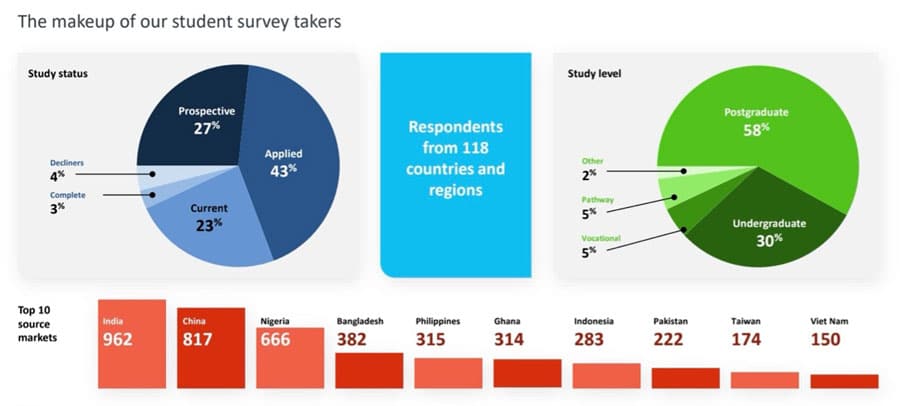
“New IDP Emerging Futures research reveals that visa concerns are now influencing international students’ decision-making earlier than in the past. And, if obtaining a visa for a preferred destination seems too difficult, uncertain, or costly, some students say they will simply decide not to study abroad. The results of the ninth Emerging Futures survey suggest major implications for governments and institutions alike. They show a distinct shift in students’ approach to choosing where in the world to study. IDP notes: “While employability, post-study work opportunities, and affordability remain core drivers, EF9 shows students are now screening options more proactively, often ruling out destinations sooner due to visa costs, policy uncertainty, or perceived barriers to entry.” The survey was conducted between early-March and late-April of 2026 among over 5,800 prospective and current students in 118 countries (Chart 1). Chart 1: Characteristics of the survey sample. Source: IDP Emerging Futures 9 Demand remains high for Big Four destinations The survey found that Australia (21%), the UK (19%), and the US and Canada (14%) remain the most preferred countries in which to study. A main reason for this is that students believe there will be a high return-on-investment (ROI) from studying in those countries, especially with regards to career prospects (Chart 2). Chart 2: Study destinations perceived to offer the highest career benefits. Source: IDP Emerging Futures Research 9 Visa barriers are jeopardising perceived ROI Despite their appeal, Big Four destinations are currently associated with uncertain, unfair, or increasingly restrictive immigration policies. Students are aware that: The likelihood of obtaining a visa for the US and Canada is lower than in the past (especially for students from some regions). Work and immigration rights are narrowing for international graduates in the US . Australia’s non-refundable visa application fee is now AU$2,000. In addition, primary applicants must now have AU$29,710 in available funds. Both these requirements are the most expensive of all destinations. The UK government will reduce its popular post-study work stream, the Graduate Route, to 18 months for undergraduate and master’s students in 2027, and proposals for further tightening of work and immigration rights are common. Developments such as these are jeopardising the perceived ROI of studying in a Big Four country. If a student is doubtful that they can pay for or obtain a visa, and if they see evidence of post-study work rights shrinking, they are naturally more likely to think twice about their decisions. The survey results show that this uncertainty is manifesting in several ways: Earlier influence: Students are exploring visa settings before or alongside their research on traditional “pull” factors such as programme availability, costs of study/living, rankings, reputation, etc. (Chart 3 below). More than 4 in 10 said that the financial requirements of a visa application, the cost of applying for a visa, and the post-study work opportunities attached to a visa exert a strong influence on their choice of study destination. IDP says: “Visa concerns are occurring earlier as prospects weigh the true cost to arrive [and] the likelihood of visa approval and employment pathways, [which points] to a strong focus on the value of their investment of an overseas degree.” Chart 3: Visa concerns strongly influence many students’ choice of destination. Source: IDP Emerging Futures Research 9 Dramatic effect: Visa issues are a major reason that some students decide to give up their goal of studying abroad (Chart 4). Of students who said they have decided not to study abroad, more than a quarter said it was because the cost of a student visa is too high (27%) or because securing a visa is too difficult (26%). Chart 4: Financial and visa issues are the biggest drags on commitment to study abroad. Source: IDP Emerging Futures Research 9 A wider net: More than three-quarters of students (78%) are now weighing multiple countries before committing, up from 66% in October 2024 (Chart 5). Chart 5: Students are much more likely to consider multiple destinations than just one. Source: IDP Emerging Futures Research 9 Visa settings as deterrent IDP notes: “[The survey findings] reflect the cumulative impact of increasingly restrictive visa policies, and act as a warning sign to all destinations that sustained policy tightening can rapidly shift student preferences.” Simon Emmett, Chief Partner Officer of IDP Education, said: “Students are behaving more like savvy consumers, comparing destinations based on the return on their investment. If students can’t quickly understand whether they’re likely to qualify, what they’ll need to show and what it will cost up front, they will eliminate destinations sooner or delay plans altogether …. “International students are planning the biggest chapter of their lives while navigating major hurdles. Governments of countries that want to attract the highest quality students should help them understand visa decisions, not add uncertainty that drives good students elsewhere.” Mr Emmett called for collaboration across the sector emphasised the collective need to “lift confidence in international education through greater transparency and accountability, better data on outcomes and visa trends, and enhanced compliance and early warning signals that protect students and support sustainable growth.” Implications for institutions The IDP research underlines the importance of strong communications, website content, and social media posts clarifying visa information for international students. If partnering with agents, institutions will also need to make sure they are constantly equipping agents with the most current, accurate information about immigration rules. In an era where students’ confidence in traditional study abroad destinations is under pressure, there is no room for error in these communications. What’s more, there is a chance to build stronger relationships with students by stepping in to provide trusted information when it may be difficult to find otherwise. For additional background, please see: “ A common challenge: Strengthening student confidence in the ROI of study abroad ” “ What students want: The top decision factors for study abroad ” The post New IDP research shows link between visa uncertainty and the perceived ROI of study abroad appeared first on ICEF Monitor - Market intelligence for international student recruitment .
Original story
Continue reading at ICEF Monitor
monitor.icef.com
Summary generated from the RSS feed of ICEF Monitor. All article rights belong to the original publisher. Click through to read the full piece on monitor.icef.com.

