
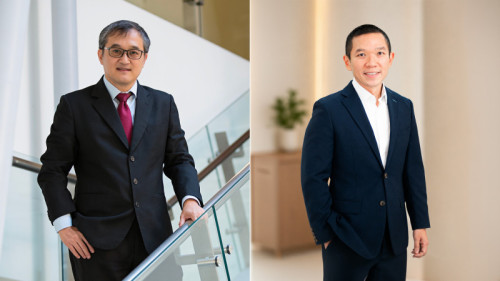
“The National University of Singapore (NUS) has appointed Professor Teo Chung Piaw as the new Dean for the NUS Business School and Professor Koh Lian Pin as the new Dean for the NUS Faculty of Science. Both appointments will take effect from 1 July 2026. They succeed current Deans Professor Andrew Rose and Professor Sun Yeneng respectively, who are returning to their academic pursuits at NUS. Prof Teo will relinquish his role as the Executive Director of the NUS Institute of Operations Research and Analytics (IORA) with effect from 1 July 2026. Prof Koh will continue to serve as the University’s Vice President (Sustainability and Resilience) and Chief Sustainability Scientist until 31 December 2026. He will also continue as Director of the Centre for Nature-based Climate Solutions under the NUS Faculty of Science. NUS President Professor Tan Eng Chye, said, "We are delighted to appoint Prof Teo Chung Piaw as Dean of NUS Business School and Prof Koh Lian Pin as Dean of the Faculty of Science. Both have demonstrated exceptional vision and deep expertise throughout their distinguished careers at NUS, and are ideally positioned to drive our faculties forward in this era of rapid transformation. Under their leadership, I am confident our Business School and Faculty of Science will not only advance groundbreaking research and education, but also develop the next generation of leaders and innovators who will shape solutions for Singapore and the global community." Business School Prof Teo, who is an NUS alumnus, is the Stephen Riady Professor at NUS Business School and Co-Director of the SIA–NUS Digital Aviation Corporate Laboratory. Over an academic career spanning more than three decades, Prof Teo has distinguished himself as a researcher, educator and academic leader. A leading scholar in operations research and analytics, his work has advanced the optimisation of business processes in areas such as logistics, inventory management and supply chain planning. Prof Teo’s achievements have been recognised across the University, and at national and international levels, reflecting both the scholarly depth and practical relevance of his work. He has also held key leadership roles at NUS Business School and helped develop IORA into a key NUS platform for research, application and collaboration in operations research, optimisation and analytics. “It is a privilege to be entrusted with the leadership of NUS Business School, an institution that has built a strong reputation for academic excellence, research impact and deep engagement with industry and society. I am grateful to Prof Rose for his stewardship and for the many ways in which he has built on and strengthened the School’s foundations. I look forward to working closely with our faculty, staff, students, alumni and partners to build on the School’s strengths, deepen our impact in Asia and beyond, and prepare future business leaders to navigate an increasingly complex and technology-driven world,” said Prof Teo. Please refer to Prof Teo’s biography here: Annexe 1 . Faculty of Science Prof Koh, a leading expert in sustainability and environmental science, helms NUS’ sustainability agenda and brings together diverse stakeholders to enhance the climate resilience and sustainability of Singapore through system-level mitigation and adaptation solutions. He oversees and champions sustainability-related research at NUS, tackling the twin planetary crises of climate change and biodiversity loss, through a whole-of-university strategy that bridges academia with policy makers, industry and civil society. With over 20 years of international experience, Prof Koh is among the world’s most cited conservation scientists. His previous roles include positions at ETH Zurich, University of Adelaide, Conservation International Foundation, and Singapore’s National Research Foundation (NRF). An NUS alumnus, he joined the NUS Department of Biological Sciences in 2020 under the NRF’s Returning Singaporean Scientists scheme and went on to serve as Vice Dean (Research) at NUS Faculty of Science from 2022 to 2024 and Director of the NUS Tropical Marine Science Institute from 2021 to 2024. He was appointed Associate Vice President and Chief Sustainability Scientist in 2023 and promoted to Vice President (Sustainability and Resilience) in 2025. Prof Koh focuses on policy-relevant science and advocacy, and has contributed to major forums including the UN COP sessions, TEDGlobal and TEDx, and the Singapore Parliament as a former Nominated Member of Parliament (2021–2023). He is also a World Economic Forum Young Global Leader and Founding Director of ConservationDrones.org. Prof Koh said, "I am deeply honoured and excited to serve my alma mater as Dean of Science. I would like to thank Prof Sun Yeneng for his outstanding leadership in shaping the Faculty into the excellent institution it is today. I am committed to working closely with our faculty, staff, and students to advance cutting-edge research, enhance educational excellence, and translate scientific discoveries into real-world impact. Together, we will foster an inclusive and collaborative environment, strengthen our partnerships with industry and the community, and elevate the Faculty as a leading hub for scientific discovery and talent development." Please refer to Prof Koh’s biography here: Annexe 2 . In appreciation Prof Tan said, “NUS is profoundly grateful to Prof Rose and Prof Sun for their exemplary leadership and dedication. Their contributions have shaped not only their respective schools, but also the University and the broader society.” “Prof Rose has steered the NUS Business School with foresight, elevating its global standing, fostering innovation and equipping our students to excel in a rapidly evolving world. Prof Sun has led the Faculty of Science with distinction, advancing research and fostering a vibrant community of scholars dedicated to excellence and advancing knowledge, while inspiring and supporting students to reach their fullest potential,” added Prof Tan. During his tenure as Dean since 2019, Prof Rose strengthened NUS Business School’s academic portfolio, regional engagement and research mission, alongside improvements in its international rankings and reputation. He oversaw the continued development of the School’s undergraduate and postgraduate offerings, expanded its faculty strength, and supported initiatives that enhanced its multidisciplinary breadth, including the integration of the Department of Real Estate into the School. Under his leadership, the School broadened access to postgraduate business education through new pathways, including the launch of the Executive Master of Science in Management for experienced professionals. NUS Business School also made further strides as a leading Asian voice in business education and policy, while advancing research in areas such as governance, sustainability, analytics, AI and policy impact. These academic, research and regional developments were complemented by continued investment in the School’s long-term institutional capacity, including enhancements to its campus infrastructure and learning spaces. Prof Sun helmed the NUS Faculty of Science since 2020. Under his leadership, the Faculty attained new heights of excellence in both undergraduate and postgraduate education. As a founding Co-Dean of the NUS College of Humanities and Sciences, Prof Sun played a pivotal role in advancing an undergraduate education model that integrates scientific inquiry, the humanities and societal impact, equipping graduates with the intellectual agility to address complex problems across disciplines. Prof Sun transformed graduate education at the Faculty, significantly expanding the Faculty’s suite of self-financing Master of Science programmes in emerging, industry-relevant fields, to prepare future-ready leaders with advanced skills for a rapidly changing landscape. He also expanded doctoral scholarship support to draw high-calibre PhD candidates to the Faculty. His deanship was marked by the recruitment of exceptional scientific talent, enhancing the Faculty’s scholarly and research stature. He also oversaw the strategic establishment of the NUS Bezos Centre for Sustainable Protein, NUS Research Centre on Sustainable Urban Farming and Centre for Data Science and Machine Learning, reinforcing the University’s global standing in impactful, future-focused scientific research.
Original story
Continue reading at NUS Newsroom
news.nus.edu.sg
Summary generated from the RSS feed of NUS Newsroom. All article rights belong to the original publisher. Click through to read the full piece on news.nus.edu.sg.

