
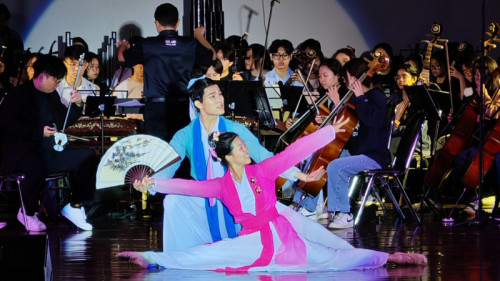
“From campus rehearsal rooms to international stages, NUS students are discovering new avenues to elevate their artistic practice beyond Singapore. Through the Study Trips for Engagement & EnRichment (STEER) programme, the ASEAN region has become a living classroom, offering students unparalleled opportunities to innovate their craft through cross-cultural collaboration. These experiences are part of NUS’ broader Arts for All framework , which seeks to broaden students’ access to the arts and embed the arts throughout their journey at NUS and beyond. Led by the Office of Student Affairs ’ Centre for the Arts (OSA CFA), these arts-focused STEER experiences bring together students from across faculties who are active in NUS’ credit-bearing arts groups, including the NUS Symphony Orchestra, NUS Wind Symphony, NUS Chinese Orchestra and NUS Chinese Dance. These students participate in structured music training through NUS' Yong Siew Toh Conservatory of Music (YST), a distinctive model that integrates rigorous conservatory training with their broader interdisciplinary academic pursuits. Through STEER, students are given the platform to engage directly with industry professionals, educators and fellow student-artists across the region via venue tours, masterclasses and collaborative live performances. Mr Francis Tan, Resident Conductor at OSA CFA, who developed the arts-focused programme, highlighted the value of this immersive approach. “Our arts STEER trips are designed for students to be active participants in the experience. Far beyond observation from the sidelines, they are involved in active performances, exchanging ideas, and engaging directly with our overseas counterparts. This creates a deeper form of learning—one that is collaborative, reflective and grounded in practice,” he said. Exploring the intersection of tradition and contemporary practice One of the key opportunities provided by the programme is the chance to study how traditional art forms are preserved and adapted for contemporary audiences. During a recent STEER programme in Bangkok, students from NUS Chinese Orchestra and NUS Chinese Dance were immersed in Thai traditional music and dance. Through visits to cultural landmarks such as Ayutthaya, the Bangkok Art & Culture Centre, and the Pichet Klunchun Dance Company, students encountered diverse approaches to sustaining and reinterpreting heritage. For NUS Chinese Orchestra and NUS Chinese Dance, whose own practices explore the intersection of tradition and contemporary expression, these experiences provided fresh, real-world perspectives to apply to their own craft. Many students came away with a deeper understanding of the broader ecosystem that supports the arts. Du Yiqing, a Year 1 student from NUS Business School , said, “Museums and universities play an important role in shaping how tradition is understood and transmitted. Universities connect this heritage to practice by encouraging structured learning, research and experimentation, allowing students to engage with tradition not only as something to preserve, but also to reinterpret and apply creatively.” Navigating the arts ecosystem and career pathways Beyond performance, the STEER programme opens doors for students to explore the business and infrastructure of the arts. During a trip to Malaysia, NUS Symphony Orchestra and YST students had the opportunity to network with regional industry leaders, including Ms Melissa Teoh, Producing Artistic Director at Sir Jeffrey Cheah Performing Arts Centre; Professor Mayco Santaella, Dean of Arts and Social Sciences at Sunway University; and Dr Low Chee Meng from UCSI University’s Institute of Music. As part of an outreach event, the NUS Symphony Orchestra and YST students met up and performed with young Malaysian musicians from the Selangor Philharmonic Orchestra, a renowned community orchestra. The NUS students also visited film and animation company Les Copaque Productions and social enterprise Rondo Production and interacted with their leaders. These sessions broadened their understanding of what a career in music could look like, from arts entrepreneurship to film scoring and community engagement, while prompting them to reflect on their roles as contributors to the wider arts ecosystem. Touring major performing arts venues like the world-class Dewan Filharmonik PETRONAS and Sunway University’s Performing Arts Centre further provided students with behind-the-scenes insights into the design, infrastructure, and investment required to sustain the arts across different cultural and economic contexts. Fostering growth through peer mentorship and masterclasses A hallmark of the NUS arts experience is the opportunity to lead and mentor. On these regional trips, NUS students step into the roles of educators and collaborators. In Bangkok, NUS students participated in cultural and artistic exchanges at the Bunditpatanasilpa Institute of Fine Arts, Chulalongkorn University and Kasetsart University. They had the opportunity to get hands-on with traditional Thai art forms and shared foundational elements of Chinese dance and Chinese music instruments with their Thai counterparts. In Muar, Malaysia, students from NUS Symphony Orchestra and YST took this step further by conducting side-by-side masterclasses with Chung Hwa High School’s String Ensemble and Band. In this teach-and-learn model, NUS musicians rehearsed next to the younger students, offering real-time guidance through demonstration and feedback. Claudia Loo, a Year 2 student from YST, who co-led a string instrument workshop with YST Teaching Assistant Mr Benedict Ng, found the opportunity rewarding. “This was my first time mentoring beginner students in Malaysia. This experience has also given me a taster of a possible career in teaching," she said. Taking the stage before international audiences The trips culminated in well-received concerts in both cities, allowing NUS students to showcase their work alongside regional collaborators. In Bangkok, the NUS Chinese Orchestra and NUS Chinese Dance groups presented a stunning interdisciplinary performance at Kasetsart University’s Prasert Na Nakhon Theatre. The combined ensemble brought together Chinese orchestra, Western wind instruments, and dance in an abridged arrangement of the Butterfly Lovers Concerto , offering many in the audience their first encounter with Chinese orchestra and dance. In Kuala Lumpur, the NUS Symphony Orchestra achieved a major milestone by making its debut at the prestigious Dewan Filharmonik PETRONAS . Performing to a sold-out crowd—which included His Excellency Mr Vanu Gopala Menon, Singapore’s High Commissioner to Malaysia—the students played as a combined orchestra with musicians from Sunway University and the Malaysian Philharmonic Orchestra, under the baton of Associate Professor Chan Tze Law, NUS Vice Dean of Students and Vice Dean (Communities & NUS Arts) at YST. The concert also saw a special engagement, led by NUS Chief Alumni Officer Ms Ovidia Lim-Rajaram, between members of the NUS Singapore and Malaysia alumni communities. Reflecting on the depth of these experiences, Mr Francis Tan noted, “These were journeys where learning did not sit on the surface of the places we visited but unfolded in the shared space of understanding and creating art together with our overseas partners." Mark Lee Zhi Ying, a Year 2 student from NUS Faculty of Arts and Social Sciences, echoed this sentiment, “We made good friendships, created lasting memories, and met NUS alumni through the corporate talks. Seeing how they have impacted communities beyond NUS and Singapore was eye-opening." As OSA continues to develop and strengthen arts-focused STEER experiences, these inaugural trips highlight how the “Arts for All” vision extends far beyond campus. By bringing together artistic practice, academic inquiry and real-world engagement, NUS is providing students with platforms they need to become not just skilled performers, but culturally attuned leaders and contributors to the arts ecosystem in Singapore and across the region. By NUS Office of Student Affairs
Original story
Continue reading at NUS Newsroom
news.nus.edu.sg
Summary generated from the RSS feed of NUS Newsroom. All article rights belong to the original publisher. Click through to read the full piece on news.nus.edu.sg.


