
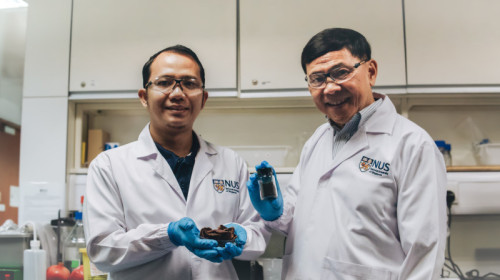
“Pomegranate peel discarded by food vendors could soon help clean up contaminated water, thanks to research from the Department of Chemistry at the Faculty of Science . Led by Professor Sam Li, the research team developed a nanoscale carbon material derived from the fruit waste that is capable of efficiently removing 4-nitrophenol (4-NP), a persistent industrial pollutant, from water. 4-NP is widely used in the production of pesticides, pharmaceuticals, and dyes, and routinely enters waterways through industrial discharge. It is highly soluble and chemically stable, allowing it to persist in aquatic environments and move through rivers and lakes. Over time, it can accumulate in food chains, posing risks to both ecosystems and human health. Regulatory bodies classify it as a hazardous contaminant, with long-term exposure linked to damage to the nervous system, liver, and kidneys. Existing methods for removing 4-NP, including chemical oxidation and biological treatment, while effective, are often energy-intensive, costly, or difficult to scale. Some require continuous chemical input or generate secondary by-products that has to be managed. Adsorption using carbon-based materials offers a simpler alternative, but many such materials rely on chemical activation processes that reduce their environmental and economic viability. Turning waste into a functional material The NUS team's approach sidesteps these issues by starting with pomegranate peels collected from local markets in Singapore. The peels are converted into biochar through controlled heating at 600 deg C, then broken down further into nanoparticles using ball milling and ultrasonication in water. The process does not require chemical activating agents. The resulting nanobiochar has a high surface area and a pore structure suitable for capturing small organic molecules like 4-NP. “We wanted a material that could remove persistent pollutants effectively without relying on harsh chemicals,” said Kustomo, NUS PhD student and first author of the study. “By working at the nanoscale, we were able to increase the number of active sites while keeping the process simple and more sustainable.” Reducing the material to the nanoscale exposes more reactive surface sites, allowing 4-NP molecules to bind with the material faster and more efficiently. This improves removal performance while maintaining a relatively straightforward production process. Strong performance and reusability In laboratory tests, the nanobiochar was added to water containing 4-NP, a toxic pollutant. Within 90 minutes, it removed more than 94 per cent of the contaminant under optimised conditions. This means the material can clean polluted water relatively quickly, by attracting and holding the pollutant on its surface. The researchers also tested whether the material could be used more than once. After each round of cleaning polluted water, the nanobiochar was washed with sodium hydroxide to remove the trapped pollutant and prepare it for reuse. Even after three cycles, it was still able to remove 85.76 per cent of 4-NP. This shows that the material can be reused while still maintaining most of its performance. The team’s findings were published in Environmental Nanotechnology, Monitoring & Management on 16 January 2026. The NUS team is now testing the material in real wastewater samples, which contain a more complex mix of contaminants than the synthetic solutions used in the study. Scaling up production and integrating the material into existing treatment systems represent important next steps. If successfully implemented, this approach could offer a more sustainable and cost-effective solution for treating industrial wastewater while also creating value from agricultural waste.
Original story
Continue reading at NUS Newsroom
news.nus.edu.sg
Summary generated from the RSS feed of NUS Newsroom. All article rights belong to the original publisher. Click through to read the full piece on news.nus.edu.sg.


