
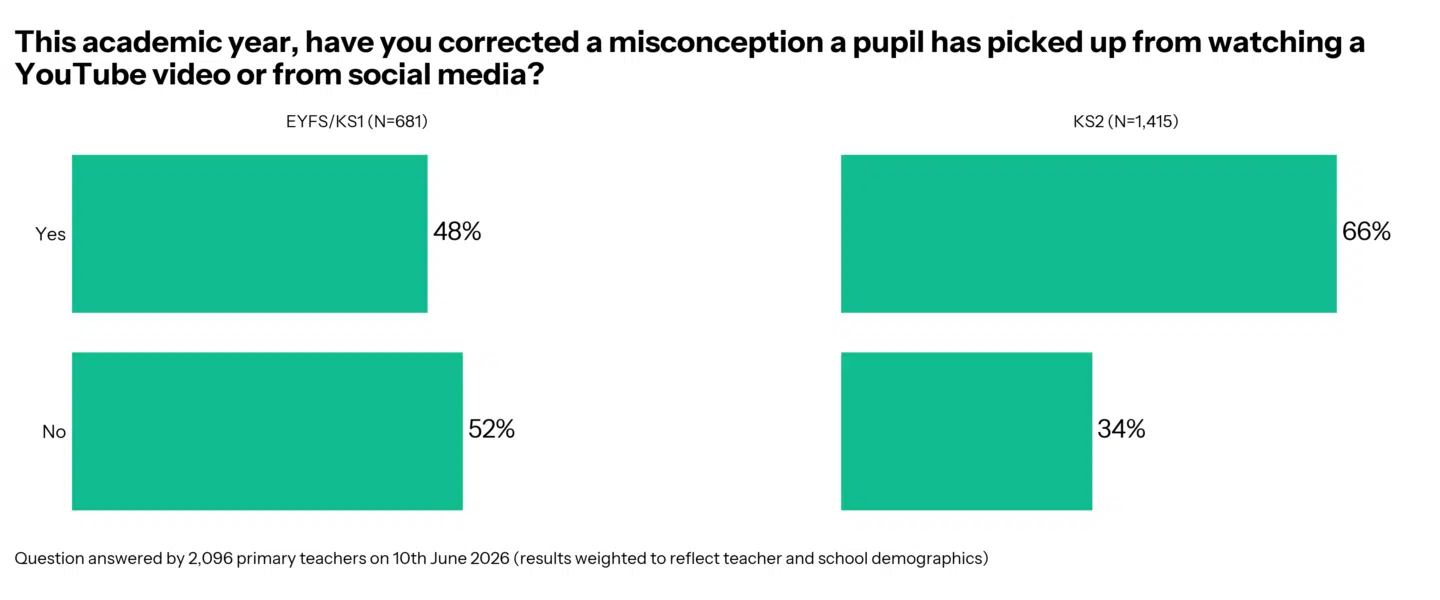
“Hey there Tappers! We are halfway through June – the countdowns have started! Soon, we’ll begin asking you our usual end-of-term questions about Sports Day, leaving celebrations, and transitions for Year 6 into Year 7. Do you have questions you think Teacher Tapp should be asking? Our inbox has been busy with Tappers sending in suggestions – so if you have topics to add to our list, please send your thoughts England@teachertapp.co.uk 📧. And thinking ahead to September (I know…I know…) if you have an INSET day CPD presentation to deliver and would like some Teacher Tapp data, please do get in touch! Or if you’re planning on using Tapp findings and would like to tell us about it, we would love to hear how you’ve made use of Tapp data in your school! New prize draw Here at Teacher Tapp we are incredibly grateful for all of the Tapps you give us. Just this week, the news of the social media ban had everyone in the Tapp office think back to when we were invited into the House of Lords to present Teacher Tapp findings on mobile phone, social media and AI use in schools. If you haven’t seen it, we made a video about it here . But we could only do that because of YOU. Therefore, we feel it is only right that we regularly say THANK YOU, and this month one lucky Tapper will win an iPad! It’s easy to enter – you just have to Tapp in June! Check out the full Ts and Cs here . Now we have a lot of juicy edu-findings this week 🙌 so let’s get started… Social media ban On Monday 15 June, the prime minister, Keir Starmer made the announcement that social media will be banned for children under the age of 16. When we last asked teachers how they felt about the idea of social media restrictions for children, 96% agreed. But what else do we know about how social media has been impacting young people at school? This week, 58% of primary teachers reported correcting misconceptions their students have picked up from what they’ve read online, with the figure rising to 66% for KS2 teachers, and dropping to 48% for EYFS/KS1 teachers – so it’s certainly not a problem confined to just the older years. The same was true for 74% of secondary teachers, with humanities and English teachers the most likely to report having to correct misconceptions (87% and 85%, respectively). Ofsted workload From Government bans to Government inspections – Teacher Tapp has been looking at the impact of the new inspection framework, which has been in place since September. School inspections are now taking place using the new scorecard system, and the change has impacted both the schools being inspected and those awaiting inspection. One way the new framework has made an impression has been the creation of new documents or operational changes. 60% of teachers told us their schools have made changes or created documents. But of those who have made changes, how many think the changes have had a positive impact? For 24% of teachers, they felt it was too early to tell. But for the rest, the feeling hasn’t been overwhelmingly positive: Just 2% of teachers described the impact as “significantly positive”. 21% of teachers told us it was “slightly positive”. A huge 69% of teachers say the changes have had no impact at all. And then 6% felt it was a slightly negative impact, and 3% a significantly negative impact. These findings highlight the issues of the increased workload and how leaders are coping with the changes. You can read more about these findings in the Tes article here . Legal rights and interview questions Now, an aspect of school that isn’t a focus of Ofsted: the recruitment processes. The questions a teacher is asked in their interview are covered by the Equality Act 2010 , which outlines how employers can’t discriminate against a person based on certain personal characteristics. These laws apply even before you have started working for a school, and therefore, there are some subjects that teachers shouldn’t be asked about during the recruitment process. Based on some of the questions Tappers have been sending in about interviews, we had a feeling that some schools are still getting this wrong. To check, we asked about the different protected characteristics to check how common it was for teachers to be asked about these subjects. The good news is the vast majority have not been asked these questions ( 82% ), however, 7% have been asked about health conditions or disabilities, and 6% have been asked about marital status. 6% were asked about sickness absence and 5% were asked about children or caring responsibilities. Some groups appear to be more likely to be asked about certain topics than others: women in their 30s are most likely to be asked about having children ( 5% ) or caring responsibilities ( 8% ) compared to men and women in their 50s, who were least likely ( 0% and 2% ). Men in their 50s were more likely than women in their 50s to be asked about retirement plans ( 9% vs 5% ). The interview lesson observation When leaders were asked which part of the interview they felt was the most useful indicator for future performance, both primary and secondary leaders felt it was the interview lesson that gave them the best insights ( 56% and 46% ). But how best to set up the (clearly important!) interview lesson? We set out to find out the approach to interview lesson observations favoured by teachers, and asked if they preferred to be observed teaching a lesson at the interview school, or record themselves teaching, or be observed with their own pupils by a teacher from the school they are interviewing for. The top choice for primary teachers was to be observed with their own pupils by a teacher visiting from the school they are interviewing for ( 37% ), and over in secondary, the top choice was to be observed at the interview school with their pupils ( 46% ). The least popular choice in both phases was recording yourself teaching ( 4% in primary and 3% in secondary). The really good news is that 27% of primary and 30% of secondary teachers don’t have strong feelings about how their interview lesson observations are done. Perhaps you’ve always taken the same approach with your interview lessons and not considered other options. In your opinion, is there a preferred approach that gives the best indicator of the quality of teaching? Or is it purely a logistical decision? Get in touch with your thoughts! Tapp experiment: PPA cover Last week we explored different attitudes towards advising friends on whether or not they should teach their own child in reception, this week (in part inspired by the news coverage of a teacher who was disciplined for calling in sick when on a stag do) we ran an experiment to test reactions to requests for cover for personal, non-medical reasons. Are some reasons considered more ‘worthy’ than others? We split the panel into four groups: group one was asked to cover a colleague who wanted to attend a wedding; the second group had a request to cover to allow the teacher to watch their child in a play; the third wanted to be covered for a stag do; and the fourth and final group requested cover for a hen do. The results revealed huge differences between both phase attitudes towards cover AND towards the reason behind the request. Our first finding was that in every single scenario, secondary teachers were generally much more willing to cover. Asking for cover for a child’s production elicited the most ‘yes’ responses in both phases ( 38% primary and 50% secondary), followed by attending a wedding ( 47% vs 33%), and stag and hen dos had similar gaps: 21% secondary and 16% primary for a stag do; 21% secondary and 15% primary for a hen do. Why might primary teachers be more reluctant to give up a PPA? One reason might be that primary teachers are more likely to have PPA in a block, rather than secondary teachers who have it split into smaller chunks. Another reason could be that more primary teachers report their PPA being cancelled or moved each week ( 12% of primary vs 4% of secondary) and therefore feel less inclined to give it up. Another difference we found was whether the Tapper respondent was male or female: on the whole, male teachers were more likely to offer to cover for colleagues – with one exception: covering for a hen do. When asked about covering to allow a colleague to watch their child in a production, male primary teachers were more likely to agree to cover ( 49% vs 36% ), a gap of 13 percentage points, and male secondary teachers were also more likely to agree to cover than female secondary teachers ( 55% vs 48% ), a gap of 7 percentage points . The pattern is similar when the reason for cover was attending a wedding: in primary, male teachers were more likely to agree to cover compared to female teachers ( 43% vs 31% ) and the same in secondary ( 51% vs 44% ). But the stag and hen scenarios saw a change in pattern: for a stag do, once again male primary teachers were more likely than female primary teachers to agree ( 26% vs 14% ), and in secondary ( 27% vs 18% ). But when the request was for a hen do, the responses equalise: 17% of male primary teachers would agree to swap, compared to 15% of female primary teachers; 23% of male secondary teachers would swap, compared to 21% of female secondary teachers. The Teacher Tapp conclusion? If you need a lesson covered, where possible, ask a male colleague! Do you have your own idea for an experiment we could run on Teacher Tapp? Let us know what issue you would like us to dig into… Neurodivergent teachers Last term, Teacher Tapp asked teachers whether they considered themselves to be neurodivergent, and afterwards, we had a lot of messages asking more questions about the results: specifically if teachers had a diagnosis, and if they had shared that information with their headteacher. A third of teachers consider themselves to be neurodivergent, and of that third 7% have a diagnosis. A notable 16% reported that they didn’t know, and 50% gave a straight no. When it comes to sharing with the headteacher that they are neurodivergent, 79% of teachers with a diagnosis told their headteacher they were neurodivergent, and the same is true for 15% of teachers who do not have a diagnosis. Among teachers who have a diagnosis for their neurodivergence, 46% informed their headteacher but did not ask for adjustments, 23% asked for adjustments that were granted, and 10% asked for adjustments, but they were not granted. Among teachers who did not have a diagnosis, sharing the information with their headteacher was far less common: just 15% shared the information, made up of 13% who shared without asking for any adjustments, 1% asked for adjustments that were granted, and 1% asked for adjustments that were not granted. What can people working in schools do with this information? First off, leaders need to reflect on how these figures compare to their own settings: might you have teachers on your staff who could benefit from adjustments? Do you make sharing information about neurodivergence easy for teachers? Do leaders know how to respond if this information is shared with them? Small changes could make it easier for teachers who are neurodivergent to stay in the classroom – keep your eye out for more questions looking at this topic! Daily Reads The Daily Read that got you clicking this week was the blog all about ditching the PowerPoint , more than 1,000 Tappers read it this week – if you missed out the first time, it’s not too late to read it! There are so many great blogs out there and we love featuring them on Teacher Tapp. If you have a blog you think we should feature, then please email us at england@teachertapp.co.uk and we will check it out! The post Ofsted workload, PPA cover PLUS interview questions that cross a line appeared first on Teacher Tapp .
Original story
Continue reading at Teacher Tapp Blog
teachertapp.co.uk
Summary generated from the RSS feed of Teacher Tapp Blog. All article rights belong to the original publisher. Click through to read the full piece on teachertapp.co.uk.

