
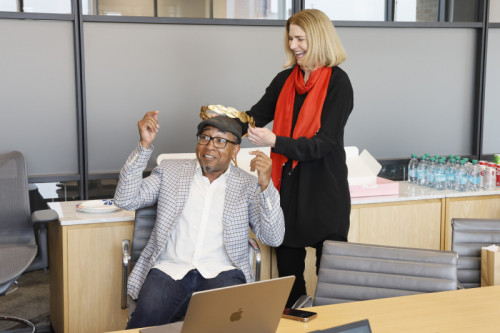
“America’s 250th birthday is a time to take stock of the past and consider the future, said Charles O. Anderson, The Ohio State University’s newest Artist Laureate . “It’s an interesting time in terms of progress and regression,” he said. “I want to think about hope. What could the next 250 years look like?” Since 2023, Ohio State has named an Artist Laureate every spring. The position comes with funding that allows the Laureate to travel the state, including the university’s regional campuses, and collaborate with communities whose stories, histories and creative traditions have not always been centered within mainstream arts spaces. Anderson , professor of Afro-contemporary dance and choreographic methodologies in the College of Arts and Sciences, was thrilled to be named the university’s fourth Artist Laureate. “I was completely shocked,” he said. “I squealed.” His excitement comes, in part, from his proposed project. “Croatoa: Re-Singing America’s Next 250 Years” will be a statewide effort to build connection between Ohio residents. Anderson’s Artist Laureate work is envisioned to include engagement with Ohio State’s regional campuses in Lima, Mansfield, Marion and Newark, alongside collaborations with peer institutions across Ohio. “We’re not all going to have the same perspective,” Anderson said. “That’s part of the American experiment. Coexistence isn’t about sameness – it’s about learning how to remain in relationship to one another while imagining a broader sense of who ‘we’ can be.” The name Croatoa comes from the lost Roanoke Island colony. In 1587, a group of English settlers landed on an island off the coast of North Carolina. By the time a second party arrived in 1590, the entire colony was deserted. Accounts vary, but many describe a tree with “CROATOA” carved into its bark. A move to Hatteras Island, formerly known as “Croatoan,” has long been considered a possible theory for what happened to the settlers. “I’m a native of Richmond, Virginia,” Anderson said. “We took trips to Jamestown when I was in school. A teacher once mentioned that Jamestown wasn’t the first colony in the United States and I became fascinated by that.” That fascination has continued to this day. “I’m a big sci-fi geek and I think about speculative fiction,” he said. “Imagine if they didn’t disappear from Roanoke Island but instead took a different path for the last 250 years. That’s what this project is: imagining what the United States will look like 250 years from now.” “Charles has exciting plans for the year, which include activities with all of the communities served by our regional campus, tie-ins with the university’s America 250 programming and collaborations with colleges and arts organizations across Ohio,” said Lisa Florman, vice provost for the arts and history of art professor. “His project utilizes his experiences as an academic leader and as a professional choreographer and dancer and combines those with collaborative engagement practices in ways that directly align with the goals of the Artist Laureate initiative, to co-create work with Ohio communities often underserved by the arts.” Anderson will travel the state to facilitate movement and vocal workshops, gather oral histories, and construct participatory ‘wailing walls,’ where individuals can leave written promises, secrets, and hopes. A small cohort of Ohio State students and local artists will serve as creative facilitators and community docents, helping guide participants through experiences centered on dialogue, reflection and collective storytelling, Anderson said. “The intention is not to force anyone,” he said. “I know a lot of people don’t like performance. We’re using it as a tool to have conversations that can feel sensitive. To have an intellectual conversation through a physical, embodied experience.” Oral histories are a foundation of Anderson’s idea, he said. “My intention is to show that all of them are part of the American story,” he said. “We want to subvert the idea of a dominant narrative. We are all here and have existed here, some of us for generations.” Valuing stories equally comes from Anderson’s teaching experience. “How many times do we have students who know a lot more than they realize?” he said. “But that knowledge doesn’t feel valuable to them, because it’s not attached to a reward. How do we shift the notion of ownership, which often creates a hierarchy, to a sense of belonging?” Anderson said the most meaningful part of these projects is the communities that form through the process. “I’m interested in what becomes possible when people come together with intention,” he said. “How many different histories and perspectives can contribute to a shared future?”
Original story
Continue reading at Ohio State News
news.osu.edu
Summary generated from the RSS feed of Ohio State News. All article rights belong to the original publisher. Click through to read the full piece on news.osu.edu.

