
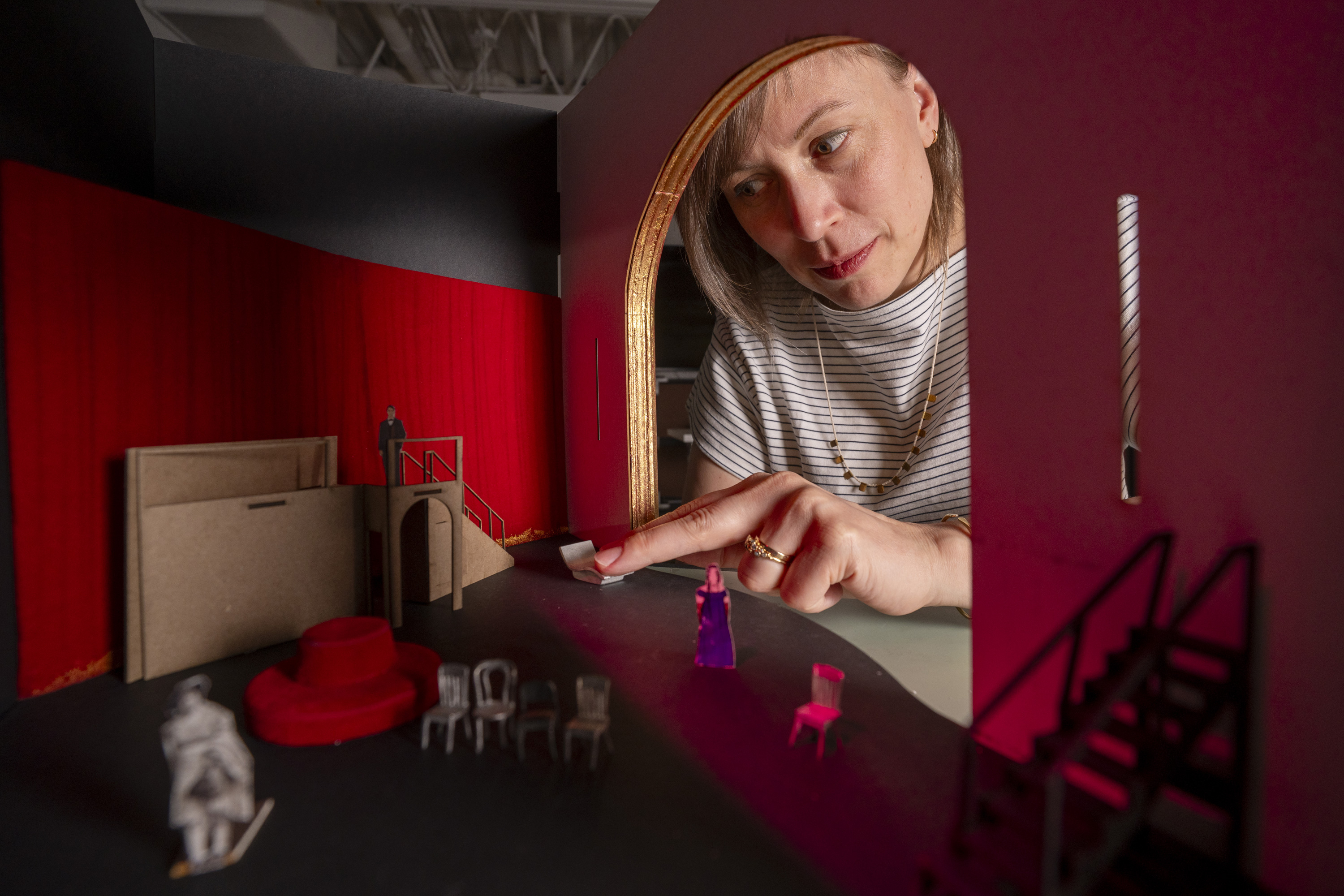
“In a theater, the first thing the audience sees, and looks at the longest, is the stage. Even so, set design is something most of us know little about. Why does a set have its form and elements? How does it suit the performance? Consider a set that designer and MIT Associate Professor Sara Brown created in 2015, when the Brooklyn of Academy of Music adapted the canonical Japanese Noh play “Hagoromo,” turning it into a chamber opera with dance. Noh plays have a traditional structure and a crucial final transformation. In “Hagomoro,” an angel loses her cloak; a fisherman only reluctantly returns it, after the angel performs a ritual dance; the angel then ascends to the heavens. To focus on the main characters, Brown’s design featured three high walls surrounding center stage, with musicians and a chorus elevated behind them. “That set was a framing device more than anything else,” says Brown, who is also associate head of MIT’s Music and Theater Arts program. “It lifted the musicians to a different plane, almost a heavenly place, so we have a heaven-and-Earth contrast. It allows the dancers to be seen against a plain backdrop. I didn’t want to lose their bodies in a sea of other bodies.” For a formal play structure, then, Brown created a formal setting, with vertical layering suggestive of its contents. The trickiest part was lighting: Brown worked with the lighting designer Clifton Taylor to cut vents in the high walls for more light, while a rigging structure allowed them to spotlight dancers. “Solving for those things is what makes the design,” Brown says. “There’s an artistic idea that underbeds everything, and there are practical considerations, which are as important, to make the piece work the way you want.” Brown has designed sets at many major venues, tackling everything from “Carmen” to “Death of a Salesman” and debut productions. She ranges broadly across theatrical genres, while teaching classes that get MIT students thinking visually, intellectually, and creatively. “Every play you’re working on should have something you grab onto as a creative challenge,” Brown says. That challenge is a collective one; it involves working with directors, performers, and design teams focused on lighting, sound, media, and costumes. “In theater-making, you have to work in a community,” Brown emphasizes. “You might bump up against some rough edges, but you develop strategies to work with everybody with dignity, and that’s important.” For her extensive work and teaching, Brown received tenure at MIT last year. Minnesota kind Brown grew up in Minnesota, where her parents made sure the whole family grasped the value of humility. That experience, says Brown, has given her “a voice I carry with me that channels my family. The worst thing you could be where I grew up was too big for your britches. So it’s a voice that says, ‘What are you doing and what is the value of this?’ Because of my upbringing and my family, it’s a kind voice, but it is a self-reflection I try to carry with me.” Brown received her BA from Gustavus Adolphus College in Minnesota, then earned an MFA from the University of Virginia. At MIT, she has successfully combined professional set design with classroom teaching. When Brown agrees to design the set for a production, the first thing she does is read the work in question. Then she sits down with the director to talk about it. “Usually I’ll talk to the director after my first read of the play,” Brown says, citing the influence of a prominent U.S. set designer, the late Skip Mercier. “He said the only thing he brings to the first meeting is a love of the play. That is a great approach. You come understanding the material, wanting to find something within it you love and are excited to work on. You’re not closed; you’re there to discover what you have in common.” Indeed, Brown emphasizes how much she appreciates the collaborative aspects of theater. Inevitably, directors, designers, and actors will not agree on everything, but from sorting through those varying viewpoints, a production emerges. “It’s about serving the whole instead of being your personal project,” Brown says. “There will always be tension, but the idea is that through that tension, something is going to result that will be better than anything you could do by yourself.” Brown does have some creative tendencies that reappear across productions. She will often opt for simplicity and adaptability on stage. For a production of “Pride and Prejudice” in Hartford, Connecticut, Brown designed a circular space at the front of the stage, with a slightly elevated rear area containing a piano and columns, allowing the set to shift among the many social settings of the work. Remarkably, another set Brown designed was actually used for two different plays running at the same time: “Death of a Salesman” and “Skeleton Crew,” a 2008 play about a closing auto plant in Detroit. “A throughline in my work is that I gravitate to things that appear to have a simplicity and integrity or formalism, and then reveal different aspects of themselves, so they change over time,” Brown says. “But there is something essential in them. I’m drawn to simplicity, something without a lot of noise.” “Where the good stuff is” Still, Brown is always open to new challenges. She once designed the set for the contemporary play “The Lily’s Revenge,” which has five acts and requires the audience to move around in the theater. “You have to figure out how to reconfigure the space in many different ways with the available materials and it has to feel like a big transformation,” Brown says. “Sometimes you’re working on things and don’t understand the totality of it [the production] until you step back and see it all together.” Much as Brown works on a variety of theater projects, she also works with a variety of MIT students, from any given course of study, in the classroom. “It’s everybody, which is great,” Brown says. “There are students who did high school theater and people who have never seen a play.” While teaching classes in the Music and Theater Arts program — which include classes on set design, the foundations of design, and drawing for designers — Brown has also served as a faculty advisor for MIT Morningside Academy of Design, an interdisciplinary hub for design on campus. “There’s an underlying process of design that does unite disciplines,” Brown says. Consider set design and architecture, for instance: “Sometimes in theater you’re trying to make spaces that actually express an inefficiency. You’re creating obstacles for people onstage,” Brown says. By contrast, architects might be trying to get people to flow efficiently through buildings. Still, she adds, “It’s the same process, with different results.” Besides, architects do try to design common spaces, whether atriums, lounges, or meeting rooms, where people stop and interact, mirroring set design to an extent. In any case, Brown notes, when she is working with MIT students in design classes, she is often “reversing the idea that there’s something external you’re seeking that is the right answer, which I think they’re used to doing in other realms of education.” Instead, in theater, whether it’s Brown’s own professional work, or a first-time design for a student, she says, “This is a process where you have to mine your interior life and think about what you want to bring out in this event that’s going to happen onstage. That can be scary, but that’s where the good stuff is.”
Original story
Continue reading at MIT News
news.mit.edu
Summary generated from the RSS feed of MIT News. All article rights belong to the original publisher. Click through to read the full piece on news.mit.edu.

