
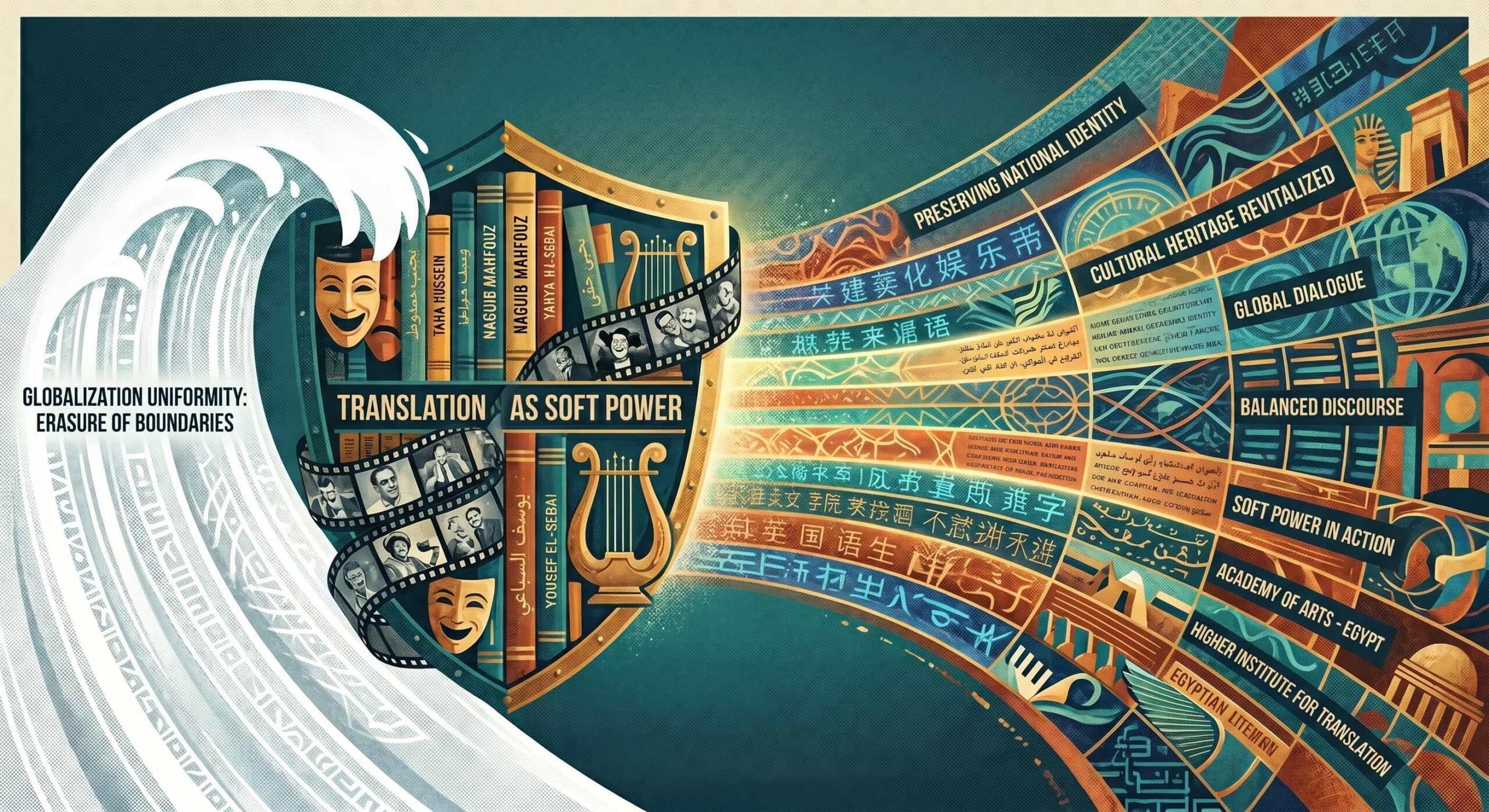
“In today’s world, where globalization is often applied in a uniform and single-minded way, a phenomenon understood largely in terms of erasing cultural boundaries, the role of translation emerges as the last vestige of soft power, perhaps even the only remaining means of protecting and re-presenting identity in a way that preserves its value within a changing global context. Translation is no longer merely a technical linguistic activity; it has become a conscious and complex cultural practice, tasked with confronting the challenge of our time: openness to the world while simultaneously defending cultural distinctiveness. This issue is more crucial than ever, occupying a central place in cultural discussions, given Egypt’s increasing openness to international cultural cooperation through exchange programmes, grants, and specialized seminars. These initiatives reflect an institutional orientation toward building partnerships based on knowledge and cultural interaction. In this context, translation has become the most important tool for reintroducing Egypt’s valuable cultural heritage into shared spaces, without reduction or distortion. This approach is clearly evident in the strategic vision of the Egyptian Ministry of Culture, which seeks to support cultural industries and enhance soft power by presenting Egyptian artistic and cultural heritage as an active entity capable of interacting with others, rather than merely a static inheritance. Hence, the focus is on translating arts and literature as dynamic mediums capable of faithfully presenting this heritage while respecting the diversity of cultural spheres to preserve its essence. Prof. Inas Abd-ElKhaleq Within the Academy of Arts, this role has been realized through the establishment of the Higher Institute for the Translation of Arts, Literature, and Artistic Media. Its vision prioritizes preparing specialized personnel capable of dealing with artistic texts as intricate semantic systems that transcend the limits of language to encompass culture, customs, traditions, image, sound, and performance. Translating a work of art is not a literal transfer but a re-creation of an aesthetic experience, requiring strong awareness of identity on the one hand and of the mechanisms of global reception on the other. Egypt’s prominent writers, such as Naguib Mahfouz, Taha Hussein, Yahya Haqqi, Youssef El-Sebai, and countless others, did not simply produce distinguished literary works. Their writings were literary studies and penetrating insights into the human psyche and its complexities, undoubtedly transcending local boundaries. This is precisely what the translator must convey: universal messages that can inspire all cultures and foster a broader understanding of the human experience. Similarly, Egypt’s timeless cinematic and theatrical heritage, with all its giants who transmitted world heritage to us and left their mark, deserves our utmost attention. We must retranslate it within the same global context that emphasizes the artwork’s cultural content, rather than focusing solely on the technicalities of dialogue, which are certainly open to multiple interpretations. Our cinematic heritage of comedic works from the 1940s and 1950s confirms this, as these films transformed comedy into a weapon of political defiance against occupation, inspiring audiences worldwide. Likewise, the realistic films of the 1990s, which reflected the early signs of globalization and foreshadowed our current situation, offered insightful artistic perspectives that interpreted and engaged with the world, rather than being confined to their own culture. Perhaps the greatest challenge today lies in transforming translation into an effective tool of soft power, consolidating Egypt’s cultural presence on the international stage, not only through artistic production but also through its accurate and conscious presentation, which respects its distinctive character and illuminates its richness and universality. In conclusion, translation is no longer a cultural choice but a tactical necessity imposed by the nature of the times. It is the means by which we reshape ourselves to the world and participate in forming a more balanced and pluralistic global discourse, a discourse that acknowledges and celebrates difference, rather than obliterating it. Prof. Inas Abd-ElKhaleq – Dean, Higher Institute of Art, Literature, and Artistic Media Translation The post Opinion | The Translation and Preservation of National Identity and Cultural Heritage in the Age of Globalization: A Perspective from Egyptian Cultural Institutions first appeared on Dailynewsegypt .
Original story
Continue reading at Daily News Egypt
www.dailynewsegypt.com
Summary generated from the RSS feed of Daily News Egypt. All article rights belong to the original publisher. Click through to read the full piece on www.dailynewsegypt.com.