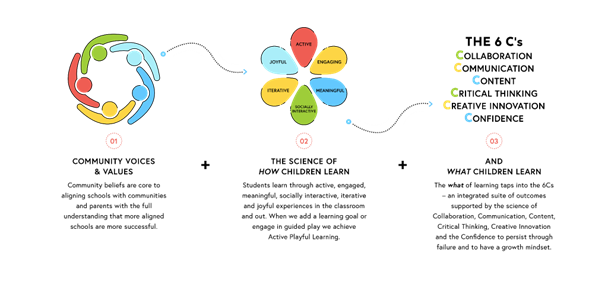
“The Active Playful Learning Consortium supports teachers to build a toolkit of play-based learning practices to incorporate into their instruction. At a Glance More states are mandating the use of play-based learning in schools, but teachers might be uncertain about how to implement these policies. The Active Playful Learning project studies how coaches can help teachers gradually adopt play-based instructional practices within their existing curriculum. Teachers work with a coach to set goals aligned with active play, implement those goals, and then move on to new goals. Early results show positive effects on the ability of teachers to incorporate more active, playful approaches into their classrooms. For years, we’ve known that play-based learning is developmentally appropriate for elementary school-age children (Alfieri et al., 2011; Lillard et al., 2013; Zosh et al., 2018). Indeed, in recent years, states such as New Hampshire and Connecticut have passed legislation mandating play-based learning in public schools (Bornfreund, 2023). As more schools around the country adopt these practices, administrators, teachers, and researchers want to understand how to implement playful learning in the classroom. The gap between policy and implementation is often wide, raising the question of what administrators and teachers can do to make evidence-based policy practical for use in real classrooms with real students (Lee et al., 2024). The Active Playful Learning (APL) research program investigates how teachers, coaches, school administrators, and researchers can work together to bring playful content-rich learning into classrooms in multiple school districts and states. Through a practice-based coaching model, teachers and coaches work together on specific classroom changes that create a more joyful, active classroom environment where meaningful, deeper learning can take place. The program does not require a school to adopt a new curriculum, hire new personnel, or purchase new materials. It’s about making small changes, though a classroom-embedded coaching program designed to foster student agency. Initial findings from a 2019 to 2020 pilot in New Hampshire showed the promise and feasibility of bringing the program to scale (Nesbitt, Blinkoff, Gunersel, & Hirsh-Pasek, 2025). This pilot program provided the foundation for a grant from the LEGO Foundation to study the APL coaching program in elementary schools in California, Illinois, Virginia, and Texas. The grant started in 2023 and will wrap up in 2027. The APL approach APL is rooted in a three-part equation (Figure 1): Community voices and values : Teachers build on the values and practices — or funds of knowledge (Civil, 2016) — from students’ families and communities to make learning relevant and meaningful. The science of how children learn : Children learn best when they are active and engaged in the material, when content is meaningful to their lives, when they are socially interactive with peers and teachers, when learning experiences are iterative , and when the environment is joyful (Hirsh-Pasek et al., 2022). What children need to learn : The 6C’s — collaboration, communication, content, critical thinking, creative innovation, and confidence — are a broad set of skills children need both now and in the future (Golinkoff & Hirsh-Pasek, 2016). Figure 1. Active Playful Learning’s three-part equation Source: Active Playful Learning, https://activeplayfullearning.com/. Used with permission . The APL approach grounds this three-part equation in six foundational teaching practices, each associated with a pillar from the science of learning: Using small and paired student groups (active, engaged, and social) Increasing student contributions to interactions in the classroom (active, engaged, meaningful, and social) Supporting hands-on and minds-on exploration (active and engaged) Giving students voice and choice in their own learning (active, engaged, and meaningful) Helping students connect their learning to experiences both in and out of school (iterative and meaningful) Infusing positivity into learning experiences (engaged and joyful) Teachers and coaches work together on these practices throughout the school year, with a goal of making them part of daily instruction. Our hypothesis is that embedding these six practices into classroom pedagogy will transform classrooms in ways that support deeper and more joyful learning for both students and their teachers. The APL coaching model So far, APL has operated in over 65 schools and with almost 600 teachers. Teachers work with their coach for the entire length of a school year. Coaches deliver initial APL workshops to K-4 teachers covering the three-part equation, the APL teaching practices, the theoretical background, and how they and the teacher will create SMART (specific, measurable, attainable, relevant, time-bound) goals throughout the school year. Together, the teacher and coach set a goal based on an APL teaching practice. Then, the teacher works toward the goal with the support of the coach during and between biweekly one-on-one coaching sessions and debriefs. Teachers move on to a new goal when they feel they have assimilated their previous goal into their practice. These three classroom examples from our coaches illustrate how the coaching cycle brings about classroom transformation. These examples come from coaches working in Illinois, Virginia, and Texas. Hands-on math Veteran kindergarten teacher Ms. Jones opted into APL because she felt like her practice had become more teacher-centered and she wanted to find ways to infuse more activity and joy into her classroom. In her initial visit with APL coach Debbie, Ms. Jones reflected that as her district adopted more formal kindergarten curricula across subjects, she had gradually shifted her practices to fit everything into an increasingly full schedule. She wanted to remain faithful to the content of her school’s math curriculum while also creating more opportunities for students to actively discuss their thinking during math time. She felt she could promote student contributions by teaching parts of her math lessons in teacher-facilitated small groups. Debbie helped her develop her first APL SMART goal: Adapt the problem set and concept development activities of the lessons to incorporate more discussions and hands-on activities, especially within a teacher-facilitated small group, as part of a three-group math rotation system at least three times per week. Ms. Jones and Debbie thought about how to incorporate manipulatives, how students might record their thinking and work, and what prompts might spark student thinking and discussion within the group. Some of these ideas were already part of the curriculum but had been difficult to implement with the whole class. In other cases, new ideas emerged, such as using manipulatives to explore the concept in more depth or a different format for students to record their work. As Ms. Jones implemented teacher-facilitated small groups aligned to the curriculum, she discovered that the APL adaptations enabled students to do more challenging work than the curriculum specified. For example, a particular problem set may have called for six specific addition problems, but when kids worked on whiteboards with manipulatives, they were able to solve more problems with bigger numbers. When visiting Ms. Jones’ classroom, Debbie spent most of her time observing the teacher-facilitated small groups to 1) note how different students were responding to the planned activities and prompts, and 2) consider new ideas for discussion prompts, ways to incorporate manipulatives, and hands-on/minds-on ways to explore the concepts in the curriculum. Sometimes Debbie chimed in with a question or suggestion during these visits. During debriefing sessions, Debbie and Ms. Jones discussed the ways students responded to the activities and planned what she wanted to try next. After a couple of months focused on this first SMART goal, Ms. Jones felt that she could sustain this approach without further coaching support, so she moved to a new SMART goal that focused on incorporating a debrief discussion at the end of math lessons to encourage students to reflect and actively process the lesson content together. By the time the year was over, the structure of Ms. Jones’ daily math lesson had evolved significantly, moving from mostly passive whole-group or individual work to the strategic use of small groups for the bulk of the lesson. Students explored ideas more actively, and student contributions were centered. Short whole-group debriefs followed, designed to support reflection, communication, confidence, and content expertise. Increasing collaboration Mr. Robinson, also a veteran kindergarten teacher, enthusiastically joined his school’s APL coaching cohort. His first APL SMART goal focused on developing students’ communication skills, such as making eye contact and responding to a partner in a mathematical conversation. After becoming comfortable with his progress toward this goal, he aimed to expand on his initial success through a second goal: Increase students’ opportunities to build critical- and creative-thinking skills by working together in small or paired groups to solve rich math tasks, specifically involving nonstandard linear measurements. With coach Jen’s support, Mr. Robinson took a variety of steps toward his new goal. For example, he started implementing small-group work across subject areas so his students could practice sharing a workspace and joining a partner in randomized groups. Familiarity with these elements would enable the kindergartners to later focus on math within these groups. Then, Mr. Robinson and Jen developed tasks that aligned with the kindergarten standards of comparing numbers and nonstandard linear measurements. He observed as Jen modeled a lesson with his students that included open-ended challenges with more than one solution that students could approach in different ways. He then started implementing similar lessons. In one task, student groups used a set of cubes to build three towers so that one tower had more cubes than the others and one had fewer. As part of a measurement unit, student groups used nonstandard measurement tools (such as coins, pipe cleaners, and beans) to identify items in the classroom that would fit into a variety of objects, like a fictional playhouse made of a shoe. Working with their partners, students used manipulatives and designed their own ways to record their thinking on a shared workspace. In addition, Mr. Robinson considered guiding and reflective questions that might scaffold and extend students’ thinking on math tasks. Mr. Robinson brought literacy into the tasks to make them more engaging and meaningful. For instance, after learning about fairy tales, students were tasked with dividing a bowl of “crackers” between the three bears so that Papa Bear had the largest share, Baby Bear had the fewest crackers, and Mama Bear had an amount in the middle. Mr. Robinson felt that as students worked on more tasks, they demonstrated greater patient collaboration with their classmates, were increasingly confident in their own thinking skills, and required progressively less teacher direction. Students expanded the ways they showed their ideas — using numbers, pictures, words, and even organized tables. During gallery walk reflections, students noticed similarities and differences in each group’s work and identified ideas they might like to try themselves. Mr. Robinson accomplished his APL SMART goal and is excited to have a new instructional strategy in his teaching toolkit. Fostering student agency Mrs. Gomez, an experienced second-grade teacher, set a SMART goal focused on building students’ confidence and improving their content mastery in reading. Initially, Mrs. Gomez was hesitant about the idea of APL, but after her coaching conversations with APL coach Renee she was quick to implement some of the strategies aligned with her goal. These included turning and talking with a classmate, creating meaningful connections through student feedback, incorporating opportunities for reflection, and providing choice to demonstrate understanding. For example, students reread “Jack and the Beanstalk” with a partner and retold the main events to reinforce specific comprehension skills they were struggling with, such as story structure, retelling events with details, and generating and answering questions using text evidence. Following the retelling, students selected how they would show their understanding using a comprehension choice board, which offered options such as drawing their favorite part of the story and explaining why, writing a different ending, recording a video retelling the story in their own words, or interviewing a friend. The students were excited to have agency and made choices that showcased their strengths and allowed them to express their understanding in meaningful ways. Mrs. Gomez fostered meaningful connections through student feedback by asking three reflective questions after most activities: What did you like about this activity? What part of the activity helped you? What part of the activity was difficult for you? She used the responses not only to adjust her instruction but also to give students the opportunity to express themselves. With each classroom visit, Renee observed increasing evidence of APL practices. Mrs. Gomez cultivated a positive and engaging learning environment where students were not only excited about the content, but also able to take ownership of their own learning. As she reflected on her experience with APL, Mrs. Gomez shared that the approach challenged her to take a deeper look at what her students truly needed and to make changes in her instruction to better support them. Findings from coaching reports In addition to working one-on-one with their teachers, the eight APL coaches recorded teachers’ progress toward their goals. As detailed in a working paper from Brookings (Nesbit, Blinkoff, Hofkens et al., 2025), the 43 participating teachers from all four states showed significant growth in mastery toward their goals. Teachers showed the greatest mastery for facilitating small and paired groups, supporting hands-on and minds-on exploration, encouraging student voice and choice, and encouraging student contributions. Other practices where teachers made significant gains included scaffolding teacher-initiated but student-determined classroom activities, fostering student collaboration and students’ hands-on use of materials, connecting learning to students’ interests, and building on students’ prior knowledge throughout the year for more iterative instruction. Importantly, mastering these goals did not take away from classroom instruction. Because teachers reported that they were happier teaching this way, APL became an integral part of the classroom in which children could meet curricular goals. Observers saw great promise in the first year of the expanded program, as evidenced by both data and coaching reports of their interactions with teachers. But the work is not done. APL is an ongoing coaching study with a continuous improvement design. Through a series of debrief sessions with teachers and retreats with coaches, the research team continually makes changes to strengthen this coaching model. Ultimately, by focusing on coaching teachers toward incremental improvements in specific practices and providing them with agency in choosing where to start, APL helps teachers create meaningful learning for their students. Note: To learn more about APL or to gain access to our coaching materials, please visit activeplayfullearning.com . References Alfieri, L., Brooks, P.J., Aldrich, N.J., & Tenenbaum, H.R. (2011). Does discovery-based instruction enhance learning? Journal of Educational Psychology , 103 (1), 1. Bornfreund, L. (2023). State laws requiring play-based learning . New America. Civil, M. (2016). STEM learning research through a funds of knowledge lens . Cultural Studies of Science Education, 11 ,41-59. Golinkoff, R.M. & Hirsh-Pasek, K. (2016). Becoming brilliant: What science tells us about raising successful children . American Psychological Association. Hirsh-Pasek, K., Golinkoff, R.M., Nesbitt, K., Lautenbach, C., Blinkoff, E., & Fifer, G. (2022). Making schools work: Bringing the science of learning to joyful classroom practice . Teachers College Press. Lee, J.Y., Wright, C.A., Zheng, X., Todaro, R., Golinkoff, R.M., & Hirsh-Pasek, K. (2024). Professional development programmes on playful learning for early childhood teachers: a systematic review. Teachers and Teaching , 1-26. Lillard, A.S., Lerner, M.D., Hopkins, E.J., Dore, R.A., Smith, E.D., & Palmquist, C.M. (2013). The impact of pretend play on children’s development: a review of the evidence. Psychological Bulletin , 139 (1), 1. Nesbitt, K.T., Blinkoff, E., Gunersel, A.B., & Hirsh-Pasek, K. (2025). Feasibility and acceptability of an Active Playful Learning intervention for kindergarten teachers using instructional coaching. Early Education and Development , 1-21. Nesbitt, K., Blinkoff, E., Hofkens, T., Scott, M., Burchinal, M., Bustamante, A.S., Farran, D.C., Golinkoff, R.M., Kessler, S., de Kruif, R., Leslie, D., Levine, S., Owen, M., Pianta, R., Vandell, D.L., Wright, A., & Hirsh-Pasek. K. (2025). Teaching in the way human brains learn: First results from Active Playful Learning. Brookings. Zosh, J.M., Hirsh-Pasek, K., Hopkins, E.J., Jensen, H., Liu, C., Neale, D., Solis, S.L., & Whitebread, D. (2018). Accessing the inaccessible: Redefining play as a spectrum. Frontiers in Psychology , 9 , 1124. This article appears in the Spring 2026 issue of Kappan, Vol. 107, No. 5-6. The post Play-based learning for elementary classrooms appeared first on Kappan Online .
Original story
Continue reading at Phi Delta Kappan
kappanonline.org
Summary generated from the RSS feed of Phi Delta Kappan. All article rights belong to the original publisher. Click through to read the full piece on kappanonline.org.