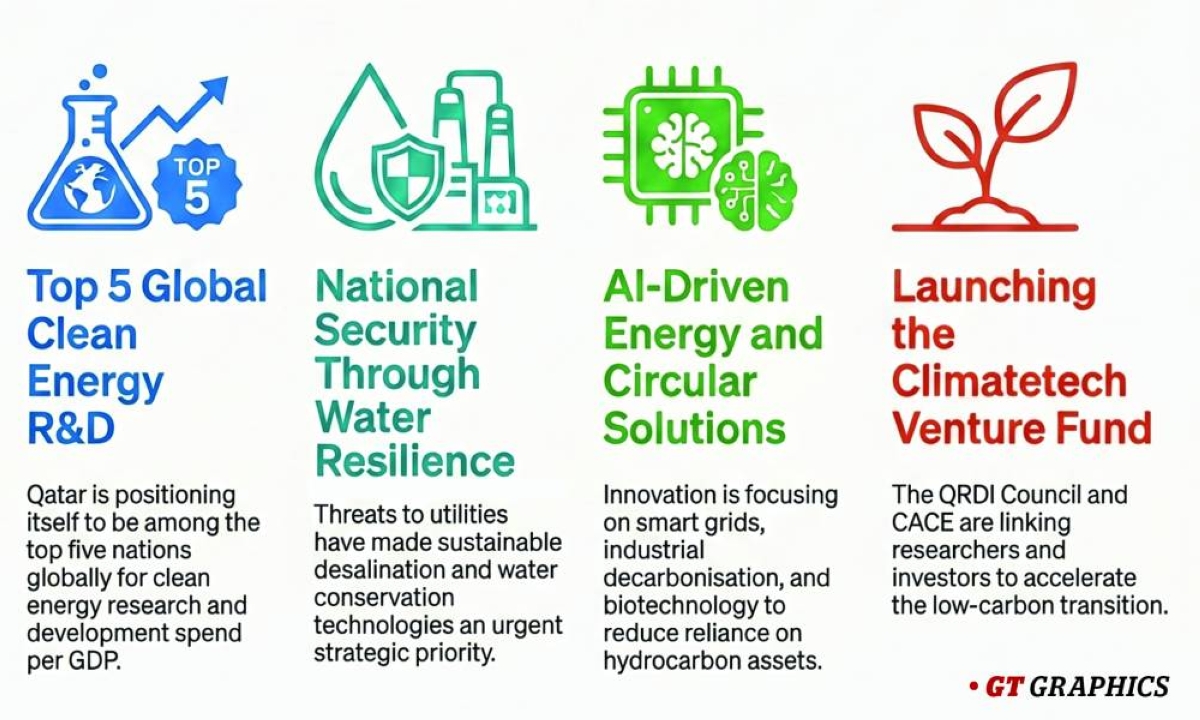
“Qatar's climatetech sector has steadily evolved from a niche sustainability drive into a strategic pillar of diversification and national resilience; even as the Iran war may appear to slow climate investment, but in reality its adoption is slated to accelerate. Qatar's market scale, private-sector maturity and oil and gas dependence are challenges; thanks to institutional support and state-backed innovation programmes, climate innovation in Qatar, which abinitio focused on energy efficiency in the hydrocabons sector, has now expanded into broader sustainability applications, including renewable energy integration, smart grids, carbon capture, desalination efficiency, biotechnology, and circular economy solutions. Facing acute environmental pressures including extreme heat, water scarcity, and rising cooling demand, Qatar offers rising opportunities for innovation in district cooling, energy-efficient buildings, desalination, and AI (artificial intelligence)-driven energy management. Emerging research also indicates growing potential for geothermal and automation-enabled clean energy systems adapted to the Gulf conditions. International collaboration has played a decisive role in accelerating the growth of climatetech in Qatar, whose environmental conditions are a natural testing ground for greentech solutions, and will continue to be central to the country's climatetech strategy. Qatar Foundation-Rolls-Royce pact is a pointer to investing, developing, and scaling-up climatech businesses, with a target to grow 20 unicorns by 2040, positioning Qatar among the top 5 countries globally investing in clean energy R&D or research and development (in terms of spend per gross domestic product). It is in line with Qatar’s vision to further promote the state’s economic diversification, including legislative and commercial incentives to develop projects that preserve the environment and counter climate change. QRDI (Qatar Research, Development and Innovation Council) has funded the Climate Action Center of Excellence (CACE) to launch Qatar's first dedicated Climatetech Venture Capital Investment Fund, linking entrepreneurs, researchers, and investors to advance sustainable technologies and drive Qatar’s low-carbon transition. Qatar Science and Technology Park (QSTP) has emerged as the central incubator for sustainability-focused entrepreneurship, offering accelerator programmes, venture funding, and industry partnerships. Transnational giants as Shell, TotalEnergies, and Iberdrola Innovation Middle East have worked closely with Qatar-based entities to support startup accelerators, pilot projects, and research programs focused on sustainability. Initiatives like the Shell.ai Futures Pitch Qatar Edition and the QSTP X TotalEnergies WaterTech Accelerator demonstrate the country’s intent to attract local and international startups working on AI-enabled energy systems, water conservation technologies, and industrial decarbonisation solutions. The Qatar Edition of Shell.ai Futures Pitch 2025 competition, held for the first time in Doha through a strategic partnership between QSTP and Qatar Shell Research and Technology Centre has recognised three pioneering startups for their innovative digital energy solutions. Qatar, which can leverage its expertise in energy systems, offers immense potential to be regional leader in climatetech innovation, on growing global demand for decarbonisation technologies, sustainable infrastructure, and climate adaptation solutions. The sector’s prominence has risen more than ever, especially after threats to water desalination plants that many regional governments now view climatetech as part of the national security and economic resilience than simply environmental policy. The Middle East crisis has rather exposed the vulnerabilities, posing short-term operational and investment-related hurdles; even as it reinforces the importance of decentralised renewable energy systems, water security technologies, and climate-resilient infrastructure. Investments in renewable energy, battery storage, smart grids, water security technologies, carbon capture, and AI-enabled infrastructure management are slated to accelerate as they have not only become urgent strategic priorities but also the region seek to reduce dependence on vulnerable hydrocarbon assets. The conflict has underscored risks to desalination facilities and critical utilities, creating strong demand for sustainable water technologies and resilient urban infrastructure across the Gulf. In the short-term, supply chain disruptions remain a concern as many climatetech firms depend on imported components like solar panels, batteries, semiconductors, and advanced industrial equipment. Geopolitical tensions, shipping delays, and rising logistics costs have temporarily increased project expenses and slowed down implementation timelines across the region. Long-term potential far outweighs short-term woes; Qatar’s future climatetech success will likely depend on its ability to commercialise research, scale startups regionally, and balance energy leadership with sustainability commitments in an increasingly carbon-conscious world. Qatar has all the ingredients — capital, infrastructure and strategy — to become an international laboratory for climate resilience innovation.
Original story
Continue reading at Gulf Times Qatar
www.gulf-times.com/qatar
Summary generated from the RSS feed of Gulf Times Qatar. All article rights belong to the original publisher. Click through to read the full piece on www.gulf-times.com/qatar.
