
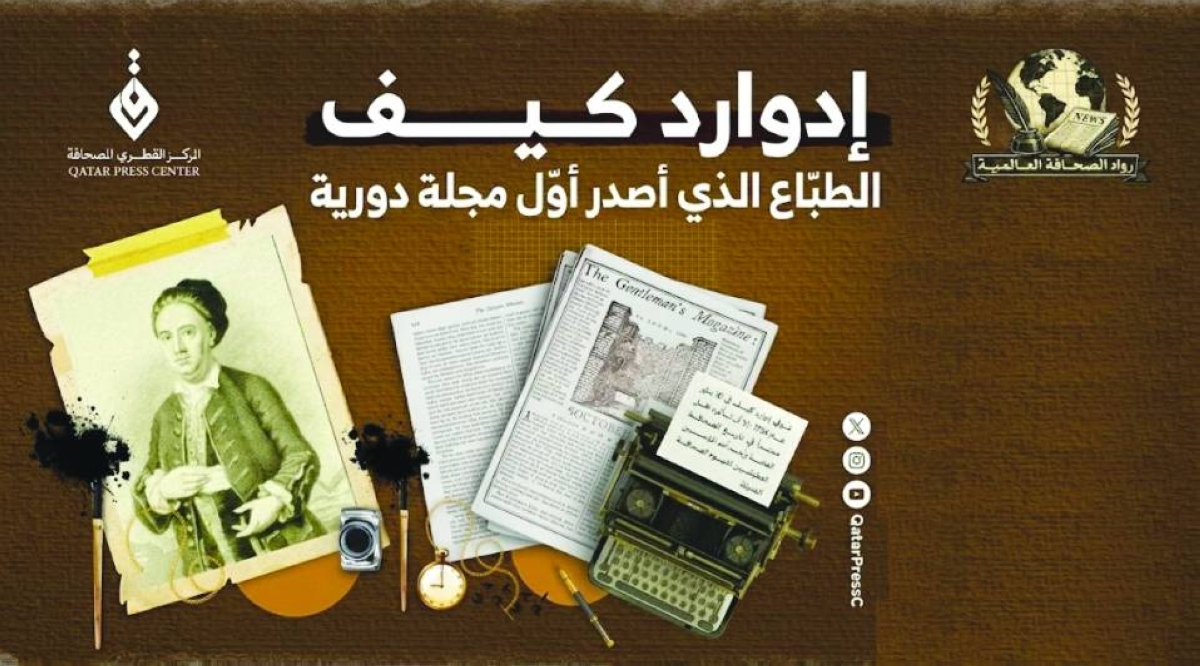
“The Qatar Press Centre (QPC) continues its 'Pioneers of Global Journalism' series with an episode on Edward Cave, the English printer, editor, and publisher, and one of the most prominent pioneers of modern journalism. The 'Pioneers of Global Journalism' series is a cultural and educational initiative highlighting prominent media figures who left an indelible mark on the development of journalism and the promotion of freedom of expression worldwide. Edward Cave is credited with founding *The Gentleman's Magazine, considered the first model of a periodical in the modern sense. Journalism historians agree that this issue marked a pivotal turning point in the history of publishing, as it introduced the first comprehensive periodical that combined politics, literature, science, news, and entertainment, targeting both intellectuals and the general public. Cave was born on February 27, 1691, in Newton, Warwickshire, in central England, to a modest family; his father was a shoemaker. He grew up in humble circumstances and attended a local school, but his education was cut short when he was expelled on charges of theft, an early turning point in his life. Cave entered the workforce early, working in various jobs, including timber and small businesses, before finding his way into the world of printing and publishing. He began his professional career in English printing houses, where he gained experience through meticulous manual tasks, including arranging metal type, preparing pages, operating hand-operated printing presses, and proofreading for linguistic and typographical errors before printing. This period was crucial in shaping Cave’s deep understanding of the mechanisms of newspaper and magazine production. He became intimately familiar with the stages of content creation, from writing to printing and distribution. As his experience with printing presses accumulated, Cave began to develop a new idea: compiling various types of content into a single periodical publication. At that time, publications were printed sporadically and irregularly, and there was no established format for a comprehensive magazine. Therefore, Cave proposed publishing a monthly magazine that combined news, articles, and cultural content in a unified format. He tried to convince several London publishing houses and printing presses to adopt the idea, but he faced widespread rejection due to the project's novelty and unfamiliarity in the publishing market at the time. With the continued rejection, Cave decided to pursue the project himself, relying on his practical experience and his belief in the new model's potential for success. In 1731, he launched *The Gentleman's Magazine. Its diverse content, encompassing politics, poetry, intellectual essays, social news, and cultural topics, represented a groundbreaking experiment in publishing. The magazine quickly achieved widespread success in Britain, and its influence extended internationally, becoming one of the most widely circulated periodicals of the 18th century. This success cemented Cave's position as a leading figure in the modern publishing industry and one of the first publishers to transform journalism from a mere news outlet into a structured media industry. *The Gentleman's Magazine was a financial success, generating considerable wealth for Cave due to its high circulation figures both within Britain and across the English-speaking world. Over time, the magazine became a model for the publishing industry, continuing publication for more than two centuries, with successive editors and publishers maintaining its name and prestige. Although it officially ceased publication in September 1907, some smaller issues continued until 1922 to preserve the magazine's historical name. Cave died on January 10, 1754, but his influence remains significant in the history of world journalism.
Original story
Continue reading at Gulf Times Education
www.gulf-times.com/community/education
Summary generated from the RSS feed of Gulf Times Education. All article rights belong to the original publisher. Click through to read the full piece on www.gulf-times.com/community/education.