
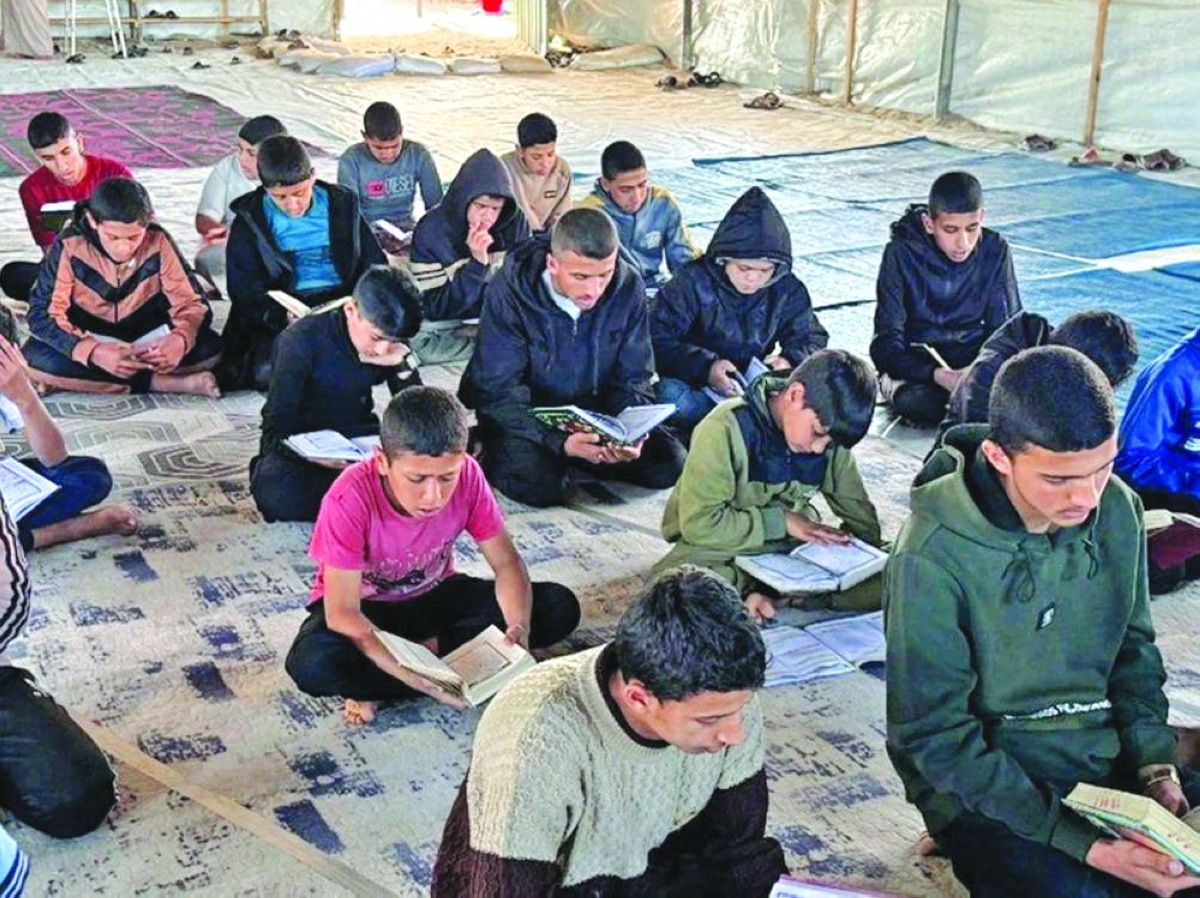
“The devastating war waged by the Israeli entity against the Gaza Strip for over two years, and the immense destruction it left behind, were not enough to extinguish the flame of devotion to the Holy Qur'an and its memorisation and learning in the hearts of Gazans. Despite the widespread destruction inflicted on infrastructure, religious and educational institutions, mosques, and Qur'an memorisation centres during the two years of war, the Gaza Strip is witnessing a remarkable official, popular, and community movement to reactivate Qur'an memorisation and teaching centres as an effective tool for spiritual and psychological recovery and for rebuilding the human capital exhausted by the brutal war. Rami al-Shaqra, supervisor of the Al-Nour Centre for Qur'an Memorisation and Sciences in the Gaza Strip, affirmed that the centre's work represents an attempt to recover and rebuild Palestinian identity in the face of the repercussions of the war and attempts to undermine all aspects of life over the past two years. He said that the Al-Nour Qur'anic School was established on the ruins of what the occupation destroyed. Al-Shaqra indicated that the current focus is on 'rebuilding the most important human resource, the individual, and reconstructing the person exhausted by the deadly war through a comprehensive Qur'anic and educational programme”. He noted that the centre currently attracts approximately 800 male and female students of various ages, from young children to senior citizens over 60, for whom specific programmes are tailored to their age group. The official added that this system is managed by an educational and training staff comprising about 60 supervisors and Qur’an teachers. Regarding the nature of the programmes offered to students under the current circumstances, al-Shaqra explained that the centre's programme is not limited to traditional worship and memorisation, but rather stems from a comprehensive educational, psychological, and rehabilitative vision aimed at integrating the Holy Qur’an into the daily lives of citizens as a means of psychological healing and overcoming trauma. “Immediately after the cessation of hostilities, we prepared comprehensive educational curricula suitable for all age groups,” he said. “This programme includes a key component for the psychological and emotional release of students, supervised by a select group of psychologists and counselors to rebuild the individual's personality and psyche,” al-Shaqra added. “Alongside this is an educational programme that explores Qur'anic stories, the biographies of the Companions, prominent figures, and influential Islamic and historical personalities to connect the generation to its roots and identity.” Abu Shaaban told to the Qatar News Agency (QNA) that the Qur’anic study circles have become a psychological haven for displaced children, providing them with a daily routine that has restored their sense of stability, in addition to instilling values of patience and mitigating the difficult behavioural effects of prolonged displacement. Huda al-Farra, 56, told the QNA: “The Qur’anic School has been a great motivator for us to memorise the Book of God and learn Islamic jurisprudence and religious sciences.” “After all we have endured – the loss of family and loved ones, injustice, and displacement – we have found in the Book of God a safe haven,” she said. “And to hold on to strength and serenity so that we may begin our lives anew.'
Original story
Continue reading at Gulf Times Education
www.gulf-times.com/community/education
Summary generated from the RSS feed of Gulf Times Education. All article rights belong to the original publisher. Click through to read the full piece on www.gulf-times.com/community/education.
