
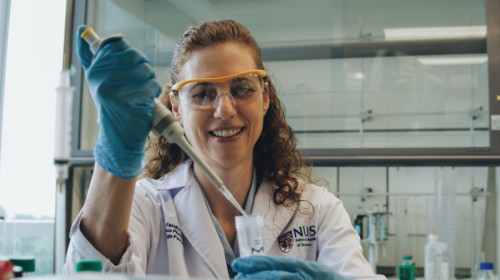
“Across dermatology clinics, doctors continue to see patients arriving with reddened skin, swelling or persistent rashes — reactions often traced back to something as routine as colouring their hair. Behind these cases lies para-phenylenediamine (PPD), a widely used ingredient in permanent hair dye, and one of the most common cosmetic allergens. Professor Giorgia Pastorin and her team from the Department of Pharmacy and Pharmaceutical Sciences of the National University of Singapore’s Faculty of Science spent nearly a decade tackling this under-recognised but growing problem. “With more teenagers and young adults colouring their hair — and with allergies not being age-dependent — the number of sensitised individuals is expected to increase,” Prof Pastorin notes. PPD’s chemistry has made it indispensable in commercial hair products. It delivers stable, long-lasting colour, but it also penetrates the skin easily and binds strongly to skin proteins. These very properties, however, can trigger lifelong allergic contact dermatitis. The goal of the NUS team is simple yet challenging: create hair dyes that work as well as those with PPD, but without the painful allergic reactions. The research, in fact, began when a clinician who treats patients with hair dye allergies posed an unexpected question to Prof Pastorin’s team: As pharmacists, you know how to deliver drugs into the body, but do you know how not to deliver them through the skin? That challenge sparked a research direction that has since expanded into a full translational effort. A safer solution for hair colouring Hair dye–induced contact dermatitis is not just uncomfortable; severe cases can lead to facial swelling, long-term sensitivity, and significant impacts on quality of life. While alternative hair dyes are available in the market, many still cause cross-reactions in up to 30 per cent of individuals already allergic to PPD, leaving few safe options for consumers. This gap is especially relevant in Asia, where use of hair dye is high, but comprehensive data on allergies remain limited. To address these challenges, Prof Pastorin and her team collaborated with chemists, clinicians, and dermatologists to design and synthesise over 20 new PPD analogues. These compounds were engineered to minimise skin penetration and reduce reactivity with skin proteins to lower sensitisation potential, while retaining strong interactions with the hair shaft to provide intrinsic colour without the use of heavy oxidising agents. Early safety tests showed promising results. Several of the new compounds developed by the NUS team demonstrated significantly lower sensitisation potential than PPD, and in some cases performed better than current commercial substitutes. At the molecular level, the researchers achieved this by fine-tuning the structure of hair dyes, including the molecular weight, electronic properties, and water affinity. These adjustments produced molecules that minimally permeate the scalp, are less reactive toward key proteins involved in allergic responses, yet still retain the ability to produce stable, natural-looking colour when applied to hair. Striking this balance, says Prof Pastorin, “took multiple iterations and many discussions with collaborating clinicians.” Next steps With support from recently-acquired government funding, the team will now progress towards formulating leave-on and wash-off prototypes and scaling up dye production. They also plan to conduct genetic safety tests, which would determine whether their dyes are suitable for long-term use. Additionally, there are plans to expand clinical trials in the United States and across Asia, including with cohorts of individuals sensitive to PPD. “We hope to confirm that our dyes do not show cross-reactivity in sensitised patients, and ensure they remain safe for Asian populations,” Prof Pastorin says. If successful, this work could reshape how permanent hair dyes are designed, replacing a decades-old chemical standard with solutions built for modern safety needs, without sacrificing the performance that consumers expect.
Original story
Continue reading at NUS Newsroom
news.nus.edu.sg
Summary generated from the RSS feed of NUS Newsroom. All article rights belong to the original publisher. Click through to read the full piece on news.nus.edu.sg.


