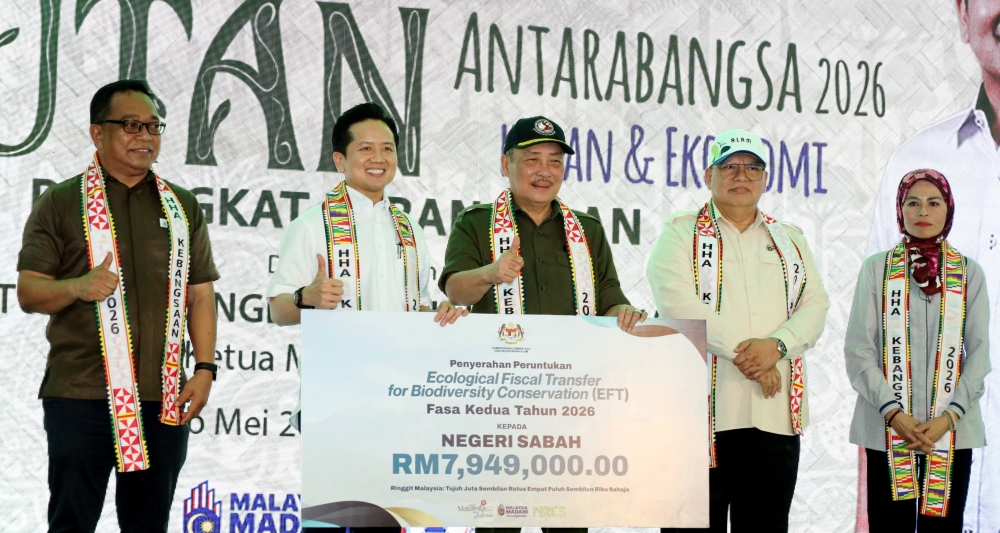
“KOTA KINABALU, May 23 — Sabah has pledged to maintain at least 50 per cent of its land under forest cover as the state prepares a long-term master plan to guide forest management and balance development with environmental conservation. Chief Minister Datuk Seri Hajiji Noor said the state government, through the Sabah Forestry Department, is drafting a Statewide Forest Master Plan that will serve as a guideline for managing Sabah’s forest resources over the next 25 years. He said the plan is part of Sabah’s efforts to rationalise land use while ensuring ecologically sensitive areas remain protected. “With the Forest Master Plan in hand, the Sabah government will ensure that all Ecologically Sensitive Areas remain protected while at the same time not neglecting sustainable socio-economic development for the wellbeing of the people of Sabah,” he said when opening the national-level International Forest Day 2026 celebration in the interior district of Sook today. Hajiji said Sabah currently maintains 63 per cent forest cover, comprising 3.85 million hectares gazetted as forest reserves and other protected areas. He added that the state is also committed to maintaining 2.2 million hectares, or 30 per cent of Sabah’s total land area, as Totally Protected Areas to strengthen biodiversity conservation. At the same time, Hajiji said Sabah has identified about 400,000 hectares of degraded forest reserve land for forest plantation development under the Forest Plantation Development Action Plan 2022–2036. According to him, the initiative is aimed at restoring degraded forest productivity while reducing the timber industry’s dependence on natural forest log supplies. The chief minister also announced that Sabah, together with the United Nations Development Programme and the Global Environment Facility, will implement the Food Systems, Land Use and Restoration Impact Programme involving integrated landscape management across 2.1 million hectares in 12 districts. The programme is expected to benefit about 56,000 rural residents by coordinating land-use planning while reducing the environmental impact of palm oil production and preserving high conservation value forests. Hajiji also said that, based on recent reports, Sabah has maintained its status as a carbon-negative state due to its vast forested areas that absorb more carbon dioxide than the state emits. He said Sabah’s forests play a critical role as “carbon sinks” in mitigating climate change and stabilising the global climate system. “This status is supported by the significant forested areas in the state, which contribute greatly to the nation’s carbon absorption capacity,” he said. He added that peat swamp and mangrove forests could also support Sabah’s blue and green economy sectors. Hajiji said the state government is continuing community-based forest restoration programmes through the Sabah Forestry Department, including the reforestation of degraded forests, rehabilitation of water catchment areas, and alternative income projects involving non-timber forest products such as kelulut honey and rattan. He said Sabah has received RM126.36 million in Ecological Fiscal Transfer funds since 2019 for biodiversity conservation projects, while the Sabah Forestry Department has also been allocated RM70.8 million under the 13th Malaysia Plan for forestry initiatives.
Original story
Continue reading at Malay Mail Education
www.malaymail.com/news/malaysia
Summary generated from the RSS feed of Malay Mail Education. All article rights belong to the original publisher. Click through to read the full piece on www.malaymail.com/news/malaysia.


