
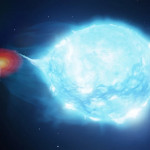
“Scientists measure force of powerful jets streaming from a black hole in the Cygnus system The findings confirm a theory posed by UW–Madison researchers a decade ago. By Chris Barncard April 29, 2026 Share this article Jets of energetic particles streaming away from the black hole Cygnus X-1 (at left in this artist’s rendering) bend in the stellar wind from the supergiant star paired in orbit with the black hole. Researchers used the extent of the bending to produce the first measurement of the power of a black hole’s jets. Image: ICRAR/Curtin University An international team of researchers has measured the power of jets of particles blasted into space by black holes, a first that confirms a prediction made by University of Wisconsin–Madison astronomers a decade ago. These jets stream out perpendicular to the spinning axis of black holes as the black holes swallow matter, putting some portion of the energy released back into the space around the black hole. The jets can extend hundreds or thousands of light years from their source. “We know these jets probably have very energetic particles in them. We can see where they have poked holes right through things, like clouds of gas,” says Sebastian Heinz , a UW–Madison professor of astronomy and co-author of the new findings. “But to understand how they can shape the universe around them, we need to know just how powerful they are.” Using data from two continent-sized networks of radio telescopes, the team was able to watch the jets streaming from a black hole called Cygnus X-1 flutter and bend in the wind of a nearby star. Knowing the wind’s power and how far it bent the black hole jets, the researchers could determine how powerful the jets were when they collided with the wind. The Cygnus X-1 jets were blasting through space at about 150,000 kilometers per second, roughly half the speed of light, with the power equivalent to 10,000 times the output of our Sun. The observations were published in the journal Nature Astronomy . “We were able to piece together the ‘dancing’ motion of the jet and measure its properties in a way that hadn’t been possible before,” says Steve Prabu, Breakthrough Listen Fellow at University of Oxford and lead author of the study. “By doing so, we discovered that the stellar wind from the companion star is strong enough to bend the jet, and this gave us a unique way to measure the jet’s power directly.” In simulations published in 2015 , Heinz and then-graduate student DooSoo Yoon built a model of these sorts of interactions between stellar winds and black hole jets. “This basically confirms our predictions,” Heinz says. “It’s not often that you get to do that in science, especially in astronomy, because you have to wait for the universe to align. That can take a while.” Previous measurements of the jets had been based on bubbles of space they had cleared in clouds of gas, effects that may have taken many thousands of years to play out. So, those estimates of jet power produced average strengths stretched over millennia, while the new measurement represents the power of the jets within about an hour from the time the jet left the black hole. The Cygnus X-1 system — which lies about 6,000 light years from Earth, in the constellation Cygnus — includes a massive black hole and a supergiant star orbiting each other, a unique opportunity to watch black hole jets “dance” in the powerful stellar wind. But black holes may be similar enough that the new measurements give astronomers a more accurate basis on which to build new predictions and models of how black holes shape the universe around them. “This is an important anchor point,” Heinz says. “If we can build an understanding of the relationship between what’s falling into the black hole and what goes into the jet, we will be able to describe the effect the black holes can have, through their jets, on what is happening even far off from the black hole.” This research was supported in part by the National Science Foundation.
Original story
Continue reading at UW-Madison News
news.wisc.edu
Summary generated from the RSS feed of UW-Madison News. All article rights belong to the original publisher. Click through to read the full piece on news.wisc.edu.

