
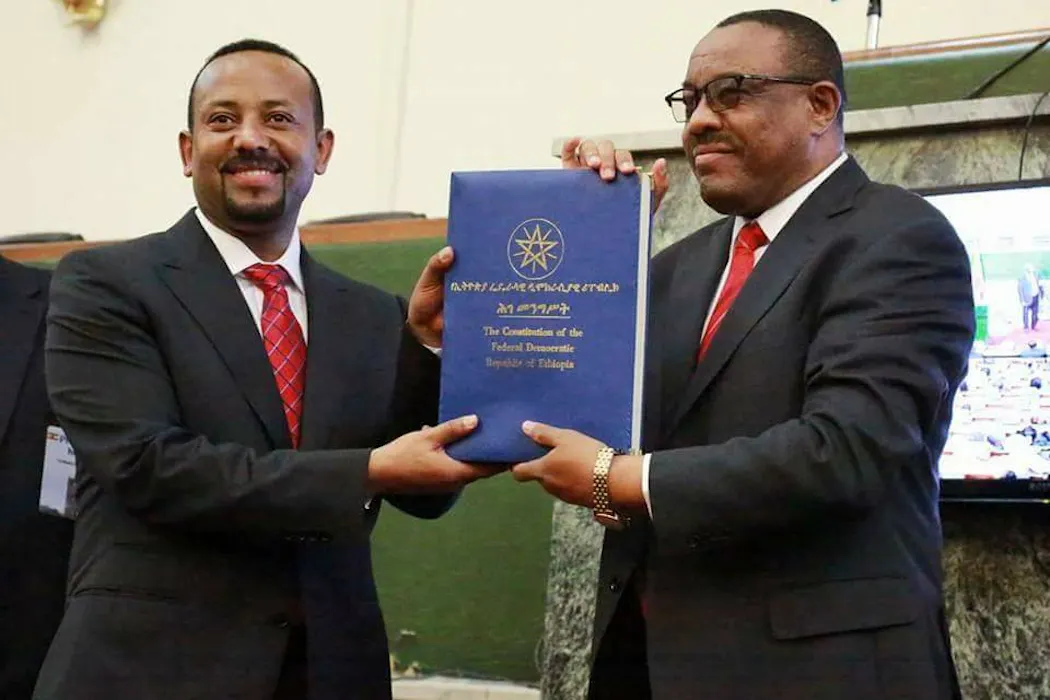
“Outgoing prime minister Hailemariam Desalegn (right) hands a copy of the Ethiopian constitution to his successor Abiy Ahmed in 2018. Wikimedia Commons , CC BY Ethiopian prime minister Abiy Ahmed has revived debate over whether the country should impose term limits on its head of government. Speaking before the National Dialogue Commission in May 2026 – just weeks before national elections – he said executive power should be “limited by law”. He suggested the issue could form part of wider constitutional reform that many Ethiopians have been calling for since 1995. At first glance, the proposal seems straightforward. But Ethiopia operates under a parliamentary system, not a presidential one. Alemayehu Fentaw Weldemariam, who has studied Ethiopia’s constitutional design and law, explains why the real issue isn’t term limits, but the failure of the parliamentary mechanisms meant to constrain executive power. Why don’t parliamentary systems usually impose term limits on prime ministers? In parliamentary systems, prime ministers derive their authority from parliament. They remain in office for as long as a majority in parliament is willing to support them. There are no fixed term limits. In presidential systems, leaders get their authority directly from voters and serve fixed terms set by the constitution. Prime ministers may be removed at any time through a vote of no confidence, internal party revolt or electoral defeat. In contrast with presidential systems, the removal of a prime minister doesn’t always trigger a national election. When a prime minister loses office, a new leader may be selected within the governing party. The underlying parliament still has democratic legitimacy, so there is no need to return to voters – or to cap tenure. Margaret Thatcher served for 11 years in the UK. Angela Merkel governed Germany for 16 years. Their longevity was evidence that parliamentary accountability and electoral competition were functioning as intended. They remained in office because they continued to command confidence within competitive parliamentary democracies. Thatcher’s premiership ended when Conservative MPs withdrew support through a leadership challenge. Merkel stepped down after choosing not to seek another term. By contrast, in presidential systems, the executive and legislature derive their mandates independently. Removing a president interrupts a fixed term chosen directly by voters, and a successor cannot be appointed simply through parliament. In Ethiopia, executive power is vested in the Council of Ministers, headed by the prime minister. The difficulty is that the formal parliamentary logic has often failed to operate in practice. Read more: African countries are adopting two houses of parliament to boost democracy – but that’s not always what happens First, the House of People’s Representatives has rarely functioned as an independent body capable of holding the prime minister politically accountable. This has made a no-confidence vote against the prime minister politically unrealistic. Second, leadership transitions have taken place through ruling-party decisions rather than genuine parliamentary contestation. The replacement of Hailemariam Desalegn by Abiy Ahmed in 2018 , for example, occurred through internal party politics. Parliament then formalised it. How has Ethiopia’s system produced concentrated executive power? Parliamentary systems don’t operate the same way in every political context. They function differently in: a dominant-party state: this is a political system in which several parties may legally exist and elections may be held, but one party monopolises political power over an extended period. transitional democracies: these are political systems moving from authoritarian rule toward democratic governance. The transition is often fragile, especially if political instability, economic hardship or legacies of conflict continue to shape public life. politically fragmented countries: here, political authority and party competition are divided among rival groups, making stable governance and national consensus difficult. When ruling parties dominate parliament, opposition parties are weak and lawmakers rely heavily on party leaders. Parliament may stop acting as a real check on executive power. In such situations, a prime minister can begin to resemble an elected monarch. He or she is technically accountable to parliament, but in practice holds highly concentrated power. This is what makes Ethiopia’s constitutional experience complex. The constitution adopted in 1994 and entered into force in 1995 follows the formal logic of a parliamentary government. Article 70(4) limits the president – a largely ceremonial head of state – to two six-year terms. Articles 73 and 74 impose no limit on the prime minister. On paper, this is orthodox parliamentarism. In practice, Ethiopia has the formal structure of a parliamentary system without the political conditions needed for real parliamentary accountability. These conditions are strong opposition parties, meaningful intra-party competition, independent committees and the real possibility that parliament could withdraw support from the executive. The result is that political power is concentrated in the executive and the dominant ruling coalition. What role does Ethiopia’s electoral system play in this? Electoral systems shape how votes are translated into political power and legislative representation. Ethiopia uses a first-past-the-post electoral system . This means the candidate with the most votes wins the seat. By contrast, proportional representation systems allocate seats roughly in proportion to each party’s share of the national or regional vote. First-past-the-post systems mean that modest electoral victories can be transformed into overwhelming legislative dominance. Article 54 of Ethiopia’s constitution adopts this system. Ethiopia, therefore, combines parliamentary government with an electoral model that magnifies majorities into monopolies. What does Ethiopia’s political history show? Ethiopia’s post-1995 political record illustrates this pattern clearly. Meles Zenawi served three full parliamentary terms as prime minister. He was two years into his fourth term when he died in 2012 . Meles was replaced by Hailemariam Desalegn . His premiership ended in 2018 after three years of mass protests and political upheaval . His resignation was extraordinary in Ethiopia’s political history. Abiy Ahmed took office in April 2018 to complete Hailemariam’s parliamentary cycle. He dissolved the Ethiopian People’s Revolutionary Democratic Front – in power since 1991 – and consolidated authority under his Prosperity Party . Abiy began his first full five-year term after the 2021 elections. His party won 410 out of 436 parliamentary seats , giving him the premiership. Read more: What is federalism? Why Ethiopia uses this system of government and why it’s not perfect The issue is that a prime minister can be repeatedly reappointed because the electoral and party systems limit meaningful contestation from the outset. Would term limits solve the problem? Only partially. A constitutional term limit could encourage leadership circulation, reduce the personalisation of executive office and create incentives for succession planning. In fragile democracies, such limits may serve as a safeguard against indefinite incumbency. But term limits alone would not resolve Ethiopia’s deeper constitutional problem. A dominant party can rotate prime ministers while preserving the same electoral advantages, patronage systems and concentration of power. The deeper reform question is whether Ethiopia can achieve: stronger opposition rights more independent parliamentary committees greater transparency in legislative voting more credible intra-party competition. Formally, Ethiopia isn’t a one-party state. As of 2026, the National Electoral Board of Ethiopia has accredited 24 national political parties and 45 regional parties . A total of 48 parties are confirmed to participate in the seventh general election scheduled for 1 June 2026. The absence of prime ministerial term limits in Ethiopia is not the problem. A lack of parliamentary competition and independence is. Alemayehu Fentaw Weldemariam does not work for, consult, own shares in or receive funding from any company or organisation that would benefit from this article, and has disclosed no relevant affiliations beyond their academic appointment.
Original story
Continue reading at The Conversation Africa
theconversation.com/africa
Summary generated from the RSS feed of The Conversation Africa. All article rights belong to the original publisher. Click through to read the full piece on theconversation.com/africa.
