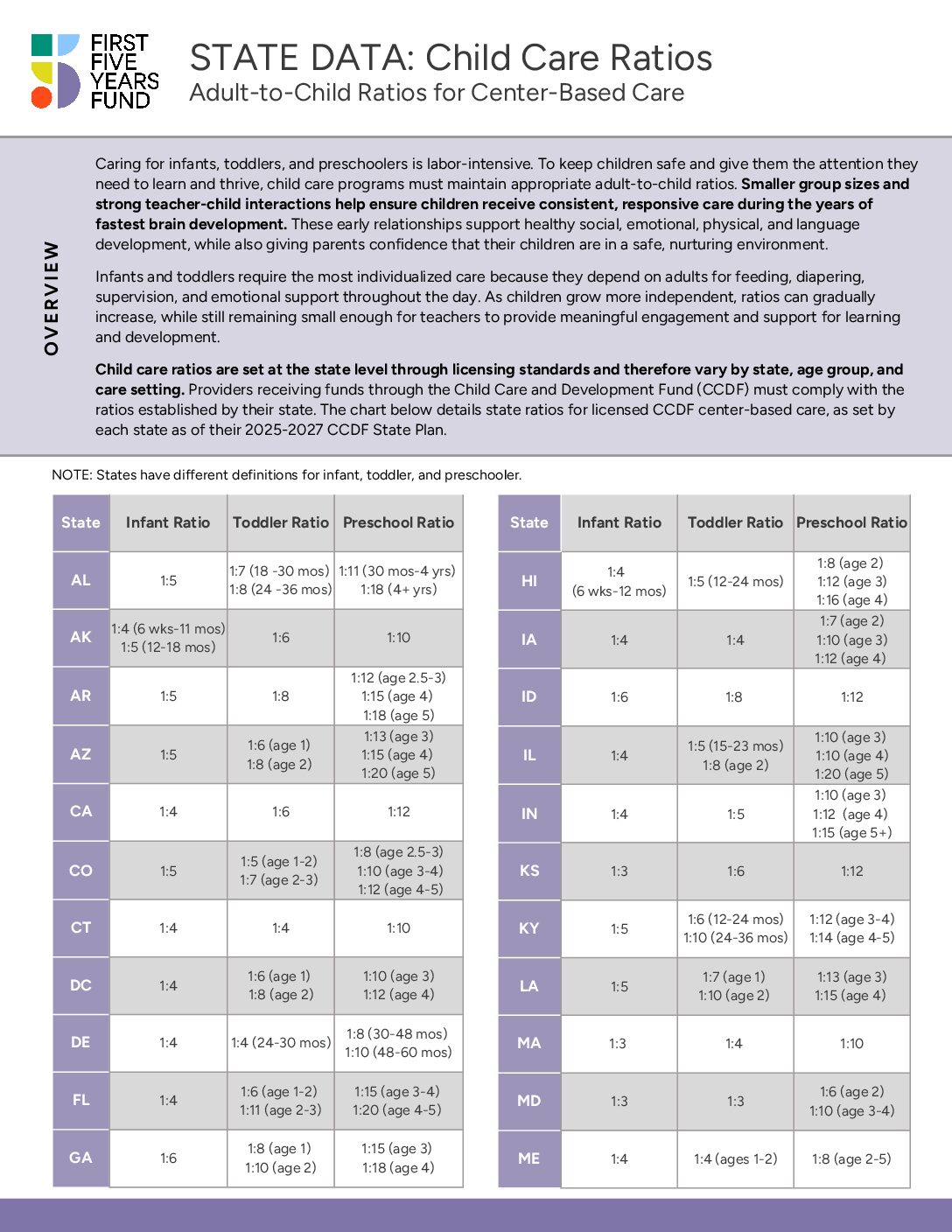
“Caring for infants, toddlers, and preschoolers is labor-intensive. To keep children safe and give them the attention they need to learn and thrive, child care programs must maintain appropriate adult-to-child ratios. Smaller group sizes and strong teacher-child interactions help ensure children receive consistent, responsive care during the years of fastest brain development. These early relationships support healthy social, emotional, physical, and language development, while also giving parents confidence that their children are in a safe, nurturing environment. Infants and toddlers require the most individualized care because they depend on adults for feeding, diapering, supervision, and emotional support throughout the day. As children grow more independent, ratios can gradually increase, while still remaining small enough for teachers to provide meaningful engagement and support for learning and development. Child care ratios are set at the state level through licensing standards and therefore vary by state, age group, and care setting. Providers receiving funds through the Child Care and Development Fund (CCDF) must comply with the ratios established by their state. The chart below details state ratios for licensed CCDF center-based care, as set by each state as of their 2025-2027 CCDF State Plan. Download (371.91 kB) The post State Data: Child Care Ratios – Adult-to-Child Ratios for Center-Based Care appeared first on First Five Years Fund .
Original story
Continue reading at First Five Years Fund
www.ffyf.org
Summary generated from the RSS feed of First Five Years Fund. All article rights belong to the original publisher. Click through to read the full piece on www.ffyf.org.