
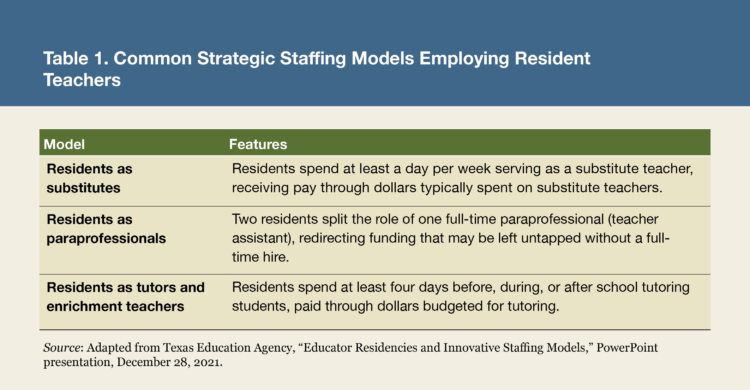
“In the face of persistent educator shortages and continued concerns over post-pandemic learning recovery, state leaders have been seeking policy strategies to better recruit, prepare, and retain a qualified, effective teacher workforce. Rigorous teacher residencies are one such strategy. California and Texas have heavily invested in them, and other states can learn from their experiences—particularly how to make these residencies affordable. Quality preparation enhances teachers’ effectiveness and their likelihood of staying in the classroom. [1] Teacher residencies—a gradual-release approach to preparation modeled in part after medical residencies—have been especially successful. [2] Residency graduates are often more effective than other beginning teachers, and they tend to stay in teaching longer—particularly compared with emergency hires, alternative-route candidates, or uncertified teachers. Residency graduates are often more effective than other beginning teachers, and they tend to stay in teaching longer. Residencies have the added benefit of reducing the costs to local education agencies (LEAs) accruing from the pricey cycle of churn and shortages that disproportionately affect the highest-need students. Given that replacing one teacher can cost between $9,000 in rural areas to more than $25,000 in urban areas, retaining existing qualified teachers can save LEAs significant sums. [3] But residency programs do require ongoing investments in resident stipends, an important component of the model. To make residencies financially sustainable under current constraints, LEAs are turning to innovative strategic staffing models. Residencies versus Traditional Preparation While programs labeled “teacher residencies” vary considerably, effective programs share several key features. These programs feature strong, collaborative partnerships between LEAs and educator preparation programs (EPPs). EPPs co-design and co-operate the residency with the LEAs where they place candidates for their clinical experience, resulting in programs that are tailored to LEAs’ contexts and that often involve selective recruitment of candidates whose credential areas meet specific LEA hiring needs. [4] Traditional teacher preparation programs do not typically feature this type of collaboration between EPP and placement LEA. [Residency] programs feature strong, collaborative partnerships between LEAs and educator preparation programs. Another notable difference is the length of the clinical placement. Traditional student teaching candidates spend no more than a single semester in a mentor teacher’s classroom. In contrast, residents engage in a full-year clinical placement that involves co-teaching—i.e., sharing instructional responsibilities—with an expert mentor teacher. As a result, residents have more opportunities to practice and receive feedback on their teaching. They also experience the full arc of the school year, which is something that both residents and hiring districts highly value. [5] During their clinical year, residents often take coursework that is tightly integrated with their clinical practice with a cohort of fellow residents so that theory and classroom experience reinforce each other in real time. Finally, while traditional student teaching is unpaid, residents often receive a stipend to defray living expenses during the residency year, generally in exchange for a postresidency commitment to teach in the LEA where they were prepared. The stipends help make high-quality preparation financially accessible for a broader, more diverse set of candidates. Coupling clinically intensive preparation with high levels of professional and financial support from the EPP and partnering LEA, high-quality residencies represent a game changer in teacher preparation. While traditional student teaching is unpaid, residents often receive a stipend to defray living expenses during the residency year. How Strategic Staffing Supports Residencies A central question for LEAs and EPPs is how to fund resident stipends. Both operate on chronically tight budgets. Few, if any, discretionary funds exist to support residents. However, LEAs do have funding streams that are tagged for substitute teachers, paraprofessionals, tutors, and other instructional support roles, and residents can fulfill these. Thus, LEAs that strategically align resident roles with existing funding can afford stipends while meeting other staffing needs. Referred to in residency circles as “strategic staffing,” this practice has been broadly touted as a promising component of a comprehensive strategy to address the residency funding challenge. In residency strategic staffing models, sponsoring LEAs fund stipends by having the teacher resident concurrently perform additional instructional services (table 1). Importantly, residents spend the majority of their time teaching alongside their mentor teacher (i.e., the teacher of record whose classroom they are working in), even as they spend some time each week in another role. EPP faculty and LEA staff alike have spoken to the importance of maintaining strong guardrails around residents’ additional instructional responsibilities so that their primary focus during the residency year remains learning to be a teacher. That said, strategic staffing can help LEAs address immediate staffing needs while also investing in the long-term stability of their teacher workforce. Experiences of California and Texas The two states that have made the greatest investments in building residency capacity and infrastructure through grant funding are California and Texas. Yet each has taken distinct approaches to planning for long-term sustainability. California’s Grant Program. Since 2018, the California legislature has allocated more than $736 million to the Teacher Residency Grant Program, with an additional $250 million planned for 2026–27. [6] Through the program, LEAs that are planning, implementing, or expanding a teacher residency in partnership with an approved EPP can apply for grants of up to $40,000 per resident, with a required LEA or EPP match of $20,000 per candidate. Applicants are required to incorporate these research-aligned components: a full year of clinical experience alongside an experienced mentor teacher, accompanied by coursework; preparation that is tailored to the LEA context and allows residents to learn about the LEA’s instructional initiatives and curriculum; a cohort model; a minimum $20,000 stipend (as of the 2023–24 fiscal year); a service requirement (candidates commit to teaching for at least four years in the grantee LEA within eight years of program completion); and no-cost induction support (i.e., free mentoring and other forms of assistance for early-career teachers) following program completion. [7] From its inception, the program has asked applicants in its request for proposals (RFP) to explain how they plan to sustain their programs once grant funding ends. At the same time, the state affords LEAs wide latitude in their approaches to sustainability. Strategic staffing models that tap into existing paraprofessional or substitute teacher budget lines have emerged as one funding source for sustainable programming. For California’s residency grant-funded programs, such models offer a way to meet the $20,000 per-resident district match requirement while also building a structure that can be sustained beyond the life of the grant. A WestEd survey of grant-funded LEAs found that more were leveraging paid paraprofessional or substitute roles to fund their residencies than other funding sources (such as federal or state funds; see figure 1). Notably, many LEAs reported that they were still exploring how to develop such models, pointing to the importance of technical assistance. Because many LEAs with grant-initiated residencies have struggled to develop sustainable funding, California is taking a more hands-on approach to sustainability planning. A revised RFP for the 2025–26 academic year prompts LEAs to identify local funding sources they could draw on—including support staff funds for strategic staffing and/or locally controlled formula funding. Applicants must also spell out the per-resident funding and cohort sizes that local funding can sustain. [8] The revised requirements also set the expectation that LEAs will collaborate on strategic staffing with the Statewide Residency Technical Assistance Center during the grant funding period. The center has developed guidance around a paraeducator strategic staffing model, which they can support LEAs in implementing. Importantly, the guidance distinguishes between the responsibilities of “para-residents” and traditional paraeducators, firmly establishing that the para-resident should be focused first on learning to be a teacher under the guidance of their mentor teacher. The center will provide LEAs with technical assistance that takes local constraints and requirements into account and helps LEAs leverage locally controlled formula funding for residencies. The revised requirements also set the expectation that LEAs will collaborate on strategic staffing with the Statewide Residency Technical Assistance Center during the grant funding period. Texas’s Grant Program. The Texas COVID Learning Acceleration Supports initiative was Texas’s initial investment in teacher residencies. Between 2021 and 2024, Texas dedicated over $90 million to its program for high-quality, sustainable residencies, including $78 million in resident and mentor teacher stipends and nearly $13 million for technical assistance. The Texas Education Agency prioritized the long-term sustainability of the residencies, particularly through strategic staffing. LEA grantees had to provide several core assurances: strong LEA-EPP partnerships, including formal agreements with state-vetted EPP residency programs, regular shared governance meetings, and preferential hiring of residency completers; high-quality residency design, including year-long clinical placements, structured mentorship and co-teaching supports, and collaborative selection and training of mentor teachers; strategic staffing implementation, with LEA, school, and EPP leaders required to participate in training and technical assistance and commit to a strategic staffing model fully funded by LEA dollars by 2024–25; and sustainable funding commitments, including a minimum $20,000 stipend for each resident, with the grant covering the stipends for the three years of the grant program. [9] The grant was structured to give LEAs time and support to develop a strategic staffing model that would meet immediate staffing needs and be sustainable. During the earlier stages of the grant, grantee LEAs engaged with technical assistance providers to design and implement a strategic staffing model. In year three, they piloted these models, and in year four—when the grant funds had sunset—they were expected to fully implement the model to help self-fund the resident stipend. [10] Texas’s program gave LEAs choices in how to implement strategic staffing models (see table 1 for examples). Importantly, it also stressed that while residents may “fill instructional needs” in strategic staffing models, the additional responsibilities “should also be a benefit to their own preparation.” [11] To keep residents’ learning and preparation at the center, the state education agency emphasized the need for planning and ongoing support from both LEAs and EPPs. [12] Texas’s program gave LEAs choices in how to implement strategic staffing models. While Texas’s investment and thoughtful grant design helped programs grow and create funding models, not all LEAs were able to continue funding $20,000 resident stipends through strategic staffing alone, even after additional rounds of grant funding to support their transition to a sustainable funding model. [13] To address this issue, among others, the Texas legislature passed House Bill 2 in 2025, an omnibus education finance package that included a wide range of investments in teacher recruitment and retention. Under H.B. 2, beginning in 2026–27 LEAs will receive ongoing state allocations of at least $12,000 per resident to contribute to resident and mentor teacher stipends, paired with an additional required LEA contribution of at least $10,000 per resident. These allocations sum to a $20,000 per resident and $2,000 per mentor teacher minimum stipend. [14] Given the support many LEAs have already received, it is likely that strategic staffing models will be the source of their LEA contribution. Residency Outcomes. In both states, the proportion of residency-trained teachers among program completers has increased substantially over the past few years. [15] In California, the number of candidates reporting they were prepared through a residency pathway has more than tripled, from about 500 in 2018–19 to roughly 1,800 in 2023–24, or about 12 percent of all newly credentialed teachers prepared in California. [16] In Texas, the number of vetted teacher residencies—programs certified as meeting state quality standards for residency preparation—increased from 15 EPPs in 2021 to 37 in 2024, representing 30 percent of all EPPs in the state. [17] Promising early outcome data suggest that state and local investments to support stipended teacher residencies in California and Texas have helped the two states progress toward a variety of policy goals. In California, residency-trained teachers reported being more satisfied with their preparation and better prepared to meet California’s teacher performance expectations relative to candidates prepared through student teacher or intern pathways. [18] They also have higher initial teaching performance assessment passage rates than teachers trained through other routes. [19] Promising early outcome data suggest that state and local investments to support stipended teacher residencies … have helped the two states progress toward a variety of policy goals. Furthermore, California’s residency-trained teachers are, as a group, more racially/ethnically diverse than candidates trained through other routes, helping to move the needle toward a teacher workforce more demographically aligned with California’s student population. [20] These early outcomes are consistent with research that shows that residencies not only provide high-quality preparation but also attract more diverse candidates because the model addresses some of the major barriers that keep potential candidates from accessing the profession. Data specific to Texas shows more substantial learning gains for students of residency-trained teachers relative to teachers trained through other routes. [21] Both states show higher retention rates in the teaching profession for residency-trained teachers. [22] Because they produce well-prepared, diverse, effective teachers who tend to stay in teaching, teacher residencies in California and Texas have proven to be well worth sustaining—and strategic staffing models have proven to be an important source of funding for doing so. Teacher residencies in California and Texas have proven to be well worth sustaining. Lessons for Other States As other states build comprehensive teacher workforce development strategies, they can draw important lessons from California’s and Texas’s approaches to investing in teacher residency programs and pressing for strategic staffing as a way to sustain them. State boards of education and professional standards boards can mobilize these lessons into effective policy in their own contexts. First, regardless of the size of the state investment, a focus on program quality and sustainability should be intentionally built into investments from the outset. States can increase returns on investment by requiring grantees to adopt programmatic features associated with positive residency outcomes. California embedded these expectations directly into its grant RFP, while Texas created a designation—“vetted teacher residencies”—that required EPPs to meet state-defined quality standards in order to partner with LEAs receiving grant funding. State boards can help set a vision for high-quality teacher preparation. For example, the Texas State Board for Educator Certification subsequently created a formally recognized teacher residency preparation pathway culminating in a new state teaching certificate, the Enhanced Standard Certificate, that codified many of the EPP program features the state required for grant funding. [23] States can increase returns on investment by requiring grantees to adopt programmatic features associated with positive residency outcomes. Second, strategic staffing models represent an important source of funds for sustaining residencies over the long term . State investments that require LEAs to match a portion of grant or formula funds can encourage LEAs to adopt these approaches. However, LEAs also need time and targeted assistance to develop effective models. Programs should have access to—and be required to engage with—technical assistance to support their implementation of strategic staffing and other sustainable funding models. Furthermore, when developing strategic staffing models, states should establish guardrails to protect residents’ learning and preparation time, as California and Texas did. For grant programs aiming to support the development of such sustainable funding structures, phased transitions from grant to LEA-provided funding can increase the likelihood that programs continue beyond the grant period. Texas’s gradual shift from grant-funded stipends to LEA-funded stipends provided LEAs with time to pilot, refine, and fully implement strategic staffing models before assuming financial responsibility. Programs should have access to technical assistance to support their implementation of strategic staffing and other sustainable funding models. Finally, although strategic staffing models can ease the financial challenges of offering resident stipends, California and Texas LEAs have found it difficult to sustain $20,000 stipends, which are already modest relative to residents’ living costs. Thus, strategic staffing will be most effective when paired with other investments and funding sources rather than relied on as a stand-alone solution . When combined thoughtfully, strategic staffing can help LEAs reallocate existing resources to provide high-quality preparation experiences for residents. As states consider launching or expanding teacher residency initiatives, state board members may benefit from reflecting on key questions: How might teacher residencies fit within a comprehensive teacher workforce development strategy? Examine existing teacher pipelines, initiatives, and trends to better understand the state’s teacher preparation landscape and whether state investments such as scholarships or loan forgiveness could reduce upfront costs for candidates or incentivize participation in high-quality residencies. How can my state ensure high-quality residency implementation as programs develop and scale ? Identify clear leverage points—grant requirements, partner eligibility criteria, and technical assistance—that can help maintain quality while expanding access. What opportunities for strategic staffing exist, and how might residency-based strategic staffing advance other state policy priorities? Consider whether residencies with strategic staffing might support your state’s broader goals related to teacher retention, workforce diversity, staffing shortages, or literacy and math instructional improvement. Ultimately, by combining thoughtful investment, strong programmatic support, and strategic staffing, states can cultivate and scale sustainable, impactful teacher residency programs, leading to a more stable and effective teacher pipeline over the long term. Julie Fitz is a senior researcher, Cathy Yun is the deputy director of EdPrepLab and a senior researcher, Victoria Wang is a researcher and policy advisor, Jennifer Bland is a senior researcher, Wesley Wei is a research and policy associate, and Steve Wojcikiewicz is a senior researcher and policy advisor at Learning Policy Institute. Notes [1] Charles T. Clotfelter, Helen F. Ladd, and Jacob L. Vigdor, “Teacher Credentials and Student Achievement: Longitudinal Analysis with Student Fixed Effects,” Economics of Education Review 26, no. 6 (2007): 673–82, https://doi.org/10.1016/j.econedurev.2007.10.002 ; Donald J. Boyd et al., “Teacher Preparation and Student Achievement,” Educational Evaluation and Policy Analysis 31, no. 4 (2009): 416–40, https://doi.org/10.3102/0162373709353129 . [2] For a review of evidence, see Ryan Saunders et al., “Teacher Residencies: State and Federal Policy to Support Comprehensive Teacher Preparation” (Learning Policy Institute & EdPrepLab, 2024), https://doi.org/10.54300/358.825 . [3] Learning Policy Institute, “2024 Update: What’s the Cost of Teacher Turnover?” interactive tool (September 2024). [4] Cathy Yun and Julie Fitz, “ Successful Teacher Residencies: What Matters and What Works” (Learning Policy Institute, 2025), https://doi.org/10.54300/480.783 ; Pathways Alliance and Prepared to Teach, “Towards a National Definition of Teacher Residencies: A Report from the Pathways Alliance Teacher Residency Working Group” (2022); Roneeta Guha, Maria E. Hyler, and Linda Darling-Hammond, “The Teacher Residency: An Innovative Model for Preparing Teachers,” report (Learning Policy Institute, 2016). [5] Cathy Yun and Julie Fitz, “Successful Teacher Residencies: What Matters and What Works” (Learning Policy Institute, 2025), https://doi.org/10.54300/480.783 [6] California Department of Finance, “Governor’s Budget Summary 2026–27,” 2026; Susan K. Patrick, Linda Darling-Hammond, and Tara Kini, “Early Impact of Teacher Residencies in California ,” fact sheet (Learning Policy Institute, 2023). [7] Teacher Residency Grant Program, California Education Code §44415.5 (2023). [8] California Commission on Teacher Credentialing, Request for Applications for Teacher Residency Implementation and Expansion Grants,” accessed December 23, 2025. [9] Steve K. Wojcikiewicz et al., “Teacher Residencies in Texas: Supporting Successful Implementation” (Learning Policy Institute, 2025), https://doi.org/10.54300/630.675 . [10] Jennifer A. Bland et al., “Strengthening Pathways into the Teaching Profession in Texas: Challenges and Opportunities” (Learning Policy Institute, 2023), https://doi.org/10.54300/957.902 . [11] Texas Education Agency, Educator Residencies and Innovative Staffing Models, PowerPoint presentation , December 28, 2021. [12] Texas Education Agency, Educator Residencies presentation . [13] Wojcikiewicz et al., “ Teacher Residencies in Texas .” [14] Texas House Bill No. 2 , 89th Legislature (2025). [15] Source for California data: Susan K. Patrick, Linda Darling-Hammond, and Tara Kini, “Educating Teachers in California: What Matters for Teacher Preparedness?” (Learning Policy Institute, 2023), https://doi.org/10.54300/956.678 . Source for Texas data: Jim Van Overschelde and Minda Lopez, Emerging Research on Scalability and Sustainability in California and Texas Teacher Residencies, PowerPoint presentation, American Association of Colleges for Teacher Education Annual Conference, New Orleans, LA, February 20, 2026. [16] Susan K. Patrick et al., “Teacher Residencies in California: Enrollment, Preparation, and Outcomes of Residency-Trained Teachers” (Learning Policy Institute, forthcoming 2026). [17] Learning Policy Institute, “Teacher Residencies in Texas,” fact sheet (2024). [18] Learning Policy Institute, “Teacher Residencies in Texas,” fact sheet . [19] Patrick et al., “Teacher Residencies in California.” [20] Residencies tend to prepare a more diverse set of candidates than traditional teacher preparation programs, likely due to the availability of financial supports. In California, the design of the residency grant program further enables this outcome by allowing grants to be used specifically for programs designed to diversify the workforce. As a result, many residencies explicitly recruit and support a racially diverse teacher candidate pool. Patrick et al., “Teacher Residencies in California.” [21] Jacob J. Kirksey, “Building a Stronger Teacher Workforce: Insights from Studies on Texas Teacher Preparation,” policy brief no. 1 (Texas Tech University Center for Innovative Research in Change, Leadership, and Education, July 2024). [22] Statewide impacts on teacher retention in California have not been analyzed, but a Learning Policy Institute study of five California teacher residencies found retention rates ranging from 84 percent to 100 percent over a two- or three-year period, which is well above the state average. See, for California data, Yun and Fitz, “ Successful Teacher Residencies .” For Texas data, see Simona Goldin et al., “Evaluation of Paid Teacher Residencies in Texas: Impacts and Promising Practices,” brief (Education Policy Initiative at Carolina, October 2025). [23] Wojcikiewicz et al., “ Teacher Residencies in Texas .”
Original story
Continue reading at NASBE
www.nasbe.org
Summary generated from the RSS feed of NASBE. All article rights belong to the original publisher. Click through to read the full piece on www.nasbe.org.
