
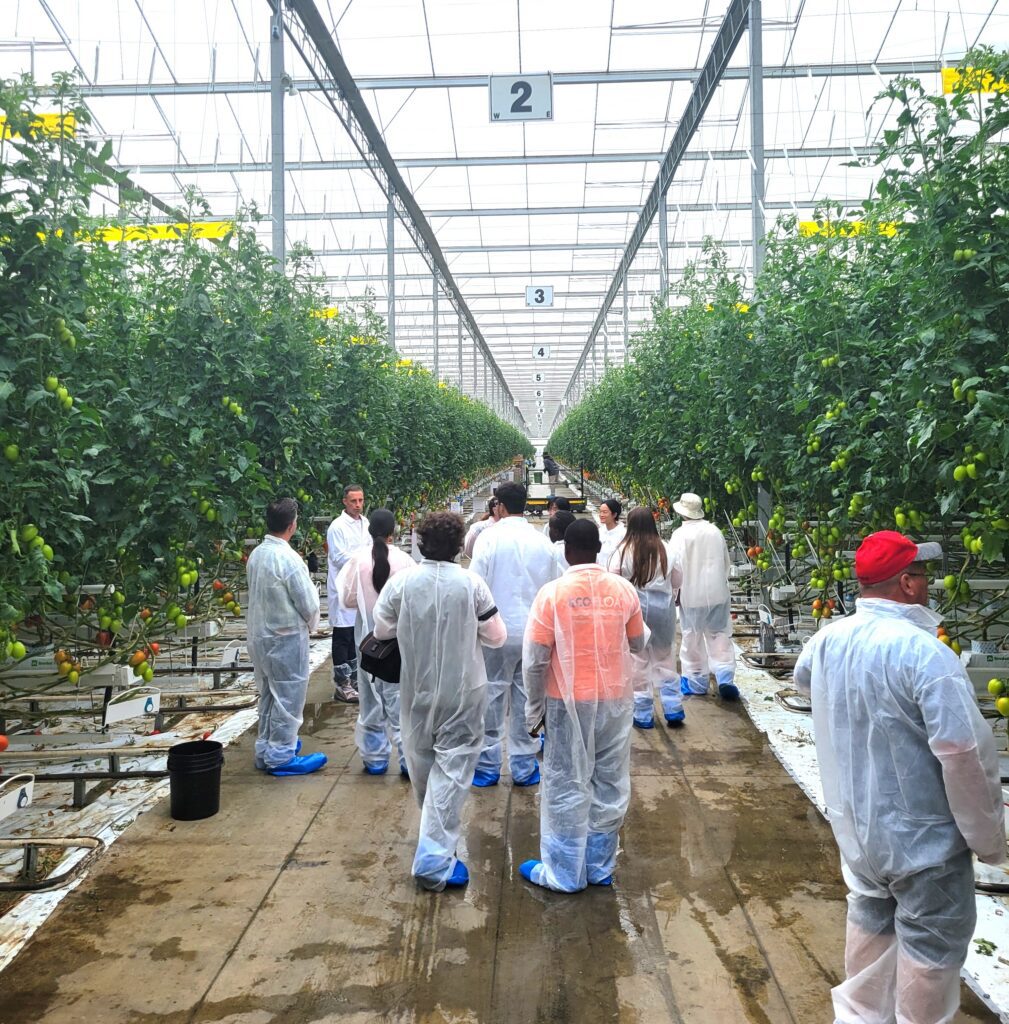
“The world is changing the way it produces and thinks about food. The global sustainable farming sector was valued at US$15.35 billion in 2024 and is projected to reach US$34.90 billion by 2034, while the broader sustainable agriculture market is expected to hit US$26.14 billion by 2030 . Keeping pace with these shifts demands more than surface-level knowledge. Employers now seek specialists who can lead on climate-smart farming and food system resilience. With a master’s programme in sustainable agriculture, you’ll get to build the depth to do just that, positioning you to step into senior roles that sit at the intersection of science, policy, and practice. The urgency behind this goes beyond good career prospects. According to the FAO’s 2024 Statistical Yearbook , 733 million people remain undernourished globally – 152 million more than in 2019 – making advanced expertise in this field a prerequisite for solving the most consequential food challenges of this generation. Here are three universities in Canada and the US offering high-impact sustainable agriculture master’s degrees: The University of Guelph’s Master’s in Sustainable Agriculture prepares students for careers in Canada’s agriculture and food sector. Source: University of Guelph University of Guelph The global food system is under pressure, and the people who understand how to fix it are in high demand. The Master of Sustainable Agriculture (MSAg) at the University of Guelph ’s (U of G), Ontario Agricultural College (OAC) trains you to be one of them – and with U of G ranked #1 in Canada – and 14 th in the world – for agriculture and forestry (QS World University Rankings by Subject, 2026), the credential carries serious weight. The MSAg is a 16-month, course-based, career-focused master’s programme with no thesis requirement. You’ll build skills across data analysis, agricultural economics, supply chain management, and agri-food technology, grounded in real industry practice from the start. Every semester builds deliberately on the last, combining field-based learning with opportunities to visit agricultural operations across Ontario, giving you firsthand insight into how modern, innovative and sustainable agricultural practices are shaping today’s agri-food sector. “Our first semester at U of G’s Ridgetown Campus is very well-integrated in the agriculture space,” says Pranshu , a student from the inaugural cohort. “We gain the theoretical knowledge as well as the practical knowledge.” That balance carries through the entire programme. Semesters two and three move to the main Guelph campus, where you can specialise in either Plant Agriculture, Livestock Agriculture, or Environmental Sciences. The depth you build there feeds directly into your fourth and final semester: a paid internship inside an agri-food organisation, where you’ll graduate with real connections and real experience. From there, you’ll be stepping into a network of 35,000 OAC alumni working across agronomy, sustainability consulting, food policy, environmental management, and beyond. The MSAg is one of several graduate pathways at OAC. The college also offers the Master of Plant Agriculture , the Master of Food, Agricultural and Resource Economics , and a range of research-based MSc and PhD programmes. University of Georgia’s College of Agricultural & Environmental Sciences students learn directly from researchers advancing new methods and technologies for agriculture and environmental sustainability. Source: University of Georgia/Facebook University of Georgia The University of Georgia ‘s College of Agricultural & Environmental Sciences (CAES) is all about caring for global ecosystems and equipping the next generation of leaders. Ranked #5 among public universities in the US for agricultural sciences, CAES is dedicated to discovering and delivering the science required for healthy living. Two graduate programmes in particular stand out for anyone working at the intersection of food systems and sustainability. The Master of Agribusiness (MAB) is a professional degree built for the space where agricultural science and business strategy meet. Rather than a thesis, it channels 36 credit hours into case-based instruction, quantitative methods, and business analysis. The 24-hour core covers economic tools, food marketing, financial management, and agribusiness management. Twelve elective hours let you go deeper into futures and options markets, international agricultural marketing, environmental economics, and water resource management. The programme culminates in a paid internship with a regional or national agribusiness firm alongside a technical report, meaning you graduate with documented industry experience already in hand. For those drawn toward the science side of sustainable food production, the MS in Crop and Soil Sciences offers a Sustainable Agriculture concentration. The research-based degree requires a minimum of 30 graduate credit hours, a thesis, and a faculty advisory committee. Students submit a programme of study in their first semester and a thesis proposal by the end of their second semester, an early structure that maintains research momentum from the start. Both programmes are based at UGA’s main campus in Athens, Georgia, within a research-intensive environment with strong industry ties across the Southeast. Financial assistance is available on a competitive basis through departmental research assistantships. Iowa State University’s Sustainable Agriculture programme trains students to think across disciplines and address real-world challenges in food security and environmental quality. Source: Iowa State University/Facebook Iowa State University Iowa State University opened its doors in 1869 as one of the first land-grant universities in the country, built on the idea that higher education should be practical and rooted in real-world problems. Agriculture has been central to that mission ever since. The university’s agriculture and forestry programmes now rank #7 globally in the 2026 QS World University Rankings. That legacy feeds into the MS in Sustainable Agriculture . The graduate programme combines knowledge and problem-solving skills from the agricultural sciences with ecology, the social sciences, and ethics. What makes it stand out is its track record – it was the first programme in the US to offer both an MS and a PhD in Sustainable Agriculture, and it remains the only graduate programme where students can pursue a genuinely interdisciplinary curriculum covering the biological, social, and economic dimensions of sustainability. That breadth is structural, not incidental. The programme runs across 21 departments – spanning Agricultural and Biosystems Engineering, Agronomy, Economics, Sociology, Landscape Architecture, Political Science, and more – with faculty cooperating to offer courses and direct research. As such, you won’t be siloed into one department; your work can genuinely cross lines. The curriculum is anchored by core courses like Foundations of Sustainable Agriculture and Agroecosystems Analysis. You’ll study agroecological principles and the social relations underlying farming and food systems, while amassing experience with sustainable techniques along the way. If food systems interest you more than farm systems, the MS in Food Science and Technology is worth a look. It has three specialisations – Functional Food and Packaging, Food Safety and Quality, and Green and Sustainable Food – that cover the post-harvest side of the same sustainability conversation. *Some of the institutions featured in this article are commercial partners of Study International
Original story
Continue reading at Study International
www.studyinternational.com
Summary generated from the RSS feed of Study International. All article rights belong to the original publisher. Click through to read the full piece on www.studyinternational.com.
