
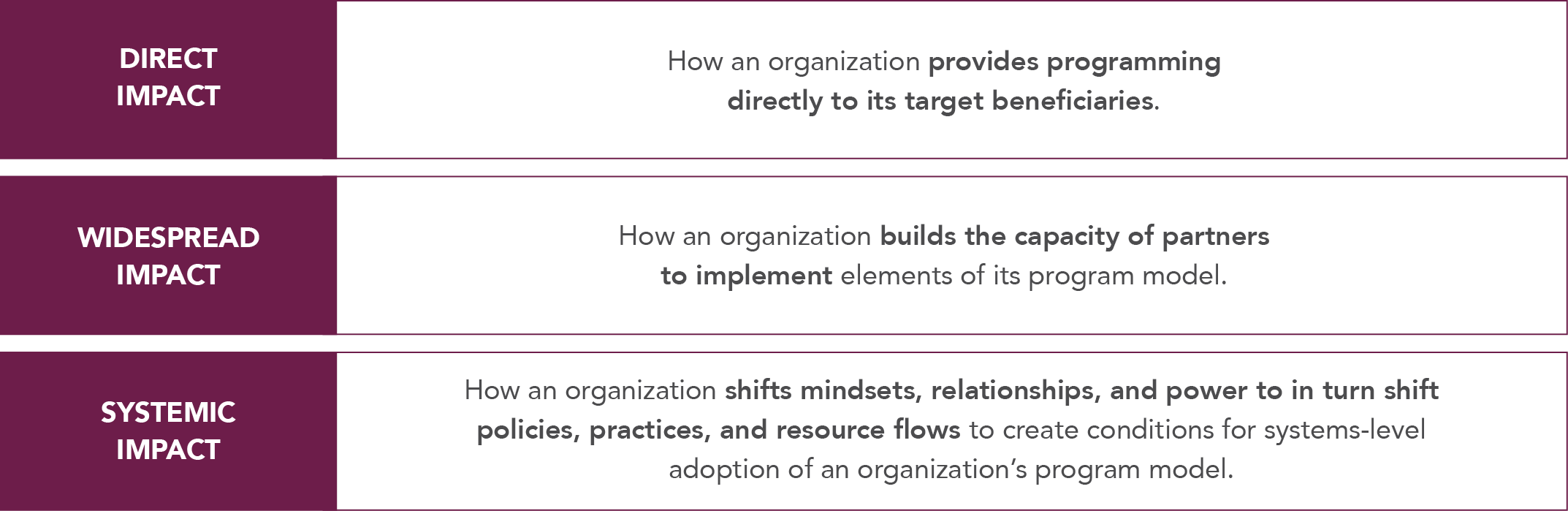
“Systemic Impact Designing and Executing Effective Campaigns Alex Cortez , Christine Wade , Kateland Beals Download PDF Introduction “Campaigns are highly energized, intensely focused, concentrated streams of activity with specific goals and deadlines. Through campaigns, people are recruited, programs launched, battles fought, and organizations built.” —Marshall Ganz{{Marshall Ganz, What Is Organizing? (2012), https://antiga.novact.org/wpcontent/uploads/2012/09/What-is-Organizing-by-Marshall-Ganz.pdf .}} In January 2025, Bellwether launched an initiative to explore strong practices in Systemic Impact (how an organization shifts mindsets, relationships, and power to in turn shift policies, practices, and resource flows to create conditions for systems-level adoption of an organization’s program model). This is the fifth in a series of publications exploring how nonprofit organizations, including those in the education sector, can effectively design and execute Systemic Impact strategies to achieve their ambitions. Learn more by reading Bellwether’s Systemic Impact series : 1. The Only Path to Scale, Success, and Sustainability 2. Systems, Markets, and Infrastructure 3. Mapping Authority in Postsecondary Systems 4. Introduction to Designing Effective Strategies 5. Designing and Executing Effective Campaigns 6. Using Measurement to Manage, Maximize, and Demonstrate the Value of Campaigns 7. The Importance of Implementation This initiative builds on Bellwether’s Pragmatic Playbook , published in June 2022, which explores how organizations can employ three strategies to maximize their overall impact and their ability to effectively compete in the education sector.{{Alex Cortez and Christine Wade, A Pragmatic Playbook for Impact: Direct, Widespread, and Systemic (Bellwether, 2022), https://bellwether.org/publications/pragmatic-playbook-for-impact/ .}} A Note on Language : Although the sector uses the terms “Systemic Impact” and “Systems Change” interchangeably, this report anchors on “Systemic Impact” (except in direct quotes). At times, the most important Systemic Impact work is not to create a change but rather to preserve the status quo or “play defense” to preserve existing progress — to resist change that is in opposition to an organization’s agenda. Over the past three-plus years, dozens of organizations across the country have adopted this framework for strategic decision-making and have used its key principles to communicate priorities in a clear, compelling external pitchbook to attract clients, partners, funders, and allies, and as an internal playbook to build alignment within their organizations. One of the biggest areas of need organizations frequently cite is access to more guidance and resources on how to build their ability to pursue Systemic Impact, including making the case internally and externally to other stakeholders such as funders. This publication provides guidance on how organizations can specifically design and execute Systemic Impact campaigns, following a five-step process (Figure 1). Step A. Establish the Campaign Agenda and Identify Relevant System(s) and Authority(ies) As an organization or coalition embarks on a Systemic Impact campaign, the first step is to establish its agenda (Step A1) and then identify which systems need to be engaged with (Step A2) and who has authority within those systems to advance the campaign’s agenda (Figure 2). Step A1. Establish the campaign agenda. An agenda is the specific, measurable objective(s), aligned to addressing specific barriers that, if achieved, will determine a campaign’s success. Any Systemic Impact agenda should articulate a compelling goal worthy of any stakeholder’s time, effort, resources, and risk to pursue (Table 1). (Note: The goal of some agendas is to play defense and prevent an unwanted change, which means measuring the preservation of the status quo.) Without a clear agenda, it is impossible (or at least challenging) to design and execute the next steps in a campaign, which involve: Identifying which system(s) and authority(ies) own the decisions that would result in achieving a given agenda. Mapping the flows of power to influence those in authority, including where organizations have power and where they need to build it further. Determining a series of actions to shift mindsets, develop relationships, and exert power on those in authority. Rallying other stakeholders (e.g., communities, peer organizations, allies in a system, and funders, among others) to commit to a campaign. Absent a clear Systemic Impact agenda, it is also much easier for the opposition to undermine a campaign and in turn advance its own competing agenda. Ultimately, without a clear agenda, power and organization around a Systemic Impact campaign tend to dissipate because there is no consensus about its sustaining purpose. TABLE 1: EXAMPLES OF CLEAR, MEASURABLE SYSTEMIC IMPACT CAMPAIGN AGENDAS Example Agendas High-Level Context/Rationale Approve 1,544 charter seats in Redwood City, California. Families in Redwood City wanted their district school board to vote to allow two new charter schools with a history of strong local performance to open in the community. Families in Redwood City wanted their district school board to vote to allow two new charter schools with a history of strong local performance to open in the community. Michigan’s Talent Together built a coalition of school district leadership and institutions of higher education (IHEs) to advocate for state-level funding to launch teacher apprenticeship degrees. Amend the Massachusetts state constitution to create an additional tax of 4% for income over $1 million. Massachusetts’ state legislative effort had not succeeded to pass a new tax to support critical social needs, including “free” community college. Increase New York’s Tuition Assistance Program (TAP) minimum grant amount from $500 to $1,000. In New York, a statewide evolution of TAP was needed to better achieve its intended purpose of easing the financial burden of tuition and making higher education more accessible, especially for students from low-income households, first-generation students, and students of color. Step A2. Identify which system(s) to focus on and who has authority within each system to advance a campaign agenda. Identifying the relevant system(s) is about locating where the decision(s) about policy, practice, and resource flows live(s). Identifying authority is about pinpointing who within that system can make the decision to support a campaign agenda. There can be many systems involved in a Systemic Impact campaign, depending on the agenda and which systems own pieces of it. In the postsecondary sector, for instance, authority is held across a range of systems and a given campaign agenda may require engaging with multiple systems to be successful (Figure 3). For example, an effort to change institutional financial aid practices may involve engaging at the IHE level about transparency and an institution’s financial aid policy on grant awards, as well as with the federal government, which sets overall funding amounts and eligibility rules for institutions to receive Title IV student aid under the Higher Education Act of 1965. In another scenario, aiming to shift how a public university allocates advising resources might require influencing IHE leadership and governing boards, while also engaging the state government, which controls appropriations and may tie funding to performance metrics such as retention and completion. If multiple systems must make a change to achieve an agenda, the resulting campaign may be significantly more complicated than a single-system campaign. Or, this may point to the necessity of multiple campaigns that are focused on different systems. Once the relevant system is identified, an organization must then pinpoint who has authority in a given system to decide to support or block an organization’s agenda, which could include : An individual whose authority comes from being elected, appointed, or employed in a specific role. A specific governing body whose authority comes from being elected or appointed. A community whose authority comes from voting (e.g., ballot initiatives). Sometimes, authority in one system may have a role in influencing those in authority in other systems. In the postsecondary example, a university is a system that holds authority and may be the focus of a Systemic Impact campaign. However, it is also a stakeholder and sometimes itself an instigator of a Systemic Impact campaign to influence decisions by larger systems — including at the state and federal levels — that have authority over the university. Building on earlier examples of clear, measurable agendas, these postsecondary organizations identified the specific systems to engage and who has authority within those systems (Table 2). TABLE 2: MAPPING SPECIFIC SYSTEMS AND AUTHORITIES THAT CAN ADDRESS SYSTEMIC IMPACT CAMPAIGN AGENDAS Example Agenda System Authority Approve 1,544 charter seats in Redwood City, California. Redwood City School District Redwood City School Board Secure $66.4 million in state funding for teacher apprenticeship degrees in Michigan. State of Michigan Michigan State Legislature Amend the Massachusetts state constitution to create an additional tax of 4% for income over $1 million. Commonwealth of Massachusetts Citizens of the Commonwealth (via a ballot initiative) Increase New York’s Tuition Assistance Program (TAP) minimum grant amount from $500 to $1,000. State of New York New York State Legislature Step B. Identify Actions That Will Build and Deploy Power to Influence Authority Power in this series is defined as “the ability to decide an agenda and make action happen to advance that agenda.”{{Alex Cortez, Christine Wade, and Kateland Beals, Systemic Impact: The Only Path to Scale, Success, and Sustainability (Bellwether, 2025), https://bellwether.org/publications/systemic-impact/ .}} Power is the currency that purchases Systemic Impact. Step B breaks down into two sub-steps, each requiring substantial work to create a campaign plan to build and deploy power (Figure 4). Before advancing a Systemic Impact campaign’s agenda, developing a common understanding of authority and power is important . Through this lens, power can then be deployed in three ways, and in any sequence and combination (Figure 5). As Chris Avery, vice president of program strategy and partnerships at Heights Philadelphia, observed, “We learned that pressure must be coupled with credible partnership, and that systems shift faster when leaders feel both supported and accountable, not cornered.”{{Interview with Chris Avery, Heights Philadelphia, December 2, 2025.}} FIGURE 5: METHODS OF DEPLOYING POWER IN SYSTEMIC IMPACT {{Ibid.}} MORE FROM BELLWETHER : For details on how to consider power in Systemic Impact, read the first publication in this series . Step B1. Map existing flows of power to identify strengths and gaps that need to be addressed to influence authority. “Once you figure out what you want to win, you have to find out who has the power to give it to you. Get very specific about that, because that will tell you if you have enough power to influence them and change their minds.” —Jamilah Prince-Stewart, FaithActs for Education{{Panel with Jamilah Prince-Stewart, FaithActs for Education, August 27, 2025.}} The fundamental question power mapping answers is “How does a campaign successfully get those in authority to take action to advance an organization’s agenda?” Power mapping can be done by visually representing how various stakeholders interact within a system and how power flows between them. It identifies both where an organization has power to influence those in authority (directly and indirectly), and where there are gaps in its power that need to be addressed to achieve campaign success. There are four key questions that guide power mapping in Systemic Impact campaigns: QUESTION 1: Who are all of the stakeholders to consider? QUESTION 2: How does power currently flow among stakeholders to influence those in authority — including the organization doing the power mapping? QUESTION 3: Where is there support for the campaign agenda? Where is there potential to gain support? Where is there opposition? QUESTION 4: Where does an organization need to build power and/or support to influence those in authority? When visually mapping power, organizations should keep in mind that: These are a lot of dimensions to try to depict visually, and some approaches to power mapping orient around a subset of these four dimensions. Power is complex. In practice, power mapping is not this “clean” (power and corresponding levels of support often exist on a continuum rather than being binary). A power map is not static — positions are constantly shifting. In fact, the purpose of a power map is to identify where to make changes and then act on that insight. Boxes and arrows can feel like a process-heavy way of capturing relationships. Some people do this intuitively in their head versus writing it out — particularly those steeped in the specific politics and relationships of the system(s) they spend significant time in. Organizations should use whatever method of visualization is most intuitive to them and will best help them achieve clarity on how power currently flows and where they need to alter those flows. QUESTION 1: Who are all of the stakeholders to consider? This requires an organization to be expansive in its thinking and consider (a) those who are impacted by the system’s status quo, (b) those in authority to make a decision, (c) those who have power to influence those in authority or other stakeholders, and (d) any stakeholder who has an implementation role in a system. For example, in postsecondary systems, stakeholders can include, but are not limited to: Students and families Communities and community leaders (e.g., community-based organizations, faith-based groups) Leaders of IHEs (e.g., university/college residents, provosts, department chairs/deans, vice presidents of student affairs, bursars, registrars, CFOs, boards of trustees) IHE staff (e.g., advisers, financial aid officers, admissions and enrollment staff, research and data teams, faculty) State and federal policymakers (e.g., state higher education executive officers, state legislators, governors, state boards of higher ducation, federal education policymakers at the U.S. Department of Education) Local policymakers (e.g., mayors, city council members) Accreditors K-12 stakeholders (e.g., high school counselors, dual enrollment program staff) Alumni Student advising organizations Intermediary and backbone organizations that provide a mix of capacity building, research, and convenings to strengthen the field Workforce and industry connectors (e.g., local employers, workforce development boards, chambers of commerce, apprenticeship program coordinators) Funders and philanthropy Labor organizations (e.g., trade unions, teachers unions) Political influencers (e.g., political party leaders, lobbyists) Advocacy groups News media and public voices (e.g., education journalists, community radio hosts) QUESTION 2: How does power currently flow among stakeholders to influence those in authority — including the organization doing the power mapping? Answering this question requires laying out all the stakeholders and mapping how power flows between and among them, recognizing that power often flows in both directions and may be at different degrees of relative strength (Figure 6). Organizations can also choose to explicitly articulate the exact nature of the relationships between stakeholders (i.e., the arrows) and therefore their influence on each other. For example, is the relationship (and therefore influence) based on: Formal authority between stakeholders? Flows of money and/or funding, including shared donors/funders? Flows of information? Alliances, collaboration, and/or partnerships? Dependencies (X depends on Y to do something, so X succeeds)? Personal relationships? Membership in coalitions, associations, and/or networks? QUESTION 3: Where is there support for the campaign agenda? Where is there potential to gain support? Where is there opposition? At this point, an organization can identify or at least estimate the starting position of support, neutrality, or opposition to its Systemic Impact campaign agenda (Figure 7). Sometimes, this power-mapping exercise helps organizations see that they have more power and influence than they originally thought, and thus an easier campaign lift than they initially thought. In conducting a recent power- mapping exercise using this guidance, Shalema Henderson, senior director of college allies and persistence partnerships at College Access: Research and Action, observed, “It was helpful to first think about who is already bought in, because it became clear that we did not need to convince anyone that our campaign was a good idea. We needed to convene folks to have them create and buy\ into their own ideas, largely shaped by our agenda.”{{Interview with Shalema Henderson, College Access: Research and Action, December 2, 2025.}} Similarly, Avery of Heights Philadelphia noted, “Seeing the ecosystem visually clarified key leverage points and revealed unexpected allies.”{{Interview with Chris Avery, Heights Philadelphia, December 2, 2025.}} QUESTION 4: Where does an organization need to build power and/or support to influence those in authority? In this final step, an organization assesses where there is a need and an opportunity to: Strengthen a positive relationship to build more influence in support of the agenda. Weaken a negative relationship to reduce influence that could be deployed against the agenda. Shift a relationship from negative to positive. Create a new relationship that did not exist before. Power maps are not static. Rather, they are the starting point from which an organization designs a set of actions to shift power in service of its campaign agenda (Sidebar 1). SIDEBAR 1 Power Mapping to Shape a Systemic Impact Campaign in Colorado In 2018, Denver voters approved the creation of the Prosperity Denver Fund (Fund) to provide college scholarships to students from low-income households. By 2023, several organizations had identified a range of changes they wanted to make to the Fund, such as expanding age and geographic eligibility and including apprenticeship programs, in response to, among other things, a surplus in the Fund. The Denver City Council had the authority to change the fund’s policies, leading a coalition of organizations to outline a power map of critical stakeholders, their relationships to the City Council, and the nature of each stakeholder’s relationship with the City Council in a coordinated effort to pursue their aligned agenda (Table 3).{{Rebecca Tauber, “A College Fund Can’t Spend All Its Money Because Families Are Getting Priced out of Denver, so City Council Is Changing Its Eligibility Rules,” Denverite, May 22, 2023, https://denverite.com/2023/05/22/prosperity-denver-fund-scholarships-eligibility/ ; Interview, June 18, 2025.}} Roger Low, founder and CEO of the Colorado Equitable Economic Mobility Initiative, shared: “Power mapping can feel abstract, but it was absolutely necessary for us to be successful. We built a diverse advocacy coalition who could be influential from different perspectives. Some voices could influence the Denver City Council by engaging them on the wonky, evidence-based nuances of policy and outcomes-driven funding, while others could speak to the importance of equity and student desires to have more choices.”{{Interview with Roger Low, Colorado Equitable Economic Mobility Initiative, February 12, 2026.}} TABLE 3: PROSPERITY DENVER FUND POWER MAP (SIMPLIFIED) Stakeholder Relationship to Authority Influence Type Denver City Council Decision-Maker Authority Colorado Equitable Economic Mobility Initiative Indirect Influence Advocacy and Strategy Leader Ednium: The Alumni Collective Direct Influence Direct Influence Denver Scholarship Foundation Trusted by Authority Fund Beneficiary, Insider Other Coalition Organizations Mixed Grassroots and Policy Voice Council Member Networks Trusted Messengers Personal/Constituent Ties Apprenticeship Providers Apprenticeship Providers Advocacy Step B2. Identify the set of campaign actions that will build and deploy power needed to successfully influence authority. Where Step B1 maps how power currently flows in support for or opposition to an organization’s campaign agenda, Step B2 focuses on the actions an organization can take to shift those flows of power. Actions are defined as the specific steps an organization (or other stakeholders) takes to build and exert power to advance a campaign agenda. There is a wide range of potential actions an organization can take in a Systemic Impact campaign, and a campaign can use\ any number, combination, and sequence of actions. The first, and most important, question when selecting campaign actions is “How does this action build power to influence those in authority to support the organization’s agenda?” Action! Or Actions! Or Many Actions … There is no shortage of ways to organize the broad range of actions a Systemic Impact campaign has at its disposal, including based on the type of action, who is taking the action, and/or whom the target/recipient of the action is. This publication organizes actions around the following four categories: 1. The first category of actions includes both capacity building and opportunities to shift mindsets and build relationships to recruit stakeholders of all types into a campaign : Workshops and trainings Small group meetings to raise awareness and build relationships One-on-one meetings 3. The third category of actions is more explicitly about electoral campaigns and/or lobbying through a mix of 501(c)(3) and 501(c)(4) work : Candidate forums or debates as a 501(c)(3) (as long as a candidate is not endorsed) Candidate endorsement as a 501(c)(4) Candidate fundraising and direct funding as 501(c)(4) Voter registration as a 501(c)(3) or 501(c)(4) Get Out the Vote as a 501(c)(3) or 501(c)(4) Lobbying as a 501(c)(3) or 501(c)(4) 2. The second category of actions is more overt acts of building and deploying power : Boycotts Canvassing Hosting debates on an issue Lawsuits Private meetings with critical stakeholders to shift mindsets, build relationships and power, and exercise power through partnership, persuasion, and/or pressure Petitions and email or text campaigns to both build and demonstrate public support Phone banking Public events (announcements, speakers, marches, protests, sit-ins) Site visits to build stakeholders’ exposure to and experiences with conditions that will influence their support and actions 4. The fourth category of actions focuses on communications, including : Blogs or vlogs Emails Texting Media interviews Letters to the editor Op-eds Policy development/policy analysis Press conferences Research and analysis Social media posts Testimony Website Videos or documentaries Campaign actions increasingly exist in a combination of real-world actions and virtual actions to reach people where they are and influence them. The Pew Research Center released a September 2025 report indicating that significant numbers of American adults use social media for news: 55% of TikTok users, 57% of users on X, 53% of users on Facebook, 41% of users on Instagram and YouTube, and 55% of users on Truth Social.{{Emily Tomasik and Katerina Eva Matsa, “1 in 5 Americans now regularly get news on TikTok, up sharply from 2020,” Pew Research Center, September 25, 2025, https://www.pewresearch.org/short-reads/2025/09/25/1-in-5-americans-now-regularly-get-news-on-tiktok-up-sharply-from-2020/ .}} As Jeremy Bird, President Obama’s former national field director, advised, “There’s no online and offline organizing. There’s organizing.”{{Ken Thomas, “Obama’s 2012 Reelection Campaign to Go Beyond Email and Text Messaging,” MassLive, June 29, 2011, https://www.masslive.com/news/2011/06/obamas_2012_reelection_campaig.html .}} Sometimes, these actions are categorized as either “grassroots” movement building or “grasstops” influencing and engagement. This separation risks an either/or framing that campaigns should be prioritizing one approach or the other; however, every Systemic Impact campaign should customize its set of actions — and who is taking them — to the specific agenda, systemic conditions, and flows of power. A community conducting private meetings with those in authority and a small group of individuals with wealth and influence conducting private meetings with those in authority are essentially taking the same action but deploying different types of power in doing so. A range of campaign actions can be taken at any given time to: 1) directly influence those in authority, 2) influence stakeholders to use their power to influence those in authority, or 3) activate a longer chain in which stakeholders influence their peers to collectively influence those in authority (Figure 8). As discussed in the first publication in this Systemic Impact series, relationships are a critical component of building and deploying power in each of these options. Consistent key themes when engaging in Systemic Impact relationship-building include the following: Building relationships happens not just from an organization pursuing its agenda but also from understanding how to support another stakeholder’s agenda. Jose Arenas, founder of Nephesh Organizing, has long taught organizers that “often you have to put aside your agenda and listen to the other person’s agenda to build trust.”{{Interview with Jose Arenas, January 15, 2025.}} Some relationships are built on reciprocity. Building relationships is a continuous act. Emily Cherniack, founder and executive director of New Politics, advised, “You have to constantly be in relationship with people … cultivate as many relationships as possible, because you never know who is going to become powerful and who is not. Don’t get comfortable with just the relationships you currently have because the ground can quickly shift — people can quickly leave or enter the stage.”{{Interview with Emily Cherniack, New Politics, March 3, 2025.}} Relationships can be forged through working together. Erika Giampietro, founder and former executive director of the Massachusetts Alliance for Early College, shared that her “personal belief is that the only way to build relationships is to do the hard work together. … We roll up our sleeves.”{{Interview with Erika Giampietro, Massachusetts Alliance for Early College, February 19, 2025.}} Who an organization has relationships with matters. Courtney Criswell, principal at Waypoint Education Partners, explained, “Influence isn’t only about how many voices you have — it’s about which voices stand together. When unlikely allies align, it creates bipartisan legitimacy and makes reflexive opposition much harder to sustain.”{{Interview with Courtney Criswell, Waypoint Education Partners, January 30, 2025.}} At other times, power listens only to power, and in these circumstances, money is often the way power manifests. Criswell was stark in observing, “People aren’t honest enough about how a small group of people in our country can move things fast if you engage with the right people. The key is having the right influencers engage with those in authority at the right time and with the right fact base.”{{Ibid.}} At the same time, the closer those in authority are to direct engagement with (and dependency on) a public constituency, the more likely they are to be influenced by constituent voice. Relationships are a long-term investment when pursuing Systemic Impact. Criswell of Waypoint Education Partners recommended “making your friends before you need them.”{{Ibid.}} Building movements of community collective power may be the best or only way to execute some of these actions to build and deploy power. There is a long, distinguished history of movements in America that span the political spectrum. There have been progressive labor movements, civil rights movements, LGBTQ+ movements, environmental movements, reproductive health movements, and social justice movements such as Black Lives Matter and Occupy Wall Street. There have also been conservative gun rights movements, Make America Great Again movements, Moms for Liberty movements, anti-abortion movements, and anti-LGBTQ+ movements. Regardless of one’s political or ideological perspective, Systemic Impact campaigns are competitions to advance an agenda that others often oppose because it is counter to their agenda. Because of this, sometimes the most useful lessons about how to organize movements come from the opposition. Movements are successful when they: Create a common set of mindsets and beliefs that help form a common agenda. Build a community and common identity where people feel seen, heard, included, and valued. Those people have something they belong to that advances their interests and affirms who they are and their worldview (sometimes to the exclusion of being influenced by new information). Build the community’s power to take action. Exercise community power in service of their agenda. Movement building fundamentally happens through organizing. Saul Alinsky reflected, “Change comes from power, and power comes from organization.”{{Saul D. Alinsky, Rules for Radicals: A Practical Primer for Realistic Radicals (Vintage, 1989).}} Organizing, like so much of Systemic Impact, is about relationships. Joe Givens, a New Orleans community organizer, advises that “organizing is about weaving a tapestry of trusted relationships.”{{Alex Cortez and Yordanos Eyoel, “Notes from the Field: If You Want Great Schools, First Work with Parents to Create ‘Actionable Demand,’” The74, May 10, 2017, https://www.the74million.org/article/notes-from-the-field-if-you-want-great-schools-first-work-with-parents-to-create-actionable-demand/ .}} Movements build an infrastructure of community power, with individuals taking on different roles in a given campaign (Sidebar 2). SIDEBAR 2 Framing Power Infrastructure in Systemic Impact Campaigns Building community power does not mean individuals sit in just one role — they can serve in a variety of roles, entering any given role for a specific campaign and shifting their role from one campaign to another. Adapted from a framework on parent power,{{“Measuring Infrastructure,” Parent Power in Education, New Profit, https://www.parentpowerined.org/measuring-infrastructure/ .}} an infrastructure of community power can help organizations to understand how many members it has in which roles, because each member may be willing and able to deploy their power differently (Figure 9). General Community Member : An individual who is consuming value from an organization (e.g., going to its website or social media) or receiving mass outreach from the organization (e.g., mass mailing, mass emailing, advertising). Subscriber/Supporter : An individual who is known to an organization with unique identifying information and who is a consumer of an organization’s resources (in ways that often can be measured). Active Member (Individual Agenda) : A member who is involved in exercising their power through engagement with an organization, with the focus being on meeting their individual needs (versus a larger collective agenda). Supporting these individuals can create value for organizations, and it also strengthens relationships that could then lead toward involvement in a campaign agenda. Active Member (Collective Agenda) : A member involved in exercising their power through a Systemic Impact campaign. Emerging Leader : A community member beginning to develop a role leading others in a campaign. Formal Leader : A community member who sees themselves and is seen by others as a leader, because they can plan and execute actions within a campaign (or even an entire campaign), and can mobilize members of their community to participate. Formal Authority : A community member who holds a formal role in a system — elected, appointed, or employed — to have influence on decisions impacting their community in a campaign. Some organizations will formally measure how many individuals are in each role as a way to assess and then build community- based power. An infrastructure of community power is not built overnight, nor is it a one-time occurrence. Infrastructure is about relationships between an organization and the communities they serve, and what community members decide they will do, individually and/or collectively, because of this relationship. An individual can enter this framework at any point. As discussed in the fourth publication in this Systemic Impact series, as communities build their collective power to impact systems, they will require a say in what the agenda for impact is that they are seeking to achieve. Some actions require explicit use of different legal structures. At times, actions to build and deploy power can be done through a conventional 501(c)(3) nonprofit. However, when organizations are exploring how to take action through advocacy (promoting or objecting to a policy), lobbying (influencing government and policy decision-makers), and/or political campaigns (endorsing a candidate or issue), they are required to establish other types of organizational structures (though a 501(c)(3) nonprofit is permitted to engage in a limited amount of lobbying; Table 4). TABLE 4: PERMITTED LOBBYING, ADVOCACY, AND ELECTORAL ACTIVISM BY ORGANIZATIONAL STRUCTURE* Nonprofits 501(c)(3) Nonprofits Limited ability to advocate to the public on policies, subject to limitations on grassroots lobbying and similar activity. Can engage in a very limited amount of lobbying (amount depends on the size of the organization and whether the entity has made a 501(h) special election). Must be operated for charitable purposes. Cannot engage on a political campaign, or endorse a candidate. Giving to a 501(c)(3) is tax deductible and donors do not need to be disclosed. 501(c)(4) Nonprofits Can advocate to the public on policies. Can engage in unlimited lobbying. Can engage in political activity as long as it is less than 50% (according to some authorities, significantly less) of the organization’s activities; political activity cannot be coordinated with a candidate’s campaign. Must be primarily operated to advance the social welfare purpose of the organization , and any lobbying should relate to this purpose. Giving to a 501(c)(4) is not tax deductible and donors do not need to be disclosed . Political Organizations Political Action Committees (PACs) Donations directly to candidates or political parties. Donation levels restricted based on federal and state contribution limits. Cannot generally coordinate with political campaigns (specifics regulated by state or federal laws, which can vary). Giving to a PAC is not tax deductible and donors are disclosed. Independent Expenditure PACs Can raise and spend unlimited amounts of funds on a political campaign (often referred to as a “Super PAC”). Cannot generally coordinate with political campaigns (specifics regulated by state or federal laws, which can vary). Giving to an Independent Expenditure PAC is not tax deductible and donors are disclosed. Note: *Bellwether is not a legal services organization and does not provide legal advice. None of this content should be construed as advice from an attorney. Readers should consult their legal counsel before engaging in lobbying, advocacy, or electoral activism. Some observations on the role of 501(c)(3)s, 501(c)(4)s, and PACs : First, nonprofits can do a lot as a 501(c)(3) in the political arena. For example, they can conduct voter registration efforts, lead Get Out the Vote efforts that encourage and enable people to vote, and help voters by providing information about and access to polling locations. 501(c)(3) nonprofits can also conduct candidate forums and host debates, as long as they do not endorse a candidate. Many nonprofits are reluctant to employ these actions as a 501(c)(3). They may lack knowledge on how to execute these actions. Others perceive a risk of being accused of violating 501(c)(3) restrictions, even though the above actions are allowable. There is also a real risk if staff or volunteers, when engaging in actions like phone banking and canvassing, are not well trained and do not follow the restrictions about not endorsing candidates or issues. Some organizations have both a 501(c)(3) and an affiliated 501(c)(4). If so, and if staff are shared, it is critical that there is close accounting of staff time, noting the time spent on political campaigns versus lobbying versus advocacy. Again, organizations interested in working through a 501(c)(4) or PAC should engage with legal counsel on the specific requirements, which can vary from state to state and at the federal level. As daunting as this may sound, an electoral campaign may be the only way to advance a Systemic Impact agenda, and voting is a critical way to express power. John Lewis, the late Civil Rights leader and Congressman, reflected, “Your vote is precious, almost sacred. It is the most powerful, nonviolent tool we have to create a more perfect union.”{{John Lewis, “Rep. John Lewis: ‘Your Vote Is Precious, Almost Sacred,’” speech at the 2012 Democratic National Convention, posted September 6, 2012, by PBS NewsHour, https://www.pbs.org/newshour/show/rep-john-lewis-your-vote-is-precious-almost-sacred .}} Some organizations will additionally work with lobbyists because they can provide the following value : Access via their relationships. Many lobbyists previously worked within the system in which they are now lobbying and have relationships (which they continually cultivate) with elected officials, their staff, and people working within government systems. They understand who has authority and then who has actual power. They have the ears of key stakeholders to influence them directly and can get their clients direct access. Systemic Impact is about building and leveraging relationships. Lobbying is about purchasing access to a lobbyist’s relationships and knowledge of how government systems operate. Crafting messaging and shifting mindsets. Lobbyists have insights into how to frame messaging and structure content to be most compelling to those whom they are lobbying. An education lobbyist shared, “One of the big things that we do as lobbyists is make recommendations about how you make [your research and point of view] digestible for those audiences. As staffers who have worked in those spaces, we have a good understanding of the way that stakeholders think about these issues and how you can achieve them through policy and regulatory opportunities.”{{Interview, July 14, 2025.}} Developing and navigating legislation and regulation. Lobbyists understand how to draft legislation and how to navigate the politics of a legislative process, and they can monitor progress and identify when challenges to progress arise. They can also identify when the needed change requires legislation versus changes to a specific regulation (the detailed rules and procedures used to implement and enforce legislation). Lobbying has specific constraints, and every state (as well as the federal government) has its own lobbying laws. Communication is a critical way to shift mindsets, build relationships, and deploy power in a Systemic Impact campaign. Effective communication requires organizations to be intentional and explicit about a set of design choices that have implications for resources and for the ability of communications actions to create their intended impact. A communication strategy should be designed around (a) the audience and purpose, (b) what this means for both the message and the messenger, and (c) how that shapes the selection of channels and formats to best reach the intended audience and have the intended purpose (Figure 10). One common and important purpose of communication in a Systemic Impact campaign — and the first step in achieving any purpose in the prior figure — is to shift mindsets. Shifting mindsets can accomplish the following: Raise Awareness (“What is happening?”) . People do not try to solve problems or seize opportunities that they do not know exist. Those pursuing Systemic Impact campaigns have the opportunity to redefine or shift perceptions of the root cause of a given problem or potential in addressing a given opportunity. Appeal to Interests (“Why should I care?”). A Systemic Impact campaign can demonstrate how support for its agenda is in someone’s interests and aligns with their incentives — either positive incentives of gaining something they value or negative incentives of something they do not want to lose. This can include nonfinancial and financial incentives, including return on investment. Appeal to or Shift Values (“Why should I care?” continued). A campaign can also demonstrate alignment with the values that guide a stakeholder’s actions — or, if necessary, aim to shift a stakeholder to embrace (or prioritize) new values that guide their actions (this could also change their incentives). Equip With Resources (“What can I do to help?”). Allied stakeholders may themselves need resources that they can then use to effectively shift mindsets on behalf of an organization’s campaign agenda. There is more than one way to shift mindsets, each of which requires being deliberate about the mix of data and emotion (Figure 11). Data is important to shifting mindsets. Data can be a powerful tool to illustrate a point or elevate an insight people may not be aware of from lived experience alone. As Maurice Jones, former CEO of FirstGen Forward, noted, “Our ability to surprise people with information (sometimes their own information) is as influential as anything to produce change.”{{Interview with Maurice Jones, former CEO of FirstGen Forward, February 20, 2025.}} Marty Walz, a former state legislator and principal at Marty Walz and Associates, explained, “As a policymaker, I found myself being deeply skeptical of everything that came my way. Year after year, I got more and more skeptical of what lobbyists and advocates said to me. I like a good story like anyone, but in the end, I also wanted data so I could understand that the policy change being pursued was going to make a difference.”{{Interview with Marty Walz, Marty Walz and Associates, March 11, 2025.}} While necessary, data (alone) is not sufficient. Data can be manipulated to tell any story. And, even if the data is accurate, a lack of trust in the organization or institution gathering or sharing that data can cause people to dismiss it. Maya Martin Cadogan, the founder and CEO of Washington, D.C.-based Parents Amplifying Voices in Education, shared, “Right now, we have a crisis — a lot of people don’t trust a lot of organizations/institutions. They will both question all data and also accept crazy data from any source. The most important thing for organizations is building themselves as a trusted source of data.”{{Interview with Maya Martin Cadogan, Parents Amplifying Voices in Education, February 12, 2025.}} Steve Martin, a professor at Columbia Business School, reflected, “I think many of us believe that if we simply provide people with information, give them the facts, then they’ll listen to us, and they’ll be influenced by that information and those facts. … The reality is that there’s really no evidence at all that suggests that information alone is an effective mechanism to get someone to listen to you and to change.”{{NPR, “How Influence Actually Works,” The Indicator from Planet Money (transcript), December 9, 2024, https://www.npr.org/transcripts/1218396327 .}} Appealing to emotions is also a critical component of shifting mindsets. Frank Luntz, a political pollster, observed that “80 percent of our life is emotion, and only 20 percent is intellect. I am much more interested in how you feel than how you think. I can change how you think, but how you feel is something deeper and stronger, and it’s something that’s inside you.”{{Frank Luntz, interview, Frontline, PBS, December 15, 2003, https://www.pbs.org/wgbh/pages/frontline/shows/persuaders/interviews/luntz.html .}} Jesús Gerena, CEO of UpTogether, advised, “The personal is what shifts mindsets and hearts. As much as the most intellectual person tells you that they just want the data — if that was the case, the data is so overwhelming that things would have shifted by now.”{{Interview with Jesús Gerena, UpTogether, February 19, 2025.}} While Walz of Marty Walz and Associates named the importance of hard data, she also saw the need to balance it with storytelling: “You need to have stories to illustrate the consequences of the status quo or the benefits of change. You need to make the policy real, so you need those stories.”{{Interview with Marty Walz, Marty Walz and Associates, March 11, 2025.}} Framing is an important component of the storytelling required to shift mindsets. How an organization chooses to frame a topic can have a significant impact on how it lands with those who hear the message. For example, the Movement Advancement Project and GLAAD’s The Art and Science of Framing an Issue recommends framing an issue so “it’s about something the majority of people agree with and care about.” An organization is more likely to be successful by “attempting to plug into existing belief systems, not rewire them. Trying to dismantle one worldview and replace it with another is far more difficult than reframing an issue so it fits within someone’s existing worldview.”{{ The Art and Science of Framing an Issue (GLAAD and MAP, 2008), https://www.lgbtmap.org/file/art-and-science-of-framing-an-issue.pdf .}} Shifting mindsets underscores that words matter . Words that mean the same thing can conjure different emotions and reactions. For example, as reported by the New York Times, Luntz advised Republicans in 2005 never to advocate for “drilling for oil” but rather to discuss “exploring for energy.” Similarly, he cautioned those he advised to “never use the term ‘government,’ which cleans our streets and pays our firemen,” but rather “attack ‘Washington,’ with its ceaseless thirst for taxes and regulations.”{{Matt Bai, “The Framing Wars,” New York Times, July 17, 2005, https://www.nytimes.com/2005/07/17/magazine/the-framing-wars.html .}} As Luntz explained in a later book, “Language matters. A lot. The words you use can change outcomes of just about anything … . [In selecting your words], it’s not what you say but what people hear” (Figure 12). Note: *The sensory and rhythmic qualities of language matter (e.g., pleasing rhythms, repeated sounds/alliteration, or melodic cadences). Effective language engages the ear as much as the intellect. Source : Adapted from Frank Luntz, Words That Work: It’s Not What You Say, It’s What People Hear. The power of effective language can apply to any type of agenda across the political spectrum. The messenger is just as important as the message. Without the messenger, the message might never be delivered, trusted, and understood. This is a function of relationships — who has access and the ability to reach different audiences and be trusted as a credible messenger of the truth — including difficult truths to hear. It is also a function of who can deliver a message compellingly. Stories are a way to deliver messages that connect people to each other, a common set of values, and common agendas to pursue . According to Ganz, “Because stories allow us to express our values not as abstract principles, but as lived experience, they have the power to move others.”{{ The Power of Story: The Story of Self, Us and Now (Leading Change Network and New Organizing Institute, 2014), https://commonslibrary.org/the-power-of-story-the-story-of-self-us-and-now/ .}} Ganz’s Public Narrative Framework uses storytelling to “answer the question of ‘why?’ — why we care, why the work that we do matters, why we value one goal over another.”{{Ibid.}} The three components of this framework are:{{Ibid.}} The Story of Self that communicates the values that have called one to leadership (“here’s who I am”). The Story of Us that communicates the values shared by those in action (“this is what we have in common”). The Story of Now that communicates an urgent challenge to those values that demand action now (“here’s what we’re going to do about it”). Sometimes, the only difference between truth and fiction in the world of Systemic Impact campaigns may be the power of the stories we tell. Dialogue also creates opportunity to shift mindsets. Engaging in a two-way exchange can allow for real-time relationship-building, learning, checking assumptions, and shifting mindsets. Creating space to both share and, critically, listen can support building trust and strengthening a relationship, a key to Systemic Impact work. Dialogue can also reduce “othering” by building understanding of those on the other side of an issue. Engaging in dialogue can support an individual to move from “What is happening?” and “Why should I care?” through to “What can I do to help?” by enabling the communicator to adjust and adapt to new information and shifts or evolutions in thinking by their audience that happen as dialogues unfold. Experiencing something new or different can also shift mindsets. One of the most powerful ways to shift mindsets in Systemic Impact campaigns is by providing an opportunity for a stakeholder to experience something up close and personal — and usually outside their everyday experience and comfort level (Sidebar 3). Experiential opportunities can also be inspiring. For example, a critical component of building awareness of, understanding about, and support for apprenticeships in the U.S. has come from visiting countries such as Switzerland where apprenticeships have become embedded in its culture, economy, and policy.{{CEMETS Education System Reform Lab website, https://cemets.ethz.ch/ ; Nancy Hoffman, “On the Road: Learning from the Successful Swiss Apprenticeship System,” Jobs for the Future blog, May 29, 2018, https://www.jff.org/blog/road-learning-successful-swiss-apprenticeship-system/ .}} Roger Low, CEO of the Colorado Equitable Economic Mobility Initiative, reflected, “A way to shift mindsets is to bring people on a journey — what would it mean for them to see something that works and then bring this back to the home front?”{{Interview with Roger Low, Colorado Equitable Economic Mobility Initiative, February 12, 2025.}} SIDEBAR 3 The Freedom to Marry Campaign Offers Several Examples of Communications Best Practices in Action The marriage equality movement began as part of the larger struggle for gay rights catalyzed by the 1969 Stonewall riots in New York City. However, until the early 2000s, the movement faced more setbacks than successes, including the 1996 Defense of Marriage Act, which signed into federal law the definition of marriage as exclusively between one man and one woman.{{“The Long Road to Marriage Equality in America Began in 1968,” CanyonWalker Connections blog, June 20, 2015, https://canyonwalkerconnections.com/long-road-marriage-equality-america/ .}} Evan Wolfson, who spent 32 years in campaigns to achieve marriage equality, noted that, “in the immediate aftermath of Stonewall, couples sought the freedom to marry in a wave of cases. One of those cases went to the United States Supreme Court. All those courts, including the Supreme Court, said no.”{{Evan Wolfson, “‘Love Is Love’ and Other Stories: The Role of Narrative in Winning the Freedom to Marry,” The Forge, July 22, 2020, https://forgeorganizing.org/article/love-love-and-other-stories-role-narrative-winning-freedom-marry/ .}} Wolfson summarized his diagnosis of what was required to win: “We didn’t need new arguments. We didn’t need to find new rights. We needed to transform the hearts and minds of the public — non-gay people in particular, but also gay people — to want to fight for this. We needed to change people’s understanding of what was at stake and why marriage matters.” The success of the phrase “love is love” illustrates the power of focusing on a particular audience, aligning messaging with values, and adhering to communications best practices (e.g., simplicity, brevity, and repetition). Originally branded as “gay marriage,” the movement repositioned itself as a campaign for “marriage equality” in the late ’90s and early ’00s, and the term gained momentum after Massachusetts became the first state in 2004 to legalize same-sex marriage. “Marriage equality” emphasized not who was seeking the right to marry but the idea that all people should have equal rights to marry under the law. While this framing contributed to building support from a majority of Americans, campaign leaders recognized a need to gain support from an even larger base to ultimately succeed. Campaign leaders conducted research that asked people who were still uncommitted or opposed about their hopes and values surrounding the topic of marriage and found that these voters “didn’t think of marriage in terms of legal right and benefits, but rather as a long-term commitment between two people. When they understood that same-sex couples held the same hope for their relationships, these voters were much more likely to support marriage equality.”{{“Lessons from the Frontlines of Marriage Equality,” Hattaway Communications, Medium blog post, September 5, 2017, https://medium.com/aspirational/lessons-from-the-frontlines-of-marriage-equality-f1ef626af543 .}} Wolfson observed that “what [the public opposed to marriage equality] needed to hear was the empathy case, the values case, the ‘love is love’ case.”{{Wolfson, “‘Love Is Love.’”}} This simple and brief message, frequently repeated, supported an increase in public support from 53% in 2010 to 63% in 2015, “not because what we had done before didn’t work, but because it wasn’t what the next people needed to hear.”{{Ibid.}} The Freedom to Marry Campaign also used the power of stories, relationships, and specific, diverse messengers to shift mindsets. The campaign encouraged a wide range of individuals to share multiple types of stories and amplified many of them via the campaign. Types of stories and messengers included:{{Ibid.}} Stories that explored the “reality and diversity of gay people’s lives” that moved beyond stereotypes. Stories from “non-gay validators” such as families, friends, and coworkers who talked about “the couples, their families, and their dreams.” “Journey stories” from “people who used to be opposed to gay people getting married but then learned more and had a change of heart.” Stories from “surprising messengers” whom recipients of the stories may not have suspected to be supporters (e.g., “the 70-year old grandparents, the conservative Republican veteran, people of faith, rural families”). By deploying such a wide range of stories and messengers, the campaign was able to reach many different audiences with messages that were most likely to resonate with them. Ultimately, success required multiple campaigns with multiple approaches extending beyond (but building from) shifting mindsets. Between 2003 and 2015, campaign victories were won at the state level for marriage equality, starting with Massachusetts in 2004 and expanding to 37 states plus the District of Columbia by the time the U.S. Supreme Court ruled 5-4 to recognize same-sex marriage at the federal level in June 2015. These 37 states each had their own types of campaigns with their own campaign agendas and sets of actions, ranging from ballot initiatives, to legislative action, to legal wins in state and federal courts overturning state-level restrictions.{{ Support for Same-Sex Marriage at Record High, but Key Segments Remain Opposed (Pew Research Center, 2015), https://www.pewresearch.org/politics/2015/06/08/support-for-same-sex-marriage-at-record-high-but-key-segments-remain-opposed/ ; Bill Chappell, “‘Equal Dignity’: U.S. Map Shows the Impact of Obergefell v. Hodges Decision,” NPR, June 26, 2025, https://www.npr.org/2025/06/26/nx-s1-5445033/obergefell-legal-same-sex-marriage-us-map .}} Today, the campaign continues to protect and preserve marriage equality as opponents continue to seek to overturn the Supreme Court decision. Step C. Develop the Work Plan and Resource Requirements, and Pressure-Test the Plan In Step B, an organization identifies a set of actions to take to build and deploy power to achieve its Systemic Impact campaign agenda. In Step C, an organization converts those actions into a detailed work plan and outlines the timeline and sequence of tactical campaign actions. It then determines what resources are required and whether they are available or feasible to secure. Finally, it assesses risks and opportunity costs before deciding whether to commit to the campaign (Figure 13). Step C1. Develop a campaign work plan. A good work plan for any type of complex endeavor, particularly a Systemic Impact campaign, must: ❏ Set clear targets for success. Creating a specific, measurable target (can be both quantitative and qualitative) that defines success. Developing a sequence of smaller targets (milestones) that build to the bigger, final target. ❏ Establish timelines of work that are realistic. Defining when the final target and milestones must be accomplished. Considering and working backwards from key external milestones (e.g., decision-making meetings, policy windows, budget cycles). ❏ Map out clear, granular steps in a logical sequence. Laying out the major steps that must be taken to achieve the target. Determining the sequence of those steps, noting that some may happen in parallel. Breaking each step down into more granular detail (activities/little steps). ❏ Set owners who are accountable for making sure each step happens. Determining who is lead and who is accountable to the steps and activities. Including who needs to be involved in the work and who needs to make decisions (may include internal and external stakeholders). Good work planning allows an organization to develop clarity and confidence to design and execute a Systemic Impact campaign. There is no right or wrong way to work plan; the most important thing is equipping an organization’s team with the clarity and confidence needed to move the work forward. While Planning … Ensure work is doable, and advocate for the time and resources to do it. Create a social contract of shared expectations of both deliverables and roles/responsibilities, and a commitment by all involved (internal and external stakeholders) before then committing the organization to the work. While Executing … Ensure progress is being made toward an agenda and signal when progress may be off track. Provide a common platform to coordinate and communicate in execution. Adapt with intentionality if/when circumstance require. Work plans can be produced in any format as long as what is produced has the key components above to guide a Systemic Impact campaign (Figure 14). Note: Systemic Impact campaigns will vary widely in time horizons depending on the scope of agenda and systems being targeted. For example, a federal-level campaign might take years while a local-level campaign may take weeks or months. Step C2. Determine resource requirements. “Great vision without great people is irrelevant.” —Jim Collins{{Jim Collins, Good to Great: Why Some Companies Make the Leap…and Others Don’t (HarperCollins, 2001).}} “Politics costs money.” —Lord McNally{{HL Deb (1 July 2010) (719) col. 1854 (UK), https://hansard.parliament.uk/Lords%E2%80%8F/2010-07-01/debates/41901c55-e058-4981-951f-5ffc72d49ac4/LordsChamber .}} Executing a Systemic Impact campaign requires resources. The first step in resourcing is knowing what is required to execute the proposed campaign plan, which can include : People and Staff Capacity Staff Time : Whose time is needed (policy staff, communications, organizers)? Does existing staff have the capacity to absorb this work? Expertise : What expertise is needed to execute this plan? Does it matter where this expertise sits (e.g., leader, board member, project team member)? Is external assistance needed (e.g., consultants, lobbyists)? Leadership Involvement : What level of senior staff and board engagement is required to signal importance? Are dedicated campaign leaders needed, or can this sit within existing roles? Infrastructure and Tools Data and Evidence : Are new research, reports, or stories needed to make the campaign’s case? What resources will these efforts require? Technology/Tools : Are any technology systems (e.g., CRM) needed for organizing supporters? Are any digital platforms needed for petitions, letter-writing, or social media campaigns? Compliance/Legal : How will the organization track time and finances if engaging in lobbying or working across a 501(c)(3) or 501(c)(4) structure? What are the legal supports required? Tactical Campaign Expenses Events : Will the organization need to organize and pay for campaign events (e.g., forums, community gatherings)? Will it need to pay for space, facilitation, translation, or event-specific materials? Outreach Actions : Will the organization need to engage in outreach efforts such as canvassing or phone banking? What are those costs (e.g., stipends, training, food, facilities, transportation, tech platforms)? News Media and Communications : Are there news media or communications costs (e.g., advertisements, digital amplification, creative design) to anticipate? Travel : Are there any travel or conference costs to plan for? Within each of these buckets, organizations need to capture both direct costs (e.g., salaries, travel, convenings, research, tech, materials production) and indirect costs (e.g., overhead, facilities; sales, general, and administrative; leadership time) associated with the plan. These are tangible resources, but they can be driven by less tangible requirements of a campaign related to relationships and power. As Avery of Heights Philadelphia noted, “Quantifying and estimating intangible resources — particularly the time required for trust-building — proved more difficult than estimating dollars.”{{Interview with Chris Avery, Heights Philadelphia, December 2, 2025.}} Organizations should consider dedicating someone to lead and have responsibility for a campaign (or campaigns). Criswell of Waypoint Education Partners counseled, “You need someone waking up and thinking about the campaign plan every day.”{{Interview with Courtney Criswell, Waypoint Education Partners, September 3, 2025.}} Leaders play a critical role in internal coordination and in building and maintaining external relationships and trust. However, a single person can only do so much. Depending on the nature and lift of a campaign, they may need staff support or support from outside partners and consultants. The next step is comparing required resources against existing resources to determine the remaining need. What people/staff capacity, infrastructure and tools, and tactical campaign components does an organization already have or have access to via coalition partners? What implications does this have for what new resources are required, and what partnerships or funding is needed (Table 5)? TABLE 5: RESOURCE-MAPPING FOR SYSTEMIC IMPACT CAMPAIGNS What Does the Organization Already Have? What Does the Organization Still Need? What staff capacity, expertise, and leadership already exist on the team? What is the state of existing data, technology, and compliance/legal supports? Is there anything existing that can be applied to this campaign? Are there existing events, outreach, or communication resources to tap into? (If working in a coalition) What resources (e.g., staff, funding, networks) will each organization contribute? Are there existing funding sources that can support this campaign? Are additional staff hires or training sessions for existing staff and/or leadership necessary to execute this plan? Does the organization need to gather additional data, purchase technology tools, or invest in additional compliance/legal supports? Are new event, outreach, and/or communications resources specific to this campaign needed? Should the organization form relationships with additional partners/organizations to help resource and execute its campaign plan? Are new funding sources needed to support this campaign? Expertise can be built and hired. Systemic Impact campaigns require a specialized skill set that does not always overlap with the skill sets of great education and nonprofit program staff and leadership. Many people across the country have worked on Systemic Impact campaigns across a wide range of causes and across the political spectrum — and at the local, state, and national levels. There are many people who have worked in government and who know the inner workings of systems and policymaking who can be advisers. Also, many of these skills can be taught. For example, Innovate Public Schools provides a community organizer training program for nonprofits and education organizations, including schools (Disclosure).{{“2026 Community Organizer Training Program,” Innovate Public Schools, https://innovateschools.org/product/2026-community-organizer-training-program/ .}} Other organizations, such as New Politics, provide support for individuals seeking to run for elected office.{{New Politics website, https://www.newpolitics.org/ .}} Third, given this assessment and gap analysis, organizations must grapple with the question of whether it is possible to secure all of the resources needed for the campaign to be executed. According to a postsecondary advising organization leader, “You can’t drive systems change with a year or two of funding. We need funding that’s a real commitment over time and consistent enough to allow the real work to happen. We can’t keep piecemealing things together.”{{Interview, December 2, 2025.}} A critical tension in Systemic Impact is the challenge of getting philanthropy to support this work in the short term and have the funding fortitude to support it for the long term. Funding from government to do this work both is rare and comes with strings attached, such as the specific agendas to pursue (which are not likely to involve exercising power to influence the policies of that government funder). As noted in the first publication in this series , Systemic Impact is ultimately philanthropy’s only exit strategy, but “Systemic Impact is neither a sprint nor a marathon, but rather a commitment to walk 10,000 steps every day, frequently around the same track, and sometimes walking backwards because those with competing agendas will push back.”{{Cortez et al., Systemic Impact. }} Funders acknowledge their own challenges to supporting Systemic Impact work. In 2023, Bellwether led an initiative to bring a dozen program officers from across nine national education foundations to discuss their challenges to funding Systemic Impact work. One of the biggest insights they shared is that they too often have to instigate internal campaigns to shift mindsets within their own organizations, and in particular with boards and living donors, to embrace Systemic Impact. This includes getting them comfortable with the concept of both building power and ceding power, the timeline required for this work, the need to be able to tell stories but also quantify progress, and the need to value shifts in systems — all of which can take time to become tangible, relative to the short-term visibility and experiential affirmation of seeing a new school or a new curriculum engaging students in a classroom. Of course, seeing those programs in action is invaluable — they show that learning and success can happen for any student. But Systemic Impact is the only way to see those programs scale to serve every student. As one program officer shared, “We [funders] are our biggest challenge; we make our own rules and our barriers are self-imposed.”{{Anonymous, from a virtual working session of education program officers on Parent Power and Systems Change, March 2023.}} Unfortunately for nonprofits, fundraising is — literally — its own separate form of campaigning to shift mindsets and attract allies and resources. Within foundations, shifting what is prioritized for funding can also be its own campaign. Step C3. Pressure-test the plan. “The question for us is: Is it winnable? Righteousness is not successful in this. You can’t just do it because it’s the right thing to do. Your responsibility, if you’re leading people who are struggling, is to determine if it’s worth their time to sacrifice. It might be a wonderful thing, but if you just can’t win right now, that’s the decision analysis.” —Prince-Stewart, FaithActs for Education{{Panel with Jamilah Prince-Stewart, FaithActs for Education, August 27, 2025.}} Before an organization commits itself to a campaign, it needs to have an honest dialogue about the following questions : Does the organization have the right skills, capacity, and funding to execute the campaign? Does it have the right partners aligned and committed to supporting this campaign (for the duration needed)? Where does this campaign sit relative to the organization’s other priorities (including other campaigns), considering the mix of short-, medium-, and long-term priorities? What is the opportunity cost of committing to this campaign, and what will the organization not do as a result? What is the true likely timeline of this campaign — will it take multiple campaign cycles to win and then see the win implemented and sustained? What is the probability of success? What is happening externally that may support, or create barriers to, success? Campaigns carry risks . An organization must have a clear perspective on what risks it is taking before committing to a campaign. An organization should consider the following questions in assessing the risks of a Systemic Impact campaign: What assumptions is an organization making that could prove false? Where might it have blind spots or biases? Could pursuing this campaign burn bridges with any stakeholders critical to long-term work (whether the campaign is successful or not)? What is the potential for harm to the causes and communities an organization cares about if a campaign does not succeed? To that organization itself? What is the risk of not pursuing a campaign, even if the odds are long? Is the campaign’s agenda so important that — net of all the above considerations — an organization should still pursue it? This does not mean organizations should avoid all risks. Daniel Anello, CEO of Kids First Chicago, advised, “We can have our sense of what we think is winnable, but we also have to push, because the system is designed for us to try to operate within its construct. On its own, it will never relinquish enough power and liberate communities in the ways we would like.”{{Panel with Daniel Anello, Kids First Chicago, August 27, 2025.}} Assessing these considerations is important because it allows an organization to reflect on whether it should pursue a campaign, alter the campaign in some way (including reducing the ambition of the campaign agenda), or hold off on a campaign until circumstances change. Losing a campaign also has consequences. A loss not only may expend real and relational capital but also can lead to reputational harm. It can lead to strains in relationships with both those an organization is trying to influence and those who are expending their own relational capital on that organization’s behalf. Losing a vote — be it legislative or a ballot initiative — can close the door to future success for a long time. Opposing the appointment or election of someone will be remembered by that someone and their allies if they still end up getting hired or elected. As hard as it is, sometimes the best thing an organization can do is not pursue a campaign. Drawing from another charter school campaign example, in a big city mayoral race, both candidates had the same general support for charter schools. However, a pro-charter advocacy group felt it was important to demonstrate its ability to support a winning candidate and so came out in support of — and provided significant PAC funding to — one candidate. The other candidate then received support from the teachers union and won 52% to 48%, ensuring the new mayor was going to be less supportive of a pro-charter school agenda. This underscores not only the risks of losing a campaign, but also the difficult reality that sometimes, against our best intentions, the most important thing to do is to stay neutral and do nothing. At the end of Step C, organizations have to decide to go forward with the campaign, do further work to design it, or pause at this point. Step D. Execute the Campaign and Be Adaptive Once Steps A-C are finished, an organization can focus on Step D’s execution for its Systemic Impact campaign (Figure 15). This phase requires a high degree of adaptation as a plan unfolds, as actions do or do not succeed in building power, and as new conditions arise — both positive and negative, and as opposition executes its own plan to advance their competing agenda — sometimes in response to an organization’s campaign making progress. Adaptation is not an impediment to progress but sometimes a necessity. As Megan Bart, national director, organizing and campaign strategy, at Educators for Excellence, shared, “Our work is always evolving, always changing and reacting to what’s happening to us externally, but our end goal is always in mind. The pathway that we ended up taking to get to our end goal changed quite a few times.”{{Panel with Megan Bart, Educators for Excellence, August 27, 2025.}} Strong lessons in Systemic Impact campaign execution include: Using the work plan as a living document. Treat its work plan and power map as living documents, adjusting along the way as needed (e.g., change timelines or sequencing, add new steps, take different actions if some are not working). As needed, plan for multiple scenarios (e.g., if X happens, the organization will do Y). Marshall Tuck, CEO of EdVoice, observed from his last statewide legislative campaign that “we began with clarity of strategy, work plans, and workstreams, but things are fluid when trying to advance legislation. We knew we’d need to consistently come back to assess, reflect, and learn quickly so we set up multiple structures with different folks to ensure regular check-ins. That served as our ‘dashboard’.”{{Interview with Marshall Tuck, EdVoice, September 15, 2025.}} Leveraging measurement to guide decision-making. As an organization commences execution of its Systemic Impact campaign, having clear measures to use in assessing progress and being nimble to make changes is critical to success, as outlined in the sixth publication in this Systemic Impact series. Organizations should: Establish an approach to measurement to manage and assess campaign performance. Regularly monitor data (quantitative and qualitative) to evaluate how the campaign and surrounding context is evolving — identifying opportunities and pivot points (e.g., be bolder, switch/abandon a campaign). Document progress and success to share externally if and when helpful (e.g., to influence stakeholders, build/maintain interest of funders). Keeping stakeholders aligned and engaged. Find ways for stakeholders to participate (particularly when their voice may be influential). Ensure ongoing coordination and commitment among coalition members (if relevant) via communications, meetings, and data sharing. Share and celebrate small victories along the way to maintain momentum and morale. Stand up structures as a team (and/or coalition) to support the above (e.g., biweekly or monthly meetings). Systemic Impact campaigns are about shifting human mindsets and actions, so campaigns can sometimes involve drama, and have breakthroughs and breakdowns at a moment’s notice (Sidebar 4). SIDEBAR 4 ConnCAN’s Charter School Expansion Campaign in Connecticut{{Krista Kaput, Kelly Robson Foster, and Alex Cortez, Building Parent Power: A Case Study on FaithActs for Education (Bellwether, 2023), https://bellwether.org/publications/building-parent-power/ .}} During the 2013 legislative session in Connecticut, then-Gov. Dannel Malloy had approved funding for four charter schools, but the Appropriations Committee removed it. In response, Prince-Stewart (then in her role leading ConnCAN) and 15 Black and Latino faith leaders from New Haven, Bridgeport, and Hartford met with state policymakers and advocated for the funding to be reinstated. To sustain the pressure, they and their charter allies organized a multifaceted Systemic Impact campaign. They organized a rally of 600 churchgoers, faith leaders, charter parents and students, and other community leaders. They also held a series of meetings with state leaders to press their case and conducted phone banking and email blasts to build and sustain public support. Prince-Stewart and the faith leaders eventually secured the funding, but their fight was not over. In April 2014, Connecticut’s State Board of Education was set to meet to approve four new charter school proposals. However, ConnCAN got word that the board would approve only two. In the weeks leading up to the vote, local boards of education hosted public meetings for each school. Prince-Stewart and the faith leaders once again organized members of their congregations to turn out for the meetings to show their support for the charter schools. While this was happening, Pastor William McCullough got a call from the governor, who was running for reelection, asking if he could come to McCullough’s congregation to engage with voters. McCullough agreed and immediately started to organize other pastors in the area. “I told them the governor is coming into my church and we can use that to advocate for the charter schools.” When the governor came to McCullough’s office on Sunday morning before services, there was not one but six pastors there, all aligned in their demands for the governor to put the two other charter schools back on the board’s agenda. Otherwise, they said, it would be hard for their congregations to vote for him. They kept Malloy in the pastor’s office meeting with them and did not allow him to go out to speak to the congregation (which was getting extended amounts of gospel singing) until he agreed to support their agenda. After intense and unified pressure by the pastors, the governor was persuaded to add the charter schools back to the agenda. The pastors and Prince-Stewart organized so that, on the day of the vote, their congregations filled the room with stakeholders who were proponents of the charter schools. On April 2, 2014, the state board of education unanimously approved all four charter schools. Step E. Reflections, Learnings, and Next Steps “People need the space, time, and skills to reflect on their experiences so they can apply those lessons appropriately in new venues … . Making this happen will require more direct action from which to learn, physical spaces to come together, strong communication mechanisms, and the necessary level of trust to frankly analyze what has and has not worked.” —Mark Fraley{{Mark Fraley, History Matters: Building towards an Educational Justice Movement (Leadership for Educational Equity, 2016).}} At some point, a specific Systemic Impact campaign is considered finished — via either success or failure — both of which likely lead to the next campaign in an organization’s broader, enduring Systemic Impact campaign (Figure 16). Organizations should always conduct an after-action campaign debrief to ask a set of hard questions : Did the campaign accomplish its agenda? If so, why? If not, why? What was learned about the agenda, the systems and authority involved, and the mapping of power, and which actions were most effective and cost-effective in building and deploying power? Where was power built or depleted? How can power be preserved or further strengthened? What comes next (regardless of a win or loss)? If the campaign was successful, what still has to be done (including to maintain the win and ensure successful implementation, which may be another campaign)? What new opportunities were created to advance other agendas? Which should be pursued? Organizations should consider how to share the outcomes of a campaign, and with whom. This is important for both successful campaign outcomes and campaigns that do not win. Both have lessons about campaign actions, both may have built power for the long term (and to use in the next campaign), and both may point to what a next campaign should focus on but also do differently. Organizations must also decide how to navigate the paradox of attribution: to take credit or not take credit? One challenge in exploring examples of Systemic Impact campaigns is that some organizations have been most effective in achieving campaign success because their role in driving impact was opaque and their use of power to influence those in authority was not seen, lest it damage relationships, brand, and the ability to exercise that power in the future. Sometimes, anonymity is power. And sometimes power comes from demonstrating its effective use. If organizations act completely anonymously and are not named as part of the conversation or efforts, it reduces their ability to build brand, reputation, and/or power as the work unfolds — limitations that may reduce future ability to generate influence or funding. Sometimes, successful campaigns can have “many parents” with many organizations involved and claiming credit for success; organizations have to balance not claiming more credit than they reasonably deserve, while at the same time ensuring that key stakeholders understand their contribution. There is no right answer, but what is important is that an organization is extremely intentional about when it is center stage, when it is backstage, and when it needs to pretend it was not even in the theatre. The extent to which an organization does and does not promote its role should be specific to the campaign context and the context of relationships and power in the systems in which the organization works. Organizations should decide which stakeholders need to see behind the curtains to understand how success was achieved. Last, promoting a campaign win is an opportunity to celebrate and support those stakeholders who helped make it happen, including those in authority. A campaign win requires support from stakeholders who expended their own time, energy, financial capital, and political capital to make it happen, and ultimately those in authority (whether because of partnership, persuasion, or power) to support the campaign. Communicating about outcomes is an opportunity to celebrate their actions, thank them, and in doing so reinforce relationships for the long term. Promoting a win can explicitly focus on thanking those in authority who would not have supported the campaign without persuasion or pressure. Promoting a win can also be used to name those opposed to the win as a consequence of their lack of support. In Systemic Impact, the wheel is always turning, and the next campaign is just around the corner. Conclusion Successful Systemic Impact campaigns require intentional planning, adaptability in execution, and a clear understanding of risks and which ones are worth taking. There are reasons so many nonprofits — including in the education sector — opt out of Systemic Impact campaigns. It is very different work from scaling programming, work that requires different skill sets and timelines that often do not align with philanthropic funding windows. Systemic Impact campaigns are unapologetically about building and using power, and that is not something all organizations are comfortable doing. And yet, pursuing Systemic Impact is the only way to achieve population-level scale, success, and sustainability. When successful, Systemic Impact campaigns do not just change what a system does; they fundamentally reshape how power flows within the system and how it operates. Acknowledgments We would like to thank the many experts who shared their knowledge with us to inform our work, including interviewees for their time, insights, and expertise as well as the community of practice participants who contributed to this publication. Thank you also to ECMC Foundation for its financial support of this project. We would also like to thank our Bellwether colleague Octavia Larbi for her support. Thank you to Amy Ribock, Kate Stein, Andy Jacob, McKenzie Maxson, Temim Fruchter, Julie Nguyen, and Amber Walker for shepherding and disseminating this work, and to Super Copy Editors. The contributions of these individuals and entities significantly enhanced our work; however, any errors in fact or analysis remain the responsibility of the authors. Disclosure Bellwether works with organizations and leaders who share our viewpoint-diverse commitment to improving education for all young people — regardless of identity, circumstance, or background. As part of our commitment to transparency, a list of Bellwether clients and funders since our founding in 2010 is publicly available on our website. An organization’s name appearing on our list of clients and funders does not imply any endorsement of or by Bellwether. Separate from the creation of this publication, Bellwether worked with Innovate Public Schools. About the Authors ALEX CORTEZ Alex Cortez is a partner at Bellwether. He can be reached at alex.cortez@bellwether.org . CHRISTINE WADE Christine Wade is a senior associate partner at Bellwether. She can be reached at christine.wade@bellwether.org . KATELAND BEALS Kateland Beals is a senior consultant at Bellwether. She can be reached at kateland.beals@bellwether.org . Bellwether is a national nonprofit that works to transform education to ensure young people — especially those furthest from opportunity — achieve outcomes that lead to fulfilling lives and flourishing communities. Founded in 2010, we help mission-driven partners accelerate their impact, inform and influence policy and program design, and bring leaders together to drive change on education’s most pressing challenges. For more, visit bellwether.org . © 2026 Bellwether This report carries a Creative Commons license, which permits noncommercial reuse of content when proper attribution is provided. This means you are free to copy, display, and distribute this work, or include content from this report in derivative works, under the following conditions: Attribution. You must clearly attribute the work to Bellwether and provide a link back to the publication at www.bellwether.org . Noncommercial. You may not use this work for commercial purposes without explicit prior permission from Bellwether. Share Alike. If you alter, transform, or build upon this work, you may distribute the resulting work only under a license identical to this one. For the full legal code of this Creative Commons license, please visit www.creativecommons.org . If you have any questions about citing or reusing Bellwether content, please contact us. The post Systemic Impact: Designing and Executing Effective Campaigns appeared first on Bellwether .
Original story
Continue reading at Bellwether
bellwether.org
Summary generated from the RSS feed of Bellwether. All article rights belong to the original publisher. Click through to read the full piece on bellwether.org.

