
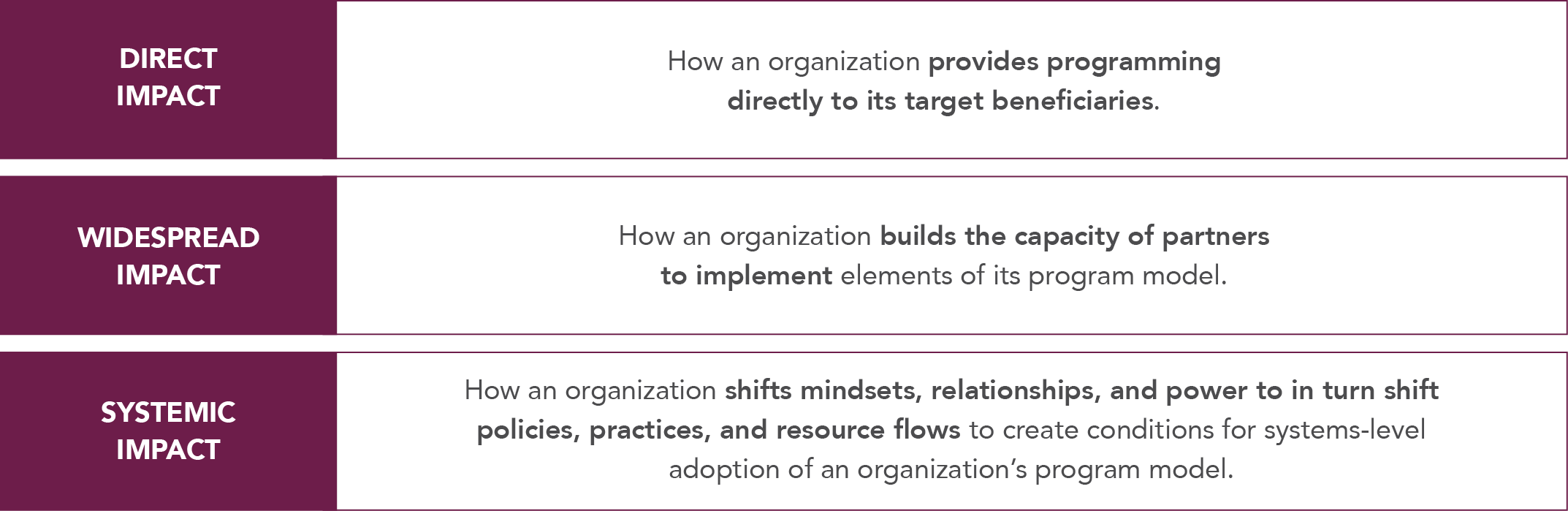
“Systemic Impact The Importance of Implementation Alex Cortez , Christine Wade , Kateland Beals Download PDF Introduction “Implementation is where so many efforts for change fall apart… We are so excited about the bill signing or the announcement of a grant that we forget this is the beginning, not the end.” —Marty Walz, Former State Legislature and Principal, Marty Walz and Associates{{Interview with Marty Walz, Marty Walz and Associates, March 11, 2025.}} In January 2025, Bellwether launched an initiative to explore strong practices in Systemic Impact (how an organization shifts mindsets, relationships, and power to in turn shift policies, practices, and resource flows to create conditions for systems-level adoption of an organization’s program model). This is the seventh in a series of publications exploring how nonprofit organizations, including those in the education sector, can effectively implement Systemic Impact strategies to achieve their ambitions. Learn more by reading Bellwether’s Systemic Impact series : 1. The Only Path to Scale, Success, and Sustainability 2. Systems, Markets, and Infrastructure 3. Mapping Authority in Postsecondary Systems 4. Introduction to Designing Effective Strategies 5. Designing and Executing Effective Campaigns 6. Using Measurement to Manage, Maximize, and Demonstrate the Value of Campaigns 7. The Importance of Implementation This initiative builds on Bellwether’s Pragmatic Playbook , published in June 2022, which explores how organizations can employ three strategies to maximize their overall impact and their ability to effectively compete in the education sector.{{Alex Cortez and Christine Wade, A Pragmatic Playbook for Impact: Direct, Widespread, and Systemic (Bellwether, 2022), https://bellwether.org/publications/pragmatic-playbook-for-impact/ .}} A Note on Language : Although the sector uses the terms “Systemic Impact” and “Systems Change” interchangeably, this report anchors on “Systemic Impact” (except in direct quotes). At times, the most important Systemic Impact work is not to create a change but rather to preserve the status quo or “play defense” to preserve existing progress — to resist change that is in opposition to an organization’s agenda. Over the past three-plus years, dozens of organizations across the country have adopted this framework for strategic decision-making and have used its key principles to communicate priorities in a clear, compelling external pitchbook to attract clients, partners, funders, and allies, and as an internal playbook to build alignment within their organizations. One of the biggest areas of need organizations frequently cite is access to more guidance and resources on how to build their ability to pursue Systemic Impact, including making the case internally and externally to other stakeholders such as funders. The first six publications in this series explain the importance of Systemic Impact, how to design and execute Systemic Impact strategies, and how to use measurement to manage, maximize, and demonstrate the impact of this strategy. This publication explores the importance of focusing on implementation before, during, and after a Systemic Impact issue campaign ‘win’ (Sidebar 1). Implementation is the chasm between a win and a win delivering real value. It can be a big chasm. Often, “implementation is where Systemic Impact goes to die.”{{Interview with Roger Low, Colorado Equitable Economic Mobility Initiative, February 12, 2026.}} To achieve the win, organizations may first have to pursue and succeed in a range of Systemic Impact campaigns (such as electoral or appointment) to determine who is in authority (Figure 1). Then, organizations have to pursue issue campaigns to ensure those in authority support that organization’s policy agenda. Even winning an issue campaign on policy is not the end. Was it funded? Was it implemented — at all or as intended? After successful implementation, was it adopted by the intended stakeholders? For example, implementing a unified K-12 enrollment system will not create value if the public does not know about it or how to adopt and make use of it. SIDEBAR 1 Implementation Key Terms Legislation to Create Policy (i.e., a law or statute): A government authority (such as a state legislature) or a governing authority (such as the board of a college or nonprofit) decides to create a law that forbids, permits, encourages, or mandates a set of actions. This can also happen through ballot initiatives when authority lies directly with the public. Policy Passed Directly by an Executive With Authority : A policy made by a single individual (such as a state secretary of education or governor or a university president) who has the authority to unilaterally decide. Regulation/Rulemaking : The work that comes after a policy is voted on/decided to operationalize the law/decision and then implement it. Challenges to Successful Systemic Impact Implementation There are many ways implementation can prevent the intended value of Systemic Impact campaigns from being realized. 1. Some challenges to implementation originate in policymaking. Policy is sometimes crafted without regard for implementation and/or hearing from those who will be responsible for implementing it. Policymaking is a complex process that undergoes continual change and compromise up to the moment of a vote or decision, and that creates small changes with potentially big implications for effective implementation (Sidebar 2). Policy development often occurs without input from those who will implement it, and subsequent negotiations between competing stakeholders can further distance the final policy from on-the ground system realities. Ben Mackey, executive director of the Texas Impact Network, observed, “There is such a disconnect between what policymakers and advocacy groups — people outside systems — are talking about and focused on, and what people inside of systems are talking about and focused on.”{{Interview with Ben Mackey, Texas Impact Network, September 3, 2025.}} Good policymaking that is inclusive of internal system stakeholders can be the foundation of successful implementation — to receive input into not only what policy should be, but also how it will work in practice. Policy is often ambiguous about its actual requirements because of the circuitous pathway of negotiation and compromise that successful policymaking often takes. In Recoding America: Why Government Is Failing in the Digital Age and How We Can Do Better , Jennifer Pahlka warned that policy can be “a statement of intentions without clear instructions … or overly specific directives that can be fulfilled without achieving the real goals.”{{Jennifer Pahlka, Recoding America: Why Government Is Failing in the Digital Age and How We Can Do Better (Metropolitan Books, 2023).}} This is particularly challenging when its intent is unclear to those responsible for implementation. Alison Badget, in “Systems Change: Making the Aspirational Actionable,” observed, “New policies can fail to have their intended effect when the individuals charged with implementing them through programs haven’t internalized what the policy change means for their professional practice.”{{Alison Badgett, “Systems Change: Making the Aspirational Actionable,” Stanford Social Innovation Review , September 19, 2022, https://ssir.org/articles/entry/systems_change_making_the_aspirational_actionable .}} New policies do not exist in a vacuum but interact with other policies. They build on (and break down) what can be decades and even hundreds of years of prior policy — sometimes in intentional ways, and sometimes in ways that are unforeseen. Pahlka observed, “When we speak of ‘legacy systems’ (in this case technology) in government, it does not mean simply that they are old. It means that we are grappling with the legacy of decades of competing interests, power struggles, creative work-arounds, and make-dos.”{{Pahlka, Recoding America .}} Sometimes, new policies can alter the intent and practice of older policies. 2. A lot happens in negotiating rulemaking after a policy is passed that impacts implementation. There are multiple steps that determine how laws work in practice. For example, at the federal level, Congress sets broad statutory goals, then agencies use rulemaking to define the details — standards, procedures, and enforcement mechanisms — that shape how policies are implemented. Because the rulemaking process “can have substantial implications for policy implementation,”{{Maeve P. Carey, An Overview of Federal Regulations and the Rulemaking Process , Report No. IF10003 (Congressional Research Service, updated March 19, 2021), https://www.congress.gov/crs-product/IF10003 .}} stakeholders with various competing interests can again compete to influence regulations, sometimes with significant impact on what is implemented in practice. The regulatory rulemaking process can be as complicated or even more complicated than the initial legislative process to pass a law (Figure 2).{{Maeve P. Carey, The Federal Rulemaking Process: An Overview (Congressional Research Service Report RL32240, updated June 17, 2013), https://www.congress.gov/crs-product/RL32240 .}} SIDEBAR 2 Words Shape Systemic Impact Campaigns and Influence Implementation {{Interview, April 15, 2025.}} In the early 2000s, an effort was underway to pilot a federally funded school voucher program in the District of Columbia’s public K-12 school system. Upon passage of the District of Columbia School Choice Incentive Act of 2003, the city established the first federally funded school voucher program, known as the D.C. Opportunity Scholarship Program, to provide partial tuition for students from low-income households to attend private or parochial schools. The Roman Catholic Archdiocese of Washington (Archdiocese) agreed to participate in the program as an education provider.{{Spencer S. Hsu and Justin Blum, “D.C. School Vouchers Win Final Approval,” Washington Post , January 23, 2004, https://www.washingtonpost.com/archive/politics/2004/01/23/dc-school-vouchers-win-final-approval/ff83234d-f266-4e63-8da9-60ae057bc5e9/ .}} Originally, the legislation focused on funding vouchers to cover “the cost of education,” which included not only students’ tuition but also textbooks, uniforms, lab fees, field trips, and tutoring, among others. While there was a “list price” for tuition, the actual amount charged to families varied by child depending on whether they were the first young person from a family in the school, with additional children from a family receiving progressively more tuition assistance. Philanthropy made up the difference. As legislation was being finalized, funding to cover “the cost of education” was changed to instead cover “the cost of tuition” because tuition was a published number (even if just a list price) and easier to track, which enabled the city government to prevent participating schools from automatically billing the maximum voucher amount. However, this excluded significant additional nontuition costs required to attend the private schools. As a key partner in the voucher program’s rollout, the Archdiocese was not informed of this change until after the law had been passed and officials had begun to implement the program. This small policy shift from using the word “education” to “tuition” created a large shortfall that ultimately left the Archdiocese with a funding gap of $1.2 million it had to fund through philanthropy. This example illustrates a few key lessons in Systemic Impact campaign implementation: (a) the importance of precision — one word can (and in this case did) dramatically change policy outcomes; (b) the need for constant vigilance — this change occurred at the last minute, after the advocacy group thought it was done; and (c) why policymaking should engage those closest to the work to establish and communicate clear intent and foster transparent negotiations over changes along the way. Note : *The Office of Management and Budget’s (OMB) Office of Information and Regulatory Affairs (OIRA) reviews only significant rules, and does not review any rules submitted by independent regulatory agencies. Source : Adapted from Congress.gov, “ An Overview of Federal Regulations and the Rulemaking Process ,” 2021. There are many ways for stakeholders to influence rulemaking. The public comment process allows the public (e.g., individuals, organizations, industry, interest groups) to influence how regulations are written, including through the work of lobbyists. Stakeholders can also initiate lawsuits to influence or oppose policy implementation. Judicial and executive oversight create additional opportunities for influence: Regulations are subject to judicial review and executive branch oversight (via OMB’s OIRA division), which can delay, alter, or overturn agency decisions. Stakeholders can use the inclusive process of rulemaking to slow down or even stop implementation. In Abundance ,{{Ezra Klein and Derek Thompson, Abundance (New York: Avid Reader Press, 2025).}} Ezra Klein and Derek Thompson argue that even with the good intentions of making governance participatory — complex and opaque processes create opportunities to delay and obstruct policy creation and the implementation to the point of paralyzing progress — or “process vetocracy.”{{Ezra Klein, host, The Ezra Klein Show , podcast, “Abundance and the Left,” New York Times , April 29, 2025, Minute 12, https://podscripts.co/podcasts/the-ezra-klein-show/abundance-and-the-left .}} Klein, in a podcast about the book, contended that “process is often a tool that is of differential use — depending on the resources you have to activate that tool.”{{Roman Mars, host, 99% Invisible , podcast, “Build, Interrupted: A Conversation with Ezra Klein,” produced by 99PI, May 27, 2025, https://99percentinvisible.org/episode/629-build-interrupted-conversation-ezra-klein/transcript/ .}} In the context of housing, he argued, procedural veto points have “given every rich community in the country, who’s got the money to hire lawyers and lobbyists, a lot of ways to stop things from being built. And asymmetrically, poor communities don’t have that.”{{Ibid.}} Klein noted that this is also true of corporate interests with the deep pockets to fight and litigate in virtual perpetuity. This underscores a central theme of this Systemic Impact series: Competing against the powerful requires building power and then determining the best way to deploy it. As Jamilah Prince-Stewart, founder and CEO of FaithActs for Education, shared, “Winning an issue campaign is a start, but protecting the implementation is also extremely important. As soon as you have a policy win, someone’s going to try to take it away from you.”{{Panel with Jamilah Prince-Stewart, FaithActs for Education, August 27, 2025.}} “Winning an issue campaign is a start, but protecting the implementation is also extremely important. As soon as you have a policy win, someone’s going to try to take it away from you.” —JAMILAH PRINCE-STEWART, FOUNDER AND CEO, FAITHACTS FOR EDUCATION Finally, making implementation yet more complex, agencies may also issue “guidance” documents that include interpretive rules and general statements of policy. {{Kate R. Bowers, Agency Use of Guidance Documents , Report No. LSB10591 (Congressional Research Service, April 19, 2021), para. 4, https://www.congress.gov/crs-product/LSB10591 .}} Guidance documents are not subject to the same procedural requirements as rulemaking, which can reduce the time it takes to publish them but also limits opportunities for public involvement. And while guidance documents “do not bind the public and are not treated as binding by the courts,” they can and do impact how policy is interpreted and implemented.{{“1-19.000 – Principles for Issuance and Use of Guidance Documents,” in Justice Manual , Title 1: Organization and Functions, updated April 2022, para. 2, https://www.justice.gov/jm/1-19000-limitation-issuance-guidance-documents-1 .}} 3. Some challenges arise in the process of implementation. Those doing the implementing are typically incentivized or even required to prioritize process over outcomes and have little to no opportunity to give feedback or adjust what they are implementing. Pahlka explained, “When systems or organizations don’t work the way you think they should, it is generally not because people are stupid or evil. It is because they are operating according to structures and incentives that aren’t obvious from the outside.”{{Pahlka, Recoding America .}} Using software coding as an analogy, Pahlka noted that much of policy implementation follows a “waterfall” approach, which is a top-down execution of process, when implementation should be agile and iterative, with a focus on the product and its ability to deliver the intended outcomes (Figure 3).Given this structure, the performance of those within government systems is assessed by how well they executed on implementing the rules handed to them, not by the effectiveness of their product in delivering the intended impact. Pahlka noted that “legislators can’t fire or officially reprimand you [a civil servant], no matter how bad a job they think you did [if you followed implementation directions.] … They can’t make you ineligible for promotions or raises. On the other hand, violations to policy, process, and procedure — real or perceived — can do all of that.”{{Ibid.}} FIGURE 3: WATERFALL AND AGILE APPROACHES TO SYSTEMIC IMPACT CAMPAIGN IMPLEMENTATION Waterfall Approach prioritizes process compliance over product delivery. Agile Approach focuses on product delivery over a rigid process. According to Pahlka, waterfall focuses on “separate, sequential stages each project has to go through [in which different] teams [are] generally responsible for each of the stages, and once a given stage [is] complete, you [don’t] go back … the flow goes only one way: down.”{{Ibid.}} Agile development/implementation emphasizes being iterative and incremental, collaborative with constant end-user feedback, and flexible in response to that feedback. As Pahlka noted, “If there’s one thing government needs desperately, it’s the ability to quickly try something, pivot when necessary, and build complex systems by starting with simple systems that work and evolving from there, not the other way around.”{{Ibid.}} Implementation must navigate limited bandwidth and competing priorities. Leaders and staff being asked to implement a new policy may not view it as urgent or important when assessed against their long, existing list of competing priorities for which they (and their organizations/teams) have limited time and bandwidth to address. This can be exacerbated when policies do not include necessary funding to support implementation. Sometimes, implementation can be passively and even actively sabotaged. In both government systems and other organizational systems, those either opposed to or otherwise cynical about the staying power of a new policy can slow implementation down, raise new obstacles, and have an expectation — sometimes well earned — that if they wait long enough, implementation will be abandoned in favor of a new policy that supplants the current one. Leadership turnover (elected or appointed) can change support for a policy or even reverse it. Given that policy in our democratic system can change through legislation, executive action, and/or rulemaking, at times some agencies and leaders may hesitate to invest heavily in implementation when new leaders or administrations could soon reverse course. All these prior points are exacerbated when implementation requires cooperation across different departments, different systems (for example, federal, state, and/or local government), and/or with other organizations. Each department/organization has its own focus and priorities, its own structures and norms, its own data systems (which may or may not be easy to align), and its own resource constraints that can make required collaboration for successful implementation fraught. 4. Unforeseen events may create unintended consequences. No one can see into the future. Events can happen that disrupt priorities, change available funding, or fundamentally shift mindsets in favor of or against what a policy is attempting to achieve. 5. Some systems lack the expertise to successfully implement a policy at scale without assistance. Policy can create the demand for new programs, but that demand must then be met with a high-functioning supply — provided either directly by the federal, state, or local government or through outside providers. How Organizations Can Address Implementation Challenges This is a daunting — but not insurmountable — list of obstacles for organizations focused on ensuring successful implementation. But policies do get implemented every day and govern how stakeholders in the system act to create the policy’s intended impact. There are six actions organizations can take to overcome common implementation obstacles, grounded in the idea that, from the outset, Systemic Impact campaigns should craft policy with successful implementation in mind. 1. Focus on identifying and designing the right solution to overcome the barrier(s) a campaign is designed to address. Erika Giampietro, founder and former CEO of the Massachusetts Alliance for Early College, counseled, “Start by building things on the ground to demonstrate what works — and then use that as the basis for policy.”{{Interview with Erika Giampietro, Massachusetts Alliance for Early College, February 19, 2025.}} This includes involving those most impacted up front. As Alexandra Bernadotte, founder and CEO of Beyond 12, has long advocated, “We believe that because our students are in close proximity to the educational equity challenge, that they’re best suited to help design its solutions.”{{Interview with Alexandra Bernadotte, Beyond 12, January 22, 2025.}} 2. Start small in a Systemic Impact campaign. A narrower set of policies may be more successful in getting passed and more successful in getting implemented because the initial lift is easier. As Texas Impact Network’s Mackey counseled, “Don’t worry about swinging for the fences on the policy. Get a good policy passed, one that will allow us to do something a little different. Then, swing for the fences on implementation. You need results to be able to speak for the effectiveness of the policy so that it can be expanded.”{{Interview with Ben Mackey, Texas Impact Network, September 3, 2025.}} 3. Include those responsible for implementation in policy drafting. Public servants or staff of nongovernmental systems (like colleges) know the history of existing policies and are most able to see where there are potential complications or unintended consequences that could arise. They have the best sense of what resources it would take to successfully implement a policy. When those responsible for policy implementation and ongoing execution have had a hand in shaping the policy, they will feel more responsibility for it and are more likely to be able to implement it faithfully and effectively. People are more invested in the destination when they have been included in the journey. When those responsible for policy implementation and ongoing execution feel a commitment to the success of a policy, they will continue to support it for the long term and sustain institutional memory of a policy’s purpose as leadership turnover happens and administrations change. Courtney Criswell, principal at Waypoint Education Partners, observed, “Successful implementation often depends on continuity over time — across election cycles, administrations, and leadership changes. Some of the most durable education reforms in the U.S. have not been the result of a single sweeping policy win, but of sustained stewardship across multiple leaders who shared a commitment to outcomes, even as they differed in ideology or approach.”{{Courtney Criswell, Waypoint Education Partners, email on January 30, 2026.}} Additionally, legislators listen to regulators; having those responsible for implementing a policy support it can be a critical factor in its passage. 4. Design the policy with implementation accountability mechanisms built in. Walz of Marty Walz and Associates noted that “building review mechanisms or checkpoints into new policies helps keep the focus on implementation, and there is some external pressure to do the change well.”{{Interview with Marty Walz, Marty Walz and Associates, March 11, 2025.}} 5. Identify the true resources needed to support effective implementation — and be prepared to pursue additional campaigns to secure them. Implementation is not costless; it requires continuous effort and management that in turn require having the right people, structures, and data in place. As Walz of Marty Walz and Associates advised, “If you don’t have the money and people with the skill to implement [a policy], the change is on paper but not in reality.”{{Ibid.}} 6. Support implementation, either directly or with partners, by ensuring there is the “supply” of programming to meet the changing “demand” that a policy creates. Organizations can provide this through: A Direct Impact strategy of running programs. A Widespread Impact strategy of building the capacity of other organizations to replicate a program, making trade-offs in prioritizing breadth versus depth of impact, required fidelity and levels of control, and the level of investment, among others. Many organizations that pursue Direct Impact and/or Widespread Impact strategies expand into Systemic Impact specifically to address the systemic barriers that prevent their programs from growing. These three strategies are not mutually exclusive and can, in fact, be mutually reinforcing (Figure 4). Conclusion Systemic Impact is designed to create change; without successful implementation, true and enduring results are not possible. The road to successful implementation may be long, complex, and nonlinear with many barriers and opposing forces standing in the way. However, when organizations that take on Systemic Impact fully recognize and address implementation challenges from the outset, they dramatically increase the likelihood that their hard-won electoral and/or issue campaigns translate into achieving their ambitions. Acknowledgments We would like to thank the many experts who shared their knowledge with us to inform our work, including interviewees for their time, insights, and expertise as well as the community of practice participants who contributed to this publication. Thank you also to ECMC Foundation for its financial support of this project. We would also like to thank our Bellwether colleague Octavia Larbi for her support. Thank you to Amy Ribock, Kate Stein, Andy Jacob, McKenzie Maxson, Temim Fruchter, Julie Nguyen, and Amber Walker for shepherding and disseminating this work, and to Super Copy Editors. The contributions of these individuals and entities significantly enhanced our work; however, any errors in fact or analysis remain the responsibility of the authors. About the Authors ALEX CORTEZ Alex Cortez is a partner at Bellwether. He can be reached at alex.cortez@bellwether.org . CHRISTINE WADE Christine Wade is a senior associate partner at Bellwether. She can be reached at christine.wade@bellwether.org . KATELAND BEALS Kateland Beals is a senior consultant at Bellwether. She can be reached at kateland.beals@bellwether.org . Bellwether is a national nonprofit that works to transform education to ensure young people — especially those furthest from opportunity — achieve outcomes that lead to fulfilling lives and flourishing communities. Founded in 2010, we help mission-driven partners accelerate their impact, inform and influence policy and program design, and bring leaders together to drive change on education’s most pressing challenges. For more, visit bellwether.org . © 2026 Bellwether This report carries a Creative Commons license, which permits noncommercial reuse of content when proper attribution is provided. This means you are free to copy, display, and distribute this work, or include content from this report in derivative works, under the following conditions: Attribution. You must clearly attribute the work to Bellwether and provide a link back to the publication at www.bellwether.org . Noncommercial. You may not use this work for commercial purposes without explicit prior permission from Bellwether. Share Alike. If you alter, transform, or build upon this work, you may distribute the resulting work only under a license identical to this one. For the full legal code of this Creative Commons license, please visit www.creativecommons.org . If you have any questions about citing or reusing Bellwether content, please contact us. The post Systemic Impact: The Importance of Implementation appeared first on Bellwether .
Original story
Continue reading at Bellwether
bellwether.org
Summary generated from the RSS feed of Bellwether. All article rights belong to the original publisher. Click through to read the full piece on bellwether.org.
