
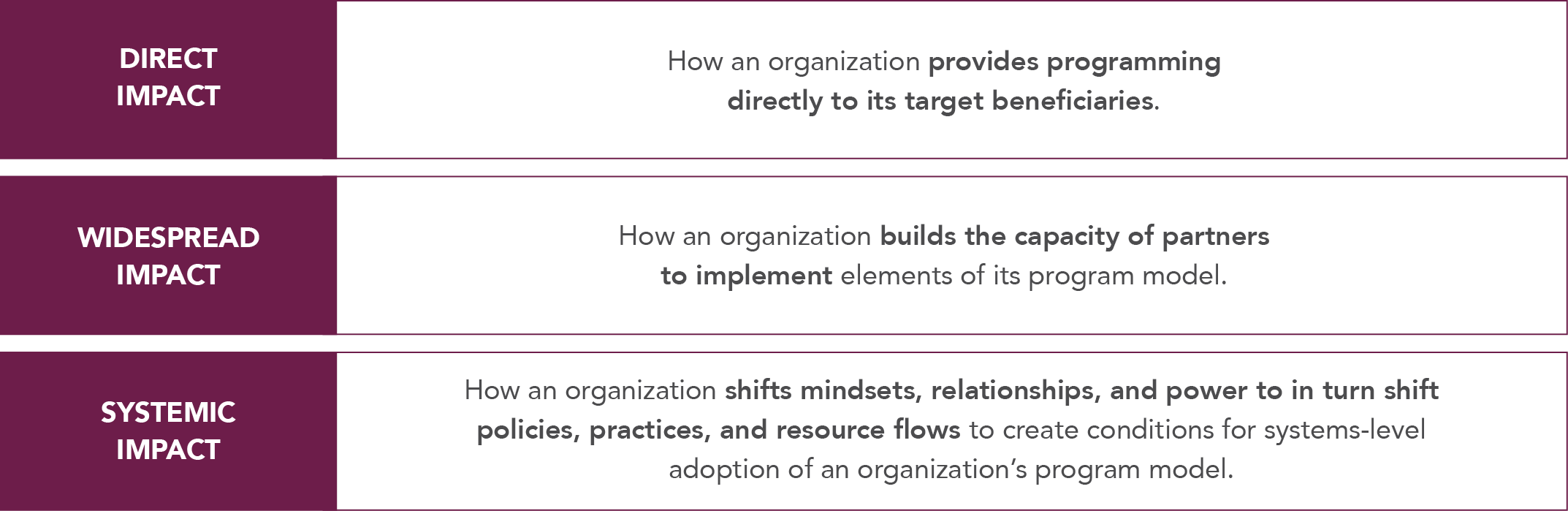
“Systemic Impact Using Measurement to Manage, Maximize, and Demonstrate the Value of Campaigns Alex Cortez , Christine Wade , Kateland Beals Download PDF Introduction “Whoever controls information, whoever controls meaning, acquires power.” —Laura Esquivel{{Laura Esquivel, Malinche , trans. Ernesto Mestre-Reed (Atria Books, 2006).}} In January 2025, Bellwether launched an initiative to explore strong practices in Systemic Impact (how an organization shifts mindsets, relationships, and power to in turn shift policies, practices, and resource flows to create conditions for systems-level adoption of an organization’s program model). This is the sixth in a series of publications exploring how nonprofit organizations, including those in the education sector, can effectively design and execute Systemic Impact strategies to achieve their ambitions. Learn more by reading Bellwether’s Systemic Impact series : 1. The Only Path to Scale, Success, and Sustainability 2. Systems, Markets, and Infrastructure 3. Mapping Authority in Postsecondary Systems 4. Introduction to Designing Effective Strategies 5. Designing and Executing Effective Campaigns 6. Using Measurement to Manage, Maximize, and Demonstrate the Value of Campaigns 7. The Importance of Implementation This initiative builds on Bellwether’s Pragmatic Playbook , published in June 2022, which explores how organizations can employ three strategies to maximize their overall impact and their ability to effectively compete in the education sector.{{Alex Cortez and Christine Wade, A Pragmatic Playbook for Impact: Direct, Widespread, and Systemic (Bellwether, 2022), https://bellwether.org/publications/pragmatic-playbook-for-impact/ .}} A Note on Language : Although the sector uses the terms “Systemic Impact” and “Systems Change” interchangeably, this report anchors on “Systemic Impact” (except in direct quotes). At times, the most important Systemic Impact work is not to create a change but rather to preserve the status quo or “play defense” to preserve existing progress — to resist change that is in opposition to an organization’s agenda. Over the past three-plus years, dozens of organizations across the country have adopted this framework for strategic decision-making and have used its key principles to communicate priorities in a clear, compelling external pitchbook to attract clients, partners, funders, and allies, and as an internal playbook to build alignment within their organizations. One of the biggest areas of need organizations frequently cite is access to more guidance and resources on how to build their ability to pursue Systemic Impact, including making the case internally and externally to other stakeholders such as funders. This publication focuses on the importance of using measurement in designing and executing a Systemic Impact campaign to manage, maximize, and demonstrate impact (Figure 1). The Importance (and Challenges) of Being Measurement-Driven Being measurement- or data-driven in any initiative, including within a Systemic Impact campaign, better equips an organization to : Plan, set priorities, and properly allocate resources to meet those priorities. Create a social contract within an organization and with external stakeholders. Clarity on performance expectations can also provide emotional safety for staff, who can operate with a shared understanding of what success looks like rather than operating in ambiguity. Manage execution while being nimble and responsive to both opportunities and challenges as they arise. Shift mindsets, and ultimately actions, by others. Demonstrate impact to attract and retain partners, allies, and funders. Learn about what does and does not work in order to continuously improve. For organizations to be truly measurement-driven, they must be good at all four steps of the measurement cycle (Figure 2). Having the right measures at the right time and in the right format — and the ability to move through this cycle — enables organizations to execute a Systemic Impact campaign with agility and respond to changing conditions, progress, and setbacks as it unfolds. This publication is focused on the first critical step — the “what” of data that organizations engaged in Systemic Impact campaigns should measure. However, gathering the “what” to employ in the next steps of the cycle often is easier said than done; measurement presents many challenges. Many organizations lack a common language around measurement : Without a common language, organizations (and even systems) cannot communicate and effectively collaborate in using measurement (Sidebar 1). People can disagree about measurement : There can be strong disagreement about what to measure. There can also be strong disagreement about how to measure. Capturing measures is not easy : Measurement is not costless and can require financial and political capital and change management to ensure internal staff and external partners are making the necessary commitments so that key data is available and accurate. Attribution is not easy : Taking credit for outcomes can be challenging for some program models with a narrow focus (such as professional development), operating within a complex system (a school district), and/or involving many organizations working together or in parallel. The results captured by measurement have consequences : Data is rational; systems are political. Measuring and reporting data can win friends and make enemies. Measuring and reporting data is an act of accountability — it is often high stakes. Measurement is itself an act of power: Without understanding a community’s definition of success and how it is measured, there is a risk that those pursuing Systemic Impact may impose their own definition. Measurement has also at times been weaponized against communities. Measurement is also ultimately about people: In education, data points represent the hopes of students who want the opportunity to pursue their dreams, and the fear that these opportunities will be denied. SIDEBAR 1 Measurement Key Terms There is no shortage of jargon on the topic of measurement. This publication uses the following definitions: Inputs : The resources (expressed together as costs) to execute a program or action — staffing, content development, event execution, systems and tools, facilities, and/or overhead/administrative. Program Design : The specific elements of a program (e.g., dosage, format, location) that are intended to deliver a set of desired outputs and outcomes. Program design both informs and is informed by the availability of inputs. The intended program design may not be what actually gets executed — being able to measure and nimbly respond to that difference is critical to program management. In the case of a Systemic Impact campaign, program design can be broken down by a set of specific campaign actions. Some organizations also articulate this in a theory of action. Outputs : Measures of (a) deliverables completed, (b) reach of a program, and/or (c) participation in a program/engagement with deliverables. Outcomes : Measurable changes that create the intended value or demonstrate progress toward that intended value. Outcome measures can include: Satisfaction/perception of value . Attainment of knowledge/skills . Shift in attitudes/beliefs about self or others. Actions that are taken as a consequence of a program, which can include actions taken by systems as a consequence of Systemic Impact campaigns. Changes in performance for the beneficiaries a strategy is meant to serve. In education, this can be measures of value from birth through working adulthood and can be measures of both achievement (GPA, proficiency/mastery, earnings) and attainment (high school graduation, pursuing and completing a postsecondary pathway). Infrastructure : In Systemic Impact strategies, there is an additional hybrid measure — a combination of outputs and outcomes — that quantifies the level of community-driven power an organization has. This measure is determined by tracking the number of individuals in different roles, each of whom is contributing in distinct ways to exercising that power. (Read the fifth publication’s Sidebar 2 in this Systemic Impact series for more details.) Measurement plays a critical role at each step of designing and executing a Systemic Impact campaign (Figure 3). Measurement in Steps A and E. Establish a Campaign Agenda and Share Results Measurement is an important part of the first and last steps in a Systemic Impact campaign (Steps A and E). By answering a set of questions at each stage, an organization or coalition can better define its agenda and capture lessons learned for ongoing measurement, results tracking, and refinement (Figure 4). In designing a Systemic Impact campaign, and in attracting allies (including funders), organizations should clearly define and quantify the intended impact and value (Sidebar 2). This includes asking the following questions: How many individuals are impacted because of the presence or absence of the issue to be addressed? What are the attributes of these individuals (e.g., their location, demographics, educational attainment level, and economic status)? What are the specific measures of impact a campaign intends to achieve? What are these individuals not able to achieve but could if a campaign were successful, in both the short term and the long term? What is the performance of these individuals relative to other populations who are operating in different conditions (i.e., without the presence or absence of the issue being addressed), to illustrate the disparity/inequity? What is the impact of their performance on others (e.g., student success that drives value for institutions of higher education via impact or revenue) or value to society (e.g., cost avoidance, tax revenue, civic engagement)? What is the impact of inaction? Will the problem persist? Will it get worse? It is important for organizations to keep in mind that some Systemic Impact campaigns are about preserving the status quo — so defending the presence of something that currently exists or the absence of something that an organization seeks to prevent (like a funding cut, or a new restriction) is itself a measurable success. SIDEBAR 2 Building an Effective Agenda and Measurement System for a Postsecondary Systemic Impact Campaign Note : This offers an example of how an organization may quantify the intended impact and value of a campaign. All figures are hypothetical and illustrative except where research citations are provided. A postsecondary advising organization wants to secure permanent institutional funding through legislation to integrate coaching into an institution of higher education’s (IHE’s) advising system, ensuring all first-generation students and students from low-income households receive evidence-based persistence coaching. Magnitude of the Problem : Roughly 10,000 students enroll at the IHE each year, 4,800 of whom are first generation and/or from low-income households. In the absence of an evidence-based persistence coaching model, approximately 1,920 of these students will drop out before their second year (60% persistence rate). Quantitative Impact of This Problem: To Individuals : Bachelor’s degree graduates earn roughly $900,000 more than nongraduates with some college over a lifetime,{{Anthony P. Carnevale, Ban Cheah, and Emma Wenzinger, The College Payoff: More Education Doesn’t Always Mean More Earnings (Georgetown University Center on Education and the Workforce, 2021), https://cew.georgetown.edu/wp-content/uploads/cew-college_payoff_2021-fr.pdf .}} meaning that the loss of about 1,920 graduates a year also results in more than $1.7 billion in potential loss in lifetime earnings. To Society : Using data from a 2012 study at Northeastern University’s Center for Labor Market Studies, the cost to society is $875 million in lost income from tax revenue and an increase in the use of social services and other government spending from losing these 1,920 students.{{Joseph McLaughlin, The Fiscal Returns to Completing High School and Additional Years of Schooling Beyond High School in the U.S. and Massachusetts (Center for Labor Market Studies, Northeastern University, 2012), https://bostonpic.org/wp-content/uploads/2022/10/Fiscal-Returns-to-Completing-High-School-and-Additional-Years-of-Schooling-Beyond-High-School-in-the-US-and-Massachusetts.pdf. Bachelor’s degree recipients have a net contribution of $885,000 versus those with one to three years of college, who have $429,000. Authors took the difference — $456,000 — and multiplied it by 1,920 students.}} Note: This does not include the nonfinancial value (e.g., better health, stronger civic engagement, lower incarceration rates associated with college completion). To This IHE : 1,920 students multiplied by $30,000 net tuition revenue per student over three years equals $58 million in lost tuition. Potential Solution and Magnitude of Impact : Shifting policy (at the IHE level or through state or federal funding) to invest in first-year student persistence coaching would cost an estimated $2 million per year. The postsecondary persistence advising organization has evidence that its model of persistence coaching reduces dropout rates by 12% between the first and second years of college (1,920 down to 1,440 dropping out after their first year), and this persistence into the second year of college is highly predictive of college completion. To Individuals : Reducing the number of dropouts by 230 students leads to a net positive impact of lifetime earnings of $207 million. To Society : Keeping an additional 230 students in college leads to a net positive impact of $105 million. To This IHE : An increase of $30,000 in net tuition over three years multiplied by 230 students who now successfully persist, for a total of approximately $7 million in additional revenue over three years from this intervention. The financial return on investment (ROI) to the college in that year ($14.4 million in revenue divided by the one-year spending of $2 million), is 3.4 times the initial investment without considering other positive contributions, including strengthening its brand and recruitment with an improved graduation rate and the potential for alumni giving. These different measures will appeal to different audiences and for different purposes in a Systemic Impact campaign. The postsecondary persistence advising organization should be strategic in where it emphasizes certain measures, including ROI. For instance, it may emphasize the value to individuals when communicating to students in an effort to bring them on board as partners to advocate for funding. It will likely be most successful in convincing the IHE to support the campaign if it centers messages around the financial ROI to the IHE and the value to the students being served. When aiming to influence state legislators, it should promote the social financial ROI (and nonfinancial value). By considering relevant stakeholders and the measures of value most likely to resonate with each up front, the postsecondary persistence advising organization can enter any situation prepared to bring a compelling quantifiable case for its agenda. Measurement in Step B. Develop the Plan to Build and Deploy Power Once a Systemic Impact campaign agenda is established in Step A, measurement is a useful tool for organizations and coalitions to map power structures and determine the level of effort needed to take action in Step B (Figure 5). In Step B, organizations engaged in Systemic Impact campaigns conduct power mapping. Measurements of levels of relationships and influence may not be precise but are nonetheless necessary to (a) evaluate where an organization has existing power, (b) where it needs to build more power, and (c) how it will assess progress against this (Figure 6). Measurements of relationships, influence, and corresponding levels of support are critical components of assessing campaign progress — even when informed by qualitative assessments and/or judgment. Based on this power mapping, organizations then determine the set and quantity of actions required to shift mindsets and build relationships to in turn build and deploy power. Organizations engaged in Systemic Impact campaigns can take a wide array of potential actions to build and deploy power, as outlined in the fifth publication in this series . Each action has its own specific measures of inputs (resources), outputs (measures of deliverables created, reach, and engagement), and outcomes (measures of value created).* In the case of some actions, there is also an additional set of measures that quantify building an infrastructure of power. Take, for instance, the role of canvassing in the context of measurement and actions. The intended outcomes of canvassing can include getting individuals to: Sign up for an ongoing relationship with an organization. Sign a petition indicating their support to those in authority, or enabling an issue to get on a ballot or an individual to meet a threshold of support to run for office. Commit to attending an event, workshop, or training or to participating in a public action (e.g., a peaceful protest). Register to vote. Sign up to get supports or provide supports to get out the vote on an election day. Note: This can occur as a 501(c)(3) nonprofit if it is done in a nonpartisan manner. Vote for a specific candidate or initiative on a ballot, or advocate for a specific piece of legislation. Note: This action can be done only through the work of a 501(c)(4) nonprofit and not a 501(c)(3). Give money. Note: If it is to a nonprofit, this can be done through 501(c)(3) work; for a candidate or initiative on a ballot, this requires working as a 501(c)(4). Note : *Bellwether is not a legal services organization and does not provide legal advice. None of this content should be construed as advice from an attorney. Readers should consult their legal counsel before engaging in lobbying, advocacy, or electoral activism. Canvassing can also be done for non-Systemic Impact campaigns, such as student or parent program recruitment. There is a set of decisions that an organization needs to make about the quantity (i.e., measures) of canvassing required as an action to build and deploy power (Figure 7). There is then a set of measures that an organization can use to track the progress and success of executing a canvassing action (Figure 8).{{Parent Power in Education, New Profit, www.parentpowerined.org .}} These measures are used in Step B to identify what actions need to be taken, in what quantities (output), and for what purpose (outcomes). This then drives identifying and quantifying resources in Step C and is what an organization manages execution against in Step D. Source : Re-created from New Profit, Parent Power in Education: Measuring What Matters, “ Canvassing .” Measurement in Step C. Develop a Work Plan and Resource Requirements, and Pressure-Test the Plan In Step C, organizations are quantifying the resources required in order to execute their Systemic Impact campaign, determining what resources they have against this need, assessing the gap, and then deciding if they can attract the resources to fill that gap before committing to a campaign (Figure 9). There is a range of resources — measures of inputs — that an organization must consider. Each has its own measures (e.g., the total number of canvassers in a given geography) but collectively can be quantified as a financial cost that organizations must decide if they can invest in. Continuing the example of canvassing, the quantities of need on the left need to then be matched to the specific cost drivers on the right (Figure 10). This is an essential component of campaign planning because it first illustrates what resources are needed, and then allows an organization to identify gaps against existing resources that need to be filled in order to set a Systemic Impact campaign up for success (or illustrate where a campaign will need to be either more limited because of limited resources, or not pursued until the resources can be secured). Measurement in Step D. Execute a Campaign and Be Adaptive Campaigns are as complex in execution as they are in planning. As the work unfolds, organizations should be able to track actual execution against expected (and budgeted) execution and prepare to pivot as circumstances require in Step D (Figure 11). This is where organizations that invest in creating and populating dashboards will be able to nimbly work through the measurement-driven cycle introduced on Page 5 to manage progress, make changes as needed, and maximize their odds of success (as well as capture learnings no matter the campaign’s outcome). “Campaigns are as complex in execution as they are in planning. As the work unfolds, organizations should be able to track actual execution against expected (and budgeted) execution and prepare to pivot as circumstances require in Step D.” What is a dashboard? A dashboard is a way to capture and share key measures in an accessible and actionable format. Good dashboards: Provide data that is important to drive insights and then decisions that will advance impact. Are shared with the right frequency to be actionable but balanced with when data becomes available. Are shared in a visually accessible way for data to be easily understood. Segment data as needed (for example, by action or stakeholder) to enable insights and decisions. Provide the right level of detail required by different audiences/stakeholders. During execution, organizations should be mindful of the following strong practices as they deploy dashboards and measure progress : Assign staff to update the dashboard weekly so it remains up to date. Add a standing agenda item in biweekly (or monthly) leadership team meetings to review progress measures and discuss adjustments. Share versions of the dashboard with the board and coalition partners during regular touchpoints to keep accountability high. Some dashboards will outline the set of actions identified in Step B and the specific program design (dosage, format, expected deliverables and participation) and then measure planned-to-actual performance to identify what is working and what is not, and to be agile in adjusting (Table). TABLE: EXAMPLE OF MAPPING KEY MEASURES FOR SPECIFIC SYSTEMIC IMPACT CAMPAIGN ACTIONS Action and Purpose Program Design Outputs Outcomes Canvassing Petition to demonstrate support for a campaign agenda. Training X canvassers. Target X,XXX signatures. Requires knocking on XX,XXX doors in neighborhoods A, B, and C. Requires XX hours of canvassing and XX canvassers working X hours over Y days. Training X canvassers. XX canvassers working YY average hours. Knocked on XX,XXX doors in neighborhoods A, B, and C. X,XXX signatures secured. Demonstrate support for a campaign action to those in authority. Could be partnership (they need this to make the case to others), persuasion (convince them of community support), or pressure (demonstration of potential community anger if agenda not supported). Private Meetings Meet with stakeholders with power/authority to learn, build relationships, influence. X meetings to be held and with whom. Training stakeholders in research meetings. Meeting preparation — goals of meeting, content to cover, distribution of roles and voices to be heard. X meetings scheduled. X meetings ultimately held. Influence change in support from X stakeholders and ‘pin’ their commitment to act. Equip those who support with what they need to take action. Identify who remains neutral/in opposition — if possible, identify what they would need to shift support. Identify next steps to take action on to sustain supporters, further influence detractors (where possible). Communications Raise awareness of agenda, shift mindsets, equip partners with resources to support agenda, persuade/ pressure others. Develop research report demonstrating disparities in performance on X and evidence that a solution exists to address the disparities. Develop op-ed for local paper, social media plan, and webinar. Content reaches X people (various platforms). Content is engaged with by X people (various platforms — emails opened, emails forwarded, report downloaded, likes and shares on social media, cited/covered in other news media). High-quality interactions — key stakeholders who reach out to organization because of its content — interest in partnering, or funding, or to indicate support for agenda, request testimony, among others. Measurement in Step E. Demonstrate a Campaign’s Value When a campaign is finished, it is critical to invest the time and effort to measure if the intended value was created as laid out in Step A and why or why not (Figure 12). Evidence-based policymaking requires evidence. If a policy was passed (or protected), did it have the required funding? In the rulemaking process, did the intent of the policy get altered, and/or did the policy get implemented well (as outlined in the seventh publication in this Systemic Impact series)? If it was implemented well, did it actually create the intended value for the intended recipients? What does this point to in terms of the next or future campaigns? As part of their agenda, some campaigns include a requirement to report key measures of progress and success (e.g., statewide efforts to deploy longitudinal data systems to better understand the economic outcomes of K-12 and postsecondary pathways). For some campaigns, this may be the entire agenda. In addition, organizations can leverage measurement about what did and did not work for future Systemic Impact campaign planning. Extending the earlier example of canvassing, was the organization able to generate the required infrastructure of power to meet its canvassing goals of number of doors knocked? Did canvassing lead to change in support of a campaign? Were there technical aspects of executing canvassing that should be addressed in the future (e.g., canvassing training, scripts, targeting the right individuals and neighborhoods)? An organization can also assess power at the end of a campaign. Because campaigns require power to succeed, it is important for an organization to understand where power was built and expended in this campaign, and what that means for the power the organization can leverage for its next campaign. To continue with the canvassing example, how many members of a community are now trained and willing to lead and participate in future canvassing efforts, should this action be necessary for a future campaign? An Example of Measurement in Action at Each Campaign Step To bring measurement to life across Steps A through E in a Systemic Impact campaign, consider a hypothetical state-level organization with an agenda to change statewide policy to ensure that students are taught with high-quality instructional materials (HQIM) at the K-12 level (Figure 13). In Step A , the organization quantified the number of students impacted by lack of HQIM, the potential measurable change in education outcomes if HQIM were implemented based on research from other states, and the dollars required to achieve this agenda. In Step B , the organization assessed what level of support it had at the time. It was able to determine that while it had a majority in its state senate, it did not yet have a majority in the state house, nor a veto-proof supermajority if the governor decided to veto the legislation. Based on power mapping, the organization assessed that two major sets of actions needed to be taken to influence those in authority to influence stakeholders who could influence those in authority: (a) direct engagement with legislators and other stakeholders who could influence them, and then (b) broad publications and social engagement to raise awareness of the problem and potential opportunity in order to shift mindsets and actions by key stakeholders. The organization would set specific targets and then track progress in executing both the quantity and the quality of these actions. In Step C , the organization quantified the resources required to execute the actions identified in Step B, and the fundraising required to ensure these resources were available. In Step D , the organization used a dashboard to monitor progress, which enabled it to be nimble in making required changes along the way. This included measuring the progress of the actions laid out in Step B and the results of those actions in terms of building influence and increasing the number of legislators committing support for a change in policy. In Step E , the organization measured the first fundamental outcome — did legislation get passed, and did it include necessary funding? It then continued to monitor implementation and, ultimately, impact — did the effective implementation of HQIM lead to a change in student outcomes? In addition, the organization reflected on which actions were well executed and effective, and what power it built that could be deployed for future campaigns. Conclusion In Systemic Impact, measurement bridges ambition and execution. Measurement articulates an organization’s understanding of the problem that a campaign is attempting to address, quantifies the potential value it is trying to create, and guides decisions about where and how to build power. It enables leaders to allocate resources wisely, set expectations with staff and stakeholders, monitor execution in real time, and adapt as conditions shift. When a campaign is successful, it allows an organization to understand and demonstrate the value created from its efforts, building support for and shaping not only the success of that specific campaign but also the organization’s understanding of how to execute future Systemic Impact campaigns. Acknowledgments We would like to thank the many experts who shared their knowledge with us to inform our work, including interviewees for their time, insights, and expertise as well as the community of practice participants who contributed to this publication. Thank you also to ECMC Foundation for its financial support of this project. We would also like to thank our Bellwether colleague Octavia Larbi for her support. Thank you to Amy Ribock, Kate Stein, Andy Jacob, McKenzie Maxson, Temim Fruchter, Julie Nguyen, and Amber Walker for shepherding and disseminating this work, and to Super Copy Editors. The contributions of these individuals and entities significantly enhanced our work; however, any errors in fact or analysis remain the responsibility of the authors. About the Authors ALEX CORTEZ Alex Cortez is a partner at Bellwether. He can be reached at alex.cortez@bellwether.org . CHRISTINE WADE Christine Wade is a senior associate partner at Bellwether. She can be reached at christine.wade@bellwether.org . KATELAND BEALS Kateland Beals is a senior consultant at Bellwether. She can be reached at kateland.beals@bellwether.org . Bellwether is a national nonprofit that works to transform education to ensure young people — especially those furthest from opportunity — achieve outcomes that lead to fulfilling lives and flourishing communities. Founded in 2010, we help mission-driven partners accelerate their impact, inform and influence policy and program design, and bring leaders together to drive change on education’s most pressing challenges. For more, visit bellwether.org . © 2026 Bellwether This report carries a Creative Commons license, which permits noncommercial reuse of content when proper attribution is provided. This means you are free to copy, display, and distribute this work, or include content from this report in derivative works, under the following conditions: Attribution. You must clearly attribute the work to Bellwether and provide a link back to the publication at www.bellwether.org . Noncommercial. You may not use this work for commercial purposes without explicit prior permission from Bellwether. Share Alike. If you alter, transform, or build upon this work, you may distribute the resulting work only under a license identical to this one. For the full legal code of this Creative Commons license, please visit www.creativecommons.org . If you have any questions about citing or reusing Bellwether content, please contact us. The post Systemic Impact: Using Measurement to Manage, Maximize, and Demonstrate the Value of Campaigns appeared first on Bellwether .
Original story
Continue reading at Bellwether
bellwether.org
Summary generated from the RSS feed of Bellwether. All article rights belong to the original publisher. Click through to read the full piece on bellwether.org.
