
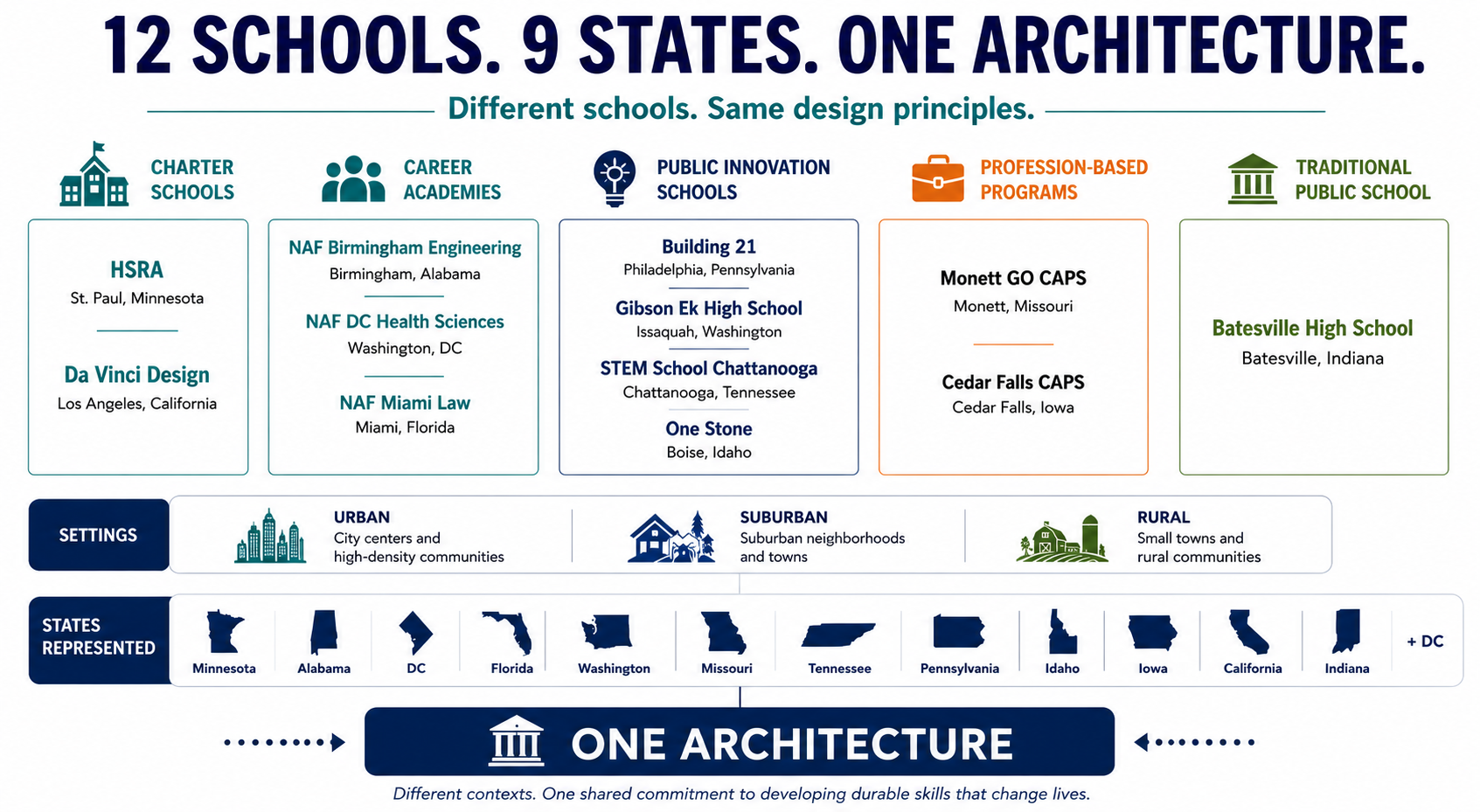
“By: Michael Crawford A charter school for opportunity youth in St. Paul. A comprehensive public high school in rural Indiana. A competency-based school in Philadelphia. A design-focused school in suburban Los Angeles. A profession-based program in an Iowa community. These schools share almost nothing on paper: not size, not population, not pedagogy, not zip code. And yet they share a roughly identical architecture for developing durable skills in young people. That was the finding we did not expect from the Research Practice Collaborative, and it is the finding we most want school, district, and state leaders to sit with. In our December piece for Getting Smart , we introduced the three practices we found shaping durable skills development across twelve schools: naming and claiming the skills, learning by doing real work, and assessing what matters most. What sixteen months of fieldwork made clearer over time is how those practices function as a design architecture : three principles that schools build around, and four amplifiers that turn good practice into deeper transformation. The full report, individual school spotlights, and a practice playbook we released this month are all available at americasucceeds.org/rpc . This article puts the architecture itself in front of leaders. The pattern is more consistent than we expected. Across all twelve schools, the same three principles kept showing up. So did the same four structural conditions that, when present, turned good practice into transformation. We came to call these the principles and the amplifiers. Together, when fully in place, they don’t just develop skills. They produce students who leave high school with genuine agency to direct their own learning and lives, a professional identity grounded in demonstrated competence rather than grades or praise, and a concrete, experience-based, informed vision of where they want to go and why. This article looks at how schools build the conditions that make those outcomes possible. Three principles that show up everywhere, even in schools that look nothing alike The principles are not a model. They are design choices that, in some recognizable form, were present in every school where durable skills development was working at scale. The first is making skills explicit and trackable. Students should be able to name what they are developing, see where they currently stand, and know what growth looks like. The implementations vary wildly. Building 21 in Philadelphia uses a four-domain competency framework with a twelve-level progression visible to every student in real time on its Beacon Learning platform. Da Vinci Design in El Segundo, California pairs a three-part Habits of Mind framework with a four-stage Design Process that students apply across every project. Batesville High School in Indiana built a ‘Bulldog Ready’ Portrait of a Graduate through three years of community engagement with more than seventy local stakeholders. Different shapes, same principle: the language is shared, the language is constant, and the language is the language students themselves use to describe their growth. The second is building learning around authentic, consequential experiences. This is the principle our research illustrates most vividly. Connor sending more than eighteen cold emails until a shop in West Seattle wrote back. Emma defending her team’s hospital design work to occupational therapists who actually had to use it. Brooke passing the same EMT certification exam working paramedics take. The mechanism is the same in every case. Skills don’t deepen because students practice them in safe contexts. They deepen because students practice them in contexts where their work matters to someone other than the teacher, and where their performance has consequences they can feel. The third is integrating skill development into everything, rather than adding it on. This is where many well-intentioned skills initiatives fall apart. A standalone ‘soft skills’ elective, a single advisory period, a Friday workshop: these can introduce vocabulary, but they cannot consolidate capability. The schools we studied build skills development into the architecture of all learning. At Da Vinci Design, professional skills, habits of mind, and design process make up the majority of every student’s grade. At Building 21, every studio, internship, and exhibition feeds the same competency framework. At Batesville, the Bulldog Ready attributes show up in DISC sessions, work-based learning reflections, and pathway courses, in the same vocabulary, all four years. The point for leaders is the design freedom and the design discipline at the same time. The principles are non-negotiable. The implementations are infinitely variable. A leader does not need to copy Building 21’s twelve-level platform or Da Vinci’s dual framework to do this work. They do need to make sure that, in some form their community can own, the language is explicit, the experiences are authentic, and the integration is total. Four amplifiers: the conditions that turn good practice into transformation Schools that implemented the three principles developed durable skills. Schools that implemented the three principles and sustained four additional conditions produced something deeper. We saw it across the twelve schools and named it in three parts: agency, the capacity students develop to direct their own learning and lives; professional identity, a sense of self grounded in demonstrated competence rather than grades or praise; and informed vision, a concrete picture of where students want to go, built from what they have actually done rather than what they have imagined or been told. We call the four conditions amplifiers because they don’t substitute for the principles; they multiply what the principles can do. Progressive complexity: challenge that is graduated to readiness, so students are stretched but not stranded. Batesville is the cleanest example we found. Freshmen spend roughly twenty percent of their time in authentic practice. By senior year, that figure is around seventy percent: every student, every Monday, all year, embedded in a real workplace with real responsibility. Ethan, a senior we followed, spends his Mondays cadet-teaching at the elementary school, accompanying fifth and sixth grade choirs, running his church youth choir, and teaching private piano lessons for pay. He is not preparing to become a music educator. He already is one. None of that would have been possible, or safe, to ask of him as a freshman. The four-year arc made it possible to ask of him as a senior. Sustained relationships: trust deep enough to enable honest feedback and authentic risk. The High School for Recording Arts in St. Paul, which serves young people (16 to 24) whom traditional education has repeatedly failed, calls this ‘family culture.’ The structure is intentional: small enrollment, teachers who know students across their full time at the school, an explicit commitment to valuing students as people before evaluating them as students. The outcomes are not subtle. HSRA reports a 90 percent graduation rate and 100 percent college acceptance for FAFSA completers, for a population that arrived having failed elsewhere. Kaveon, a student we spoke with, came in unable to make eye contact and graduated as a paid recording artist with a clear professional direction. What HSRA’s leaders understand and name explicitly is that for students carrying real trauma, no amount of skill instruction lands until the relationship is strong enough to hold it. Structured reflection: protocols that turn experience into transferable learning. Da Vinci Design’s mandatory Habits of Mind reflection in every Presentation of Learning is one form. Cedar Falls CAPS’ six-, twelve-, and eighteen-week evaluation cycle, with three written prompts each time (what did you learn, why does it matter, how will you use this) is another. The signal that reflection has actually consolidated something is when students start applying the framework on their own, in places no one asked them to. One Da Vinci student told us she uses the Design Process when she decorates cakes. That is not a charming anecdote. That is the test of durability. Attention to context. Building from students’ communities, cultures, and assets rather than treating them as obstacles. Cedar Falls CAPS organizes around the specific economy and community it serves: a regional employer base spanning healthcare, manufacturing, education, and small business, and more than forty community partners contributing real client work. Student awareness of local career opportunities rose from 21 percent at program entry to 92 percent at completion. That is not a side benefit. In a rural community where outmigration is the assumed story, it is evidence that the program built around the place rather than importing a generic model. HSRA does the same work in St. Paul, but its assets are different: hip-hop, the recording studio, students’ lived expertise. The principle is identical. The context determines the form. Two schools, two contexts, one architecture To make the architecture concrete, consider two schools at opposite ends of the institutional spectrum. Building 21 in Philadelphia is a non-criteria public school of around four hundred students, predominantly economically disadvantaged, that abandoned traditional course structures in favor of six- to twelve-week problem-centered studios on topics like water quality in Philadelphia neighborhoods, food insecurity, and public health. Students don’t take Algebra 1 and English 9 as separate courses; they develop mathematical reasoning, written communication, and collaboration through integrated work on authentic problems with real audiences. Every student does a junior internship. The competency framework is visible to every student at every moment. Amaya, a student we spoke with, entered ninth grade unable to ask for help — ‘it sort of affected my grades because of that’ — and left as a senior planning a teaching career, having tested that identity in real classrooms through the school’s education preparation elective. The four-year scaffold made the junior internship survivable. The competency transparency made her growth visible to her. The advisory relationship made it safe to risk. Batesville High School in Indiana is a traditional comprehensive public high school of around seven hundred students in a town of seven thousand. It looks nothing like an ‘innovation’ school on paper. It is the only high school in the district. Yet Batesville’s three-year community engagement process produced a Portrait of a Graduate that families and employers actively use, its sophomore DISC program runs more than twenty sessions, and its universal Monday work-based learning is staffed by three full-time coordinators managing more than fifty sustained business partnerships. Twenty-two percent of last year’s graduating class earned full Associate’s degrees alongside their high school diploma. Sixty to seventy percent of graduates remain in or return to the Batesville area, against a regional norm of forty to fifty percent. The school’s principal puts it plainly: the framework belongs to the community, not to the administration. The two schools could not look more different, yet the architecture beneath them is recognizably the same. Skills made explicit. Experiences made authentic. Integration made total. Complexity scaffolded across four years. Relationships sustained long enough to hold real challenge. Reflection structured into the rhythm of the work. Context honored as an asset. That is the message we most want leaders to take from the RPC. The work is not the property of any one school type. It is available to any school whose leaders are willing to build for it. What this means for states, districts, and networks For leaders considering where to start, here are three invitations from the fieldwork. Take honest stock of your principles. Walk through your system as a student would. Can students name the skills they are developing? Are the experiences in front of them authentic enough to have consequences? Or do skills live in pockets (e.g., one teacher’s classroom, one elective, one program) while the rest of the system runs on a different logic? Take honest stock of your amplifiers. Where are the four conditions already present? Where are they missing? Many systems have one or two amplifiers operating well (e.g., a strong advisory model, a robust reflection protocol) and treat the absence of the others as someone else’s problem. The schools producing the deepest transformations did not. They built for all four. Build for partnership. Almost none of the schools we studied got to where they are alone. They had intermediaries, employer partners, state organizations, peer schools, and university collaborators. Partnership is part of the architecture, not a happy accident on the side of it. Leaders who treat it that way notice the openings when they appear and act on them. America Succeeds is one of those partners. Through the Research Practice Collaborative we are building a community of practice for schools doing this work, and through our research and policy efforts we are working to make the conditions for it more available across systems. We would rather be useful to leaders already in motion than admired from a distance. The students in your school are capable of the same transformations Connor, Emma, Brooke, Amaya, Ethan, and Kaveon experienced. The principles and amplifiers are not theirs alone. The question is whether your system will build the conditions for them. Everything you need to go deeper — the full report, individual spotlights on all twelve schools, a practice playbook for leaders at every stage of this work, and a research-powered chatbot — is available at americasucceeds.org/rpc . Michael Crawford is the Vice President of Strategic Initiatives at America Succeeds, where he leads the charge on proliferating durable skills, combining research, strategy, and implementation to ensure these essential skills make a real-world impact. Before joining America Succeeds, Michael served in research, strategy, and partnerships roles at VELA, Western Governors University, Real World Scholars, and the Kauffman Foundation. He holds a BA in Psychology from the University of Michigan, an MS in Sport Psychology from Michigan State University, and a PhD in Educational Psychology from the University of Kansas. The post The Conditions That Make Durable Skills Real: How Schools and Systems Build for Agency, Identity, and Vision appeared first on Getting Smart .
Original story
Continue reading at Getting Smart
www.gettingsmart.com
Summary generated from the RSS feed of Getting Smart. All article rights belong to the original publisher. Click through to read the full piece on www.gettingsmart.com.

