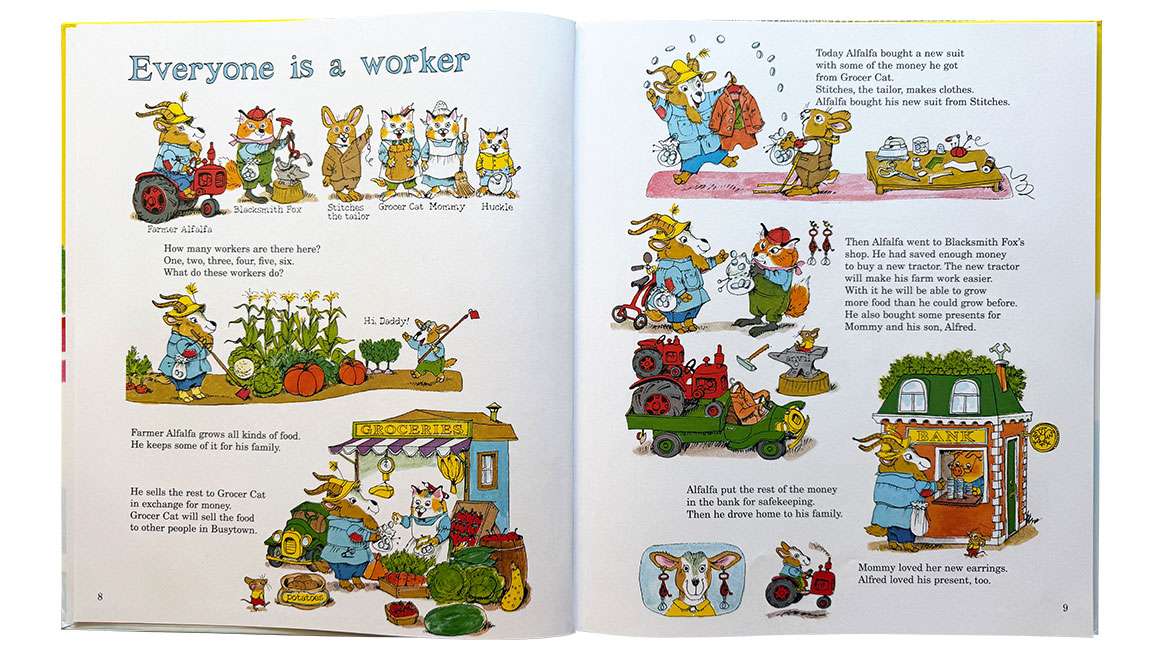
“Farmer Alfalfa heads to town with an old truck full of corn. The truck is on the verge of collapse. But after selling his corn to Grocer Cat, Farmer Alfalfa uses the money to buy a new truck. On another day, Alfalfa sells all kinds of produce and uses the money to make purchases from local merchants, including Stitches the tailor and Blacksmith Fox. Stitches, in turn, uses the money from Alfalfa to buy "an egg beater so that his family can make fudge," while Fox buys more iron to use in his blacksmith business. Welcome to the very busy—and pro-market—world of children's book author and illustrator Richard Scarry. If you were a child in the latter half of the last century, there's a good chance you read some of Scarry's books. The man was prolific, completing more than 150 works from the 1950s to the 1980s (with many more Scarry books published after his death in 1994 ). The Alfalfa stories come from Scarry's What Do People Do All Day? , originally published in 1968. Set in Busytown, the book introduces readers to an array of professions—from carpenters and electricians to mail carriers, sailors, stay-at-home mothers, air traffic controllers, and many more. Along the way, What Do People Do All Day? demystifies industrial processes that may be especially unfamiliar to young readers in the 21st century: how wheat growing in a field becomes the bread you can buy in a bakery, how cotton becomes clothing, how trees become paper, how coal becomes electricity. Some of the steps described by Scarry may now be a little outdated—but that means today's readers get a history lesson too. My sons, ages 2 and 4, are fascinated by chapters such as "The story of seeds and how they grow" and "Building a new road." They are delighted by zany Busytown characters such as Gorilla Bananas (the friendly neighborhood fruit thief) and Lowly Worm (who pops up unexpectedly throughout the vignettes). To me, the book's most notable feature is its uncomplicated and nonchalant promotion of free market economics. Again and again in What Do People Do All Day? , Scarry illustrates how capitalism can benefit both buyer and seller. Busytown characters use their labor and skills to provide products and services their neighbors want and, in exchange, earn money that they use to fulfill their own families' needs or invest in their own business activities. What makes this especially great is that the book's pro-market bent feels more incidental than ideological. This isn't a book that hits readers over the head with a particular worldview. Rather, it implies a defense of free market capitalism just by describing the simple and symbiotic way that free markets work. It may sound funny to say that realism lies at the heart of books full of anthropomorphic animals, several of whom drive pickle-shaped vehicles. But whimsy and realism go hand in hand in Busytown, in a way that just so happens to showcase some basic economic truths. If they were ever known, Scarry's personal political views seem to have been lost to history. But What Do People Do All Day? isn't the only Scarry book that feels slyly oriented toward individualism. In The Bunny Book , originally published in 1955, family members of a baby bunny take turns speculating about what the little boy will be when he grows up. "But the baby bunny did not want to be a doctor or a lifeguard or a farmer with a fine red tractor when he grew up," it says. Instead, "the baby bunny will be a daddy rabbit" who plays games with his kids, reads them books, and tucks them into bed each night. The Bunny Book— which was illustrated by Scarry and written by his wife, Patricia—never explicitly comments on this gender-role subversion. Unlike so many "message" books aimed at kids today, Scarry's work lets readers make of the story what they will. It's not even apparent if the Scarrys intended a message here at all, beyond the fact that this particular cute baby bunny boy's ambition was to be a dad. Over the years, Scarry got some flak for nonliberated portrayals of female characters in some of his early books. In later editions, he would add male characters in domestic roles, give the female animals more diverse jobs, and make other updates to keep up with changing mores. But the basic benefits of markets seem to have stood the test of time in Busytown. The post The Happy Capitalism of Richard Scarry's Busytown appeared first on Reason.com .
Original story
Continue reading at Reason
reason.com
Summary generated from the RSS feed of Reason. All article rights belong to the original publisher. Click through to read the full piece on reason.com.
