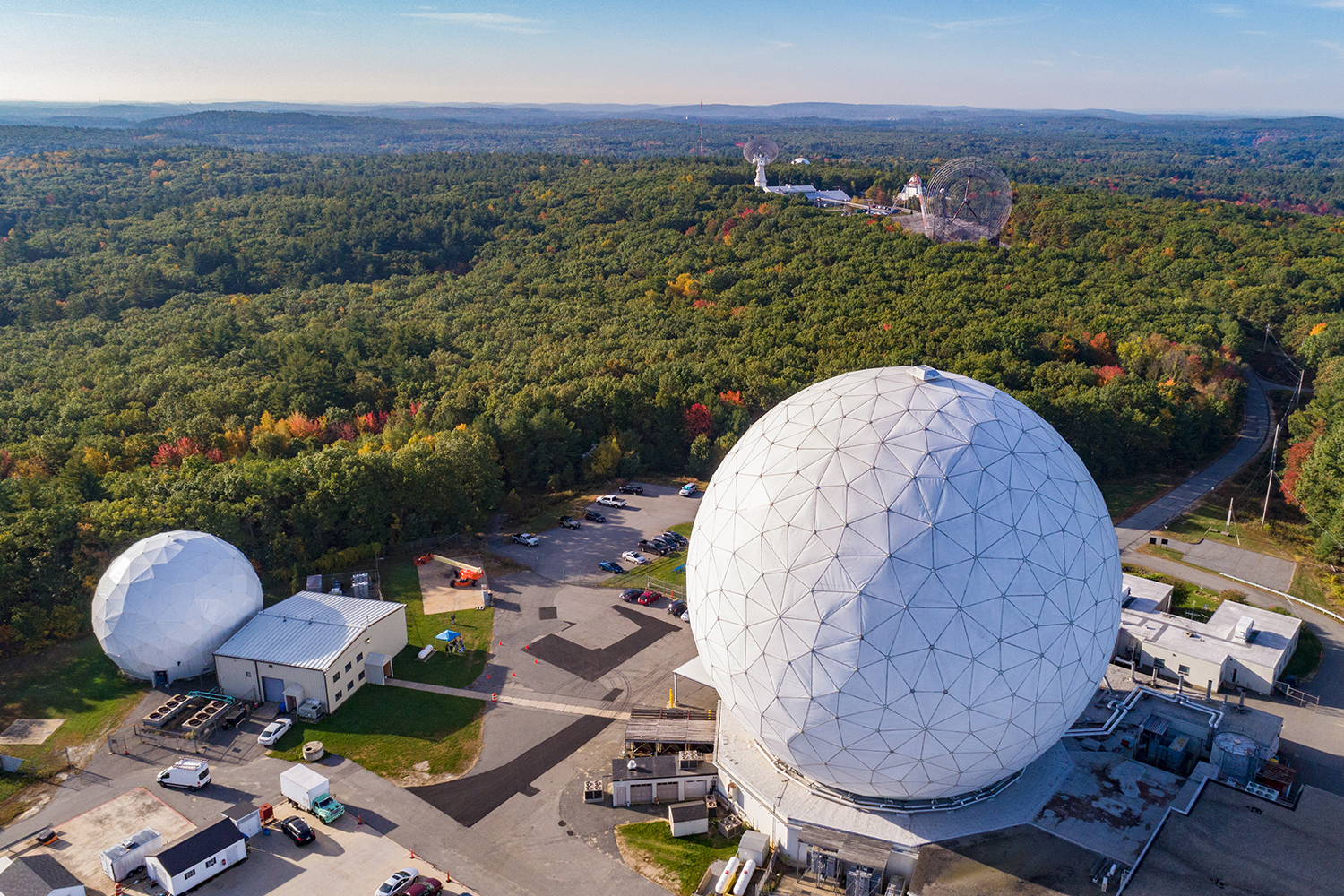
“The Haystack 37m Telescope has been a landmark in radio astronomy and radar studies of the solar system since its first light in 1964. Over the following four decades, it supported NASA's Apollo landings on the moon, made planetary radar maps of the surface of Venus, contributed to experimental tests of Einstein's general relativity , supported the development of VLBI, and conducted foundational studies of quasars and star-forming regions. Recently, the Haystack 37m Telescope — a 37-meter radio and millimeter-wavelength antenna at MIT Haystack Observatory in Westford, Massachusetts — made its return to front-line astronomical research following an extended period of system upgrades. These observations reconnect this instrument with its long tradition of scientific discovery and open a new chapter. On Dec. 8, 2025, Haystack scientists observed the supermassive black hole system at the center of the galaxy Messier 87 (M87) using a technique called very long baseline interferometry (VLBI) that links telescopes across continents to achieve extraordinary resolution. These observations mark the return of one of America's most storied radio telescopes to its historical scientific and educational mission. The observations targeted the powerful jet of energy and matter launched from M87’s central black hole, M87*. This jet, driven by a black hole six-and-a-half billion times the mass of our sun, extends thousands of light years into intergalactic space and is one of the most energetic phenomena in the known universe. Previous international campaigns, namely those led by the Event Horizon Telescope , have imaged the black hole's immediate “shadow.” The Haystack 37m Telescope observations, performed in collaboration with the telescopes of the Very Long Baseline Array (VLBA) and the Greenland Telescope (GLT), help to probe the larger-scale structure of the jet, investigating how energy is transported far beyond the black hole's vicinity. Understanding this process is central to explaining how supermassive black holes shape the galaxies that surround them. “The Haystack 37m Telescope’s exceptional sensitivity enables the intercontinental telescope array to detect faint emission from around the distant M87* black hole,” says Paul Tiede, principal investigator of the M87 study. “In tandem with the GLT and the VLBA, Haystack is helping create the first multifrequency movies of M87*’s faint jet, greatly improving our understanding of black hole physics.” The upgraded Haystack 37m Telescope opens multiple new lines of research. At MIT, Saverio Cambioni and Richard Teague of the Department of Earth, Atmospheric and Planetary Sciences (EAPS) plan to use the instrument within MIT’s Planetary Defense Project to measure asteroid sizes and shapes, characterizing objects that could pose a hazard to Earth and deepening our understanding of the solar system’s formation. Associate Professor Brett McGuire of the Department of Chemistry plans to search for complex organic molecules in space, work that speaks to the question of how the chemical precursors to life arise. “We are thrilled to provide the research community with a powerful telescope at a time where few such instruments are available,” says Jens Kauffmann, principal investigator of the Haystack 37m Telescope Astronomy Program , who uses the telescope to study the formation of stars and their planets. “Even more exciting are the prospects this generates for the next generation of astronomers. Hands-on training opportunities on world-class research telescopes have become exceptionally rare worldwide, and now we can offer this singular advanced workforce development program right here in Massachusetts.” Student involvement with the Haystack 37m Telescope has already resumed: Undergraduate interns at Haystack Observatory played an active role in developing the telescope’s control systems and data analysis algorithms. This work exemplifies Haystack’s role as a hands-on research and training environment where students contribute directly and gain practical experience with a frontline research instrument. The return to research-focused observations is the result of more than 10 years of careful, sustained work. From 2010 to 2014, the Haystack 37m Telescope underwent a major upgrade and refurbishment that enhanced its ability to observe at millimeter wavelengths. This work was primarily done to improve the antenna’s capability as a space radar. The dish now primarily serves U.S. government agencies in that capability, and astronomy was temporarily a secondary activity. But work to restore the telescope's science capability never stopped. Initial support from the National Science Foundation (NSF) in 2015 modernized systems for data analysis and radio signal processing. The first successful engineering-oriented VLBI experiments with the new dish were conducted at the same time. Additional NSF funding in 2019, provided in the context of the Next Generation Event Horizon Telescope (ngEHT) program , enabled a more general and sustained effort to upgrade receiver equipment and computing systems. Support from private donors to Haystack also aided in this longer-term effort. Several recent developments, particularly in 2025, proved significant. With support from MIT's Jarve Seed Fund for Science Innovation, scientists and engineers removed lingering technical limitations with astronomy systems and expanded the telescope's scientific reach. Other funding for projects led by the Smithsonian Astrophysical Observatory enabled the M87 campaign and commissioning of the next-generation digital back end, a highly advanced signal-processing system developed for the ngEHT. Together, these advances made the December 2025 observations possible. MIT Haystack Observatory is now pursuing support from both private and federal sources for further improvements under the Haystack 37m Telescope Astronomy Program . “The upgraded Haystack 37m Telescope empowers MIT students and researchers to pursue fundamental questions relating to our origins and our solar system,” says Richard Teague, professor at MIT EAPS. “With privileged access to such a powerful facility, we can undertake ambitious observational programs previously impossible to schedule. This is the beginning of what we expect will be an exciting era of new discoveries with the Haystack 37m Telescope.”
Original story
Continue reading at MIT News
news.mit.edu
Summary generated from the RSS feed of MIT News. All article rights belong to the original publisher. Click through to read the full piece on news.mit.edu.

